





Tested Applications
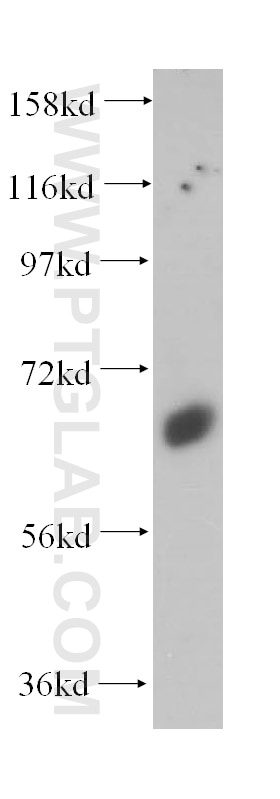
| Positive WB detected in | mouse cerebellum tissue, HCT 116 cells, mouse testis tissue, human liver tissue, Y79 cells |
| Positive IP detected in | mouse cerebellum tissue, HCT 116 cells |
| Positive IHC detected in | rat small intestine tissue Note: suggested antigen retrieval with TE buffer pH 9.0; (*) Alternatively, antigen retrieval may be performed with citrate buffer pH 6.0 |
| Positive IF/ICC detected in | HepG2 cells, HCT 116 cells |
Recommended dilution
| Application | Dilution |
|---|---|
| Western Blot (WB) | WB : 1:4000-1:20000 |
| Immunoprecipitation (IP) | IP : 0.5-4.0 ug for 1.0-3.0 mg of total protein lysate |
| Immunohistochemistry (IHC) | IHC : 1:500-1:2000 |
| Immunofluorescence (IF)/ICC | IF/ICC : 1:50-1:500 |
| It is recommended that this reagent should be titrated in each testing system to obtain optimal results. | |
| Sample-dependent, Check data in validation data gallery. | |
Product Information
14511-1-AP targets Synaptotagmin-1 in WB, IHC, IF/ICC, IP, ELISA applications and shows reactivity with human, mouse samples.
| Tested Reactivity | human, mouse |
| Cited Reactivity | human, mouse, rat |
| Host / Isotype | Rabbit / IgG |
| Class | Polyclonal |
| Type | Antibody |
| Immunogen |
CatNo: Ag5970 Product name: Recombinant human SYT1 protein Source: e coli.-derived, PGEX-4T Tag: GST Domain: 97-422 aa of BC058917 Sequence: GGKNAINMKDVKDLGKTMKDQALKDDDAETGLTDGEEKEEPKEEEKLGKLQYSLDYDFQNNQLLVGIIQAAELPALDMGGTSDPYVKVFLLPDKKKKFETKVHRKTLNPVFNEQFTFKVPYSELGGKTLVMAVYDFDRFSKHDIIGEFKVPMNTVDFGHVTEEWRDLQSAEKEEQEKLGDICFSLRYVPTAGKLTVVILEAKNLKKMDVGGLSDPYVKIHLMQNGKRLKKKKTTIKKNTLNPYYNESFSFEVPFEQIQKVQVVVTVLDYDKIGKNDAIGKVFVGYNSTGAELRHWSDMLANPRRPIAQWHTLQVEEEVDAMLAVKK Predict reactive species |
| Full Name | synaptotagmin I |
| Calculated Molecular Weight | 48 kDa |
| Observed Molecular Weight | 65 kDa, 47 kDa |
| GenBank Accession Number | BC058917 |
| Gene Symbol | Synaptotagmin-1 |
| Gene ID (NCBI) | 6857 |
| RRID | AB_2199166 |
| Conjugate | Unconjugated |
| Form | Liquid |
| Purification Method | Antigen affinity purification |
| UNIPROT ID | P21579 |
| Storage Buffer | PBS with 0.02% sodium azide and 50% glycerol, pH 7.3. |
| Storage Conditions | Store at -20°C. Stable for one year after shipment. Aliquoting is unnecessary for -20oC storage. 20ul sizes contain 0.1% BSA. |
Background Information
The synaptotagmins are integral membrane proteins of synaptic vesicles thought to serve as Ca(2+) sensors in the process of vesicular trafficking and exocytosis (PMID: 8058779). SYT1 (synaptotagmin I) was firstly identified as a 65-kDa protein with a wide distribution in neuronal and neurosecretory tissue (PMID: 7298720). Calcium binding to SYT1 participates in triggering neurotransmitter release at the synapse (PMID: 11242035). In addition to regulating exocytosis, SYT1 has also been implicated in endocytosis and neurite outgrowth (PMID: 15492212; 11078930; 10336114). This antibody recognizes endogenous SYT1, which has an experimentally determined molecular mass of 65-68 kDa. An additional band of 47 kDa could also be detected, which is corresponding to the calculated molecular weight of SYT1.
Protocols
| Product Specific Protocols | |
|---|---|
| IF protocol for Synaptotagmin-1 antibody 14511-1-AP | Download protocol |
| IHC protocol for Synaptotagmin-1 antibody 14511-1-AP | Download protocol |
| IP protocol for Synaptotagmin-1 antibody 14511-1-AP | Download protocol |
| WB protocol for Synaptotagmin-1 antibody 14511-1-AP | Download protocol |
| Standard Protocols | |
|---|---|
| Click here to view our Standard Protocols |
Publications
What published studies show
The Synaptotagmin-1 Polyclonal antibody (14511-1-AP) has 37 citations across journals including Nature Communications, Science Advances, Translational Neurodegeneration, Theranostics, Alzheimer's & Dementia, Molecular Psychiatry, Acta Neuropathologica, Cell Reports, and Journal of Headache & Pain. Key research fields include synaptic transmission, neurotransmitter release and SNARE complex assembly, neurodegeneration (Alzheimer's, Parkinson's, Huntington's), neuroplasticity, depression and stress, ischemic stroke, epilepsy, migraine, neural development, cancer, toxin pharmacology, and environmental neurotoxicity. Common applications are WB, IHC, IF, and IP across human, mouse, and rat samples.
| Species | Application | Title |
|---|---|---|
Transl Neurodegener Abnormal α-synuclein binds to synaptotagmin 13, impairing extracellular vesicle release in synucleinopathies | ||
Nat Commun Major urinary protein 1 modulates neuronal excitability in the medial prefrontal cortex in a male mouse model of affective empathy. | ||
Nat Commun Membrane remodeling by FAM92A1 during brain development regulates neuronal morphology, synaptic function, and cognition | ||
Nat Commun Molecular landscape, subtypes, and therapeutic vulnerabilities of central nervous system solitary fibrous tumors | ||
Theranostics ANKRD22, a novel tumor microenvironment-induced mitochondrial protein promotes metabolic reprogramming of colorectal cancer cells. | ||
Sci Adv Phosphorylation of Doc2 by EphB2 modulates Munc13-mediated SNARE complex assembly and neurotransmitter release |


