



Tested Applications
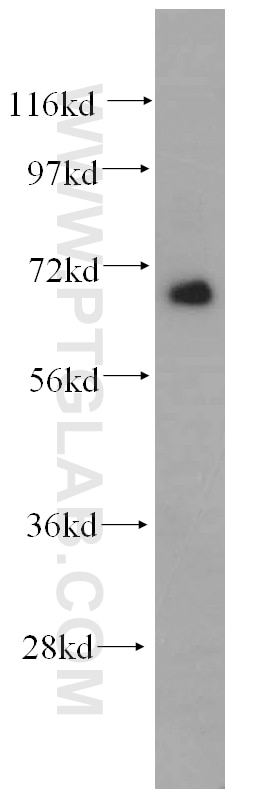
| Positive WB detected in | K-562 cells, human brain tissue, mouse spleen tissue, rat brain tissue |
| Positive IP detected in | K-562 cells |
| Positive IHC detected in | human renal cell carcinoma tissue Note: suggested antigen retrieval with TE buffer pH 9.0; (*) Alternatively, antigen retrieval may be performed with citrate buffer pH 6.0 |
| Positive IF/ICC detected in | K-562 cells |
Recommended dilution
| Application | Dilution |
|---|---|
| Western Blot (WB) | WB : 1:500-1:2000 |
| Immunoprecipitation (IP) | IP : 0.5-4.0 ug for 1.0-3.0 mg of total protein lysate |
| Immunohistochemistry (IHC) | IHC : 1:50-1:500 |
| Immunofluorescence (IF)/ICC | IF/ICC : 1:50-1:500 |
| It is recommended that this reagent should be titrated in each testing system to obtain optimal results. | |
| Sample-dependent, Check data in validation data gallery. | |
Product Information
14480-1-AP targets TFE3 in WB, IHC, IF/ICC, IP, CoIP, ChIP, ELISA applications and shows reactivity with human, mouse, rat samples.
| Tested Reactivity | human, mouse, rat |
| Cited Reactivity | human, mouse, rat, monkey, bovine |
| Host / Isotype | Rabbit / IgG |
| Class | Polyclonal |
| Type | Antibody |
| Immunogen |
CatNo: Ag5863 Product name: Recombinant human TFE3 protein Source: e coli.-derived, PGEX-4T Tag: GST Domain: 1-350 aa of BC026027 Sequence: MSHAAEPARDGVEASAEGPRAVFVLLEERRPADSAQLLSLNSLLPESGIVADIELENVLDPDSFYELKSQPLPLRSSLPISLQATPATPATLSASSSAGGSRTPAMSSSSSSRVLLRQQLMRAQAQEQERRERREQAAAAPFPSPAPASPAISVVGVSAGGHTLSRPPPAQVPREVLKVQTHLENPTRYHLQQARRQQVKQYLSTTLGPKLASQALTPPPGPASAQPLPAPEAAHTTGPTGSAPNSPMALLTIGSSSEKEIDDVIDEIISLESSYNDEMLSYLPGGTTGLQLPSTLPVSGNLLDVYSSQGVATPAITVSNSCPAELPNIKREISETEAKALLKERQKKDN Predict reactive species |
| Full Name | transcription factor binding to IGHM enhancer 3 |
| Calculated Molecular Weight | 62 kDa |
| Observed Molecular Weight | 70 kDa |
| GenBank Accession Number | BC026027 |
| Gene Symbol | TFE3 |
| Gene ID (NCBI) | 7030 |
| RRID | AB_2199587 |
| Conjugate | Unconjugated |
| Form | Liquid |
| Purification Method | Antigen affinity purification |
| UNIPROT ID | P19532 |
| Storage Buffer | PBS with 0.02% sodium azide and 50% glycerol, pH 7.3. |
| Storage Conditions | Store at -20°C. Stable for one year after shipment. Aliquoting is unnecessary for -20oC storage. 20ul sizes contain 0.1% BSA. |
Background Information
The protein encoded by this gene is a subunit of the CRSP (cofactor required for SP1 activation) complex, which, along with TFIID, is required for efficient activation by SP1. This protein is also a component of other multisubunit complexes e.g. thyroid hormone receptor-(TR-) associated proteins which interact with TR and facilitate TR function on DNA templates in conjunction with initiation factors and cofactors.
Protocols
| Product Specific Protocols | |
|---|---|
| IF protocol for TFE3 antibody 14480-1-AP | Download protocol |
| IHC protocol for TFE3 antibody 14480-1-AP | Download protocol |
| IP protocol for TFE3 antibody 14480-1-AP | Download protocol |
| WB protocol for TFE3 antibody 14480-1-AP | Download protocol |
| Standard Protocols | |
|---|---|
| Click here to view our Standard Protocols |
Publications
What published studies show
The TFE3 Polyclonal antibody (Cat# 14480-1-AP) has 36 citations across journals including Autophagy, Cell Stem Cell, Nature Communications, PNAS, Cell Death & Differentiation, Oncogene, Developmental Cell, EMBO Reports, and Journal of Biological Chemistry. Research fields span autophagy and lysosomal biogenesis, renal and hepatocellular carcinoma, neurodegeneration (Huntington disease, frontotemporal dementia), stem cell biology, inflammation, and metabolic regulation.
| Species | Application | Title |
|---|---|---|
Cell Stem Cell Niche inflammatory signals control oscillating mammary regeneration and protect stem cells from cytotoxic stress | ||
Autophagy ANXA2 (annexin A2) is crucial to ATG7-mediated autophagy, leading to tumor aggressiveness in triple-negative breast cancer cells | ||
Autophagy PRCC-TFE3 fusion-mediated PRKN/parkin-dependent mitophagy promotes cell survival and proliferation in PRCC-TFE3 translocation renal cell carcinoma.
| ||
Autophagy IL17A disrupts autophagy-lysosomal function and lysosome reformation through the GSK3B-TFE3 signaling pathway in Huntington disease. | ||
Autophagy Oxidation of multiple MiT/TFE transcription factors links oxidative stress to transcriptional control of autophagy and lysosome biogenesis. |


