

Tested Applications
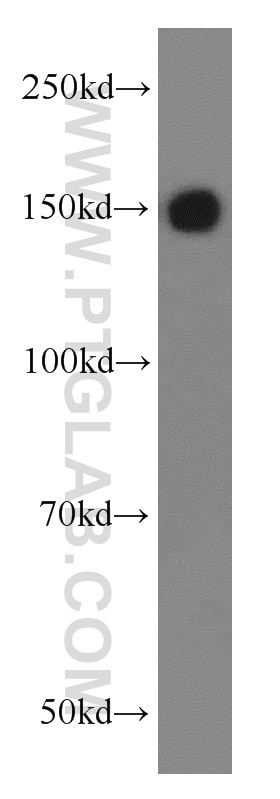
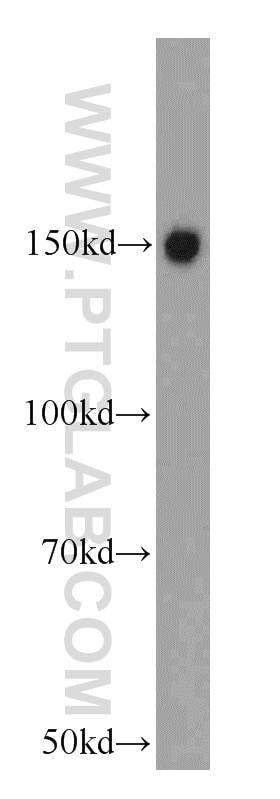
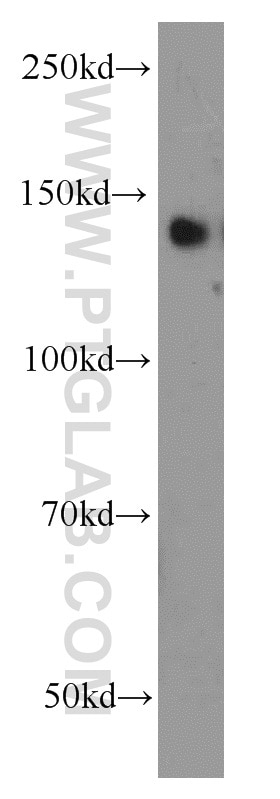
| Positive WB detected in | COLO 320 cells, MCF-7 cells, PC-3 cells |
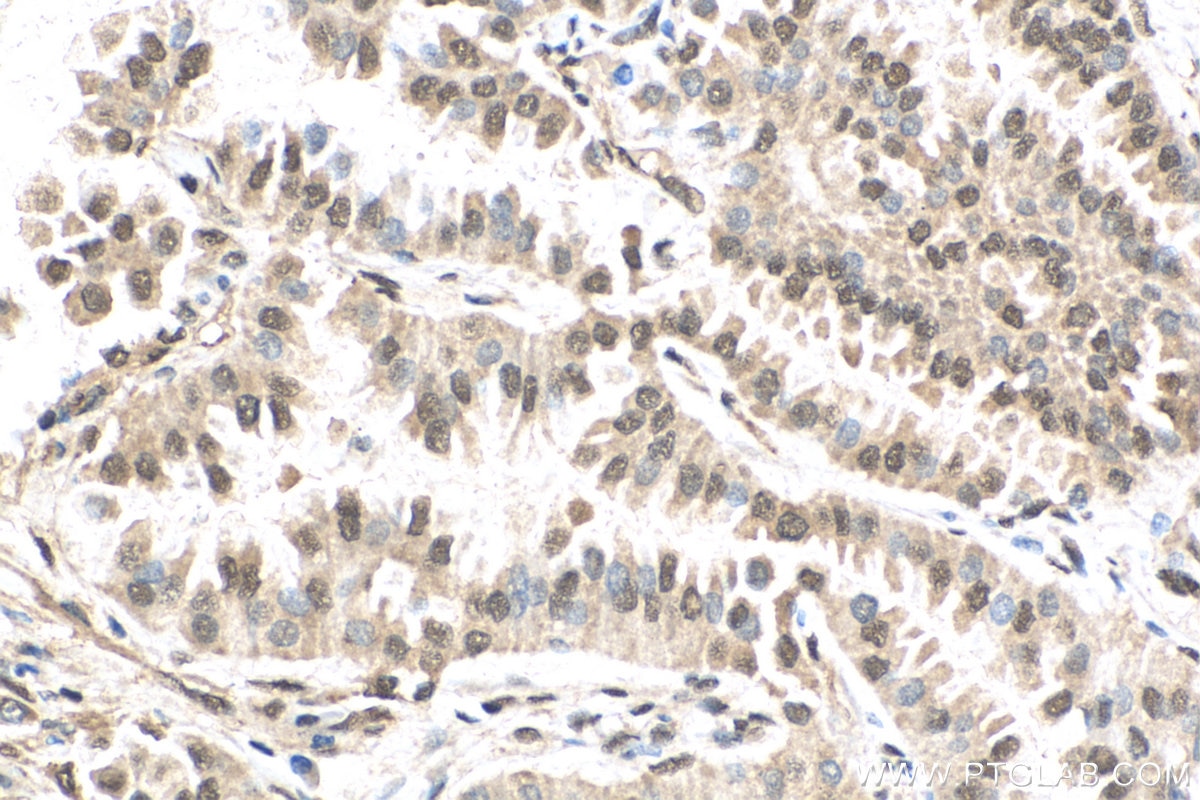
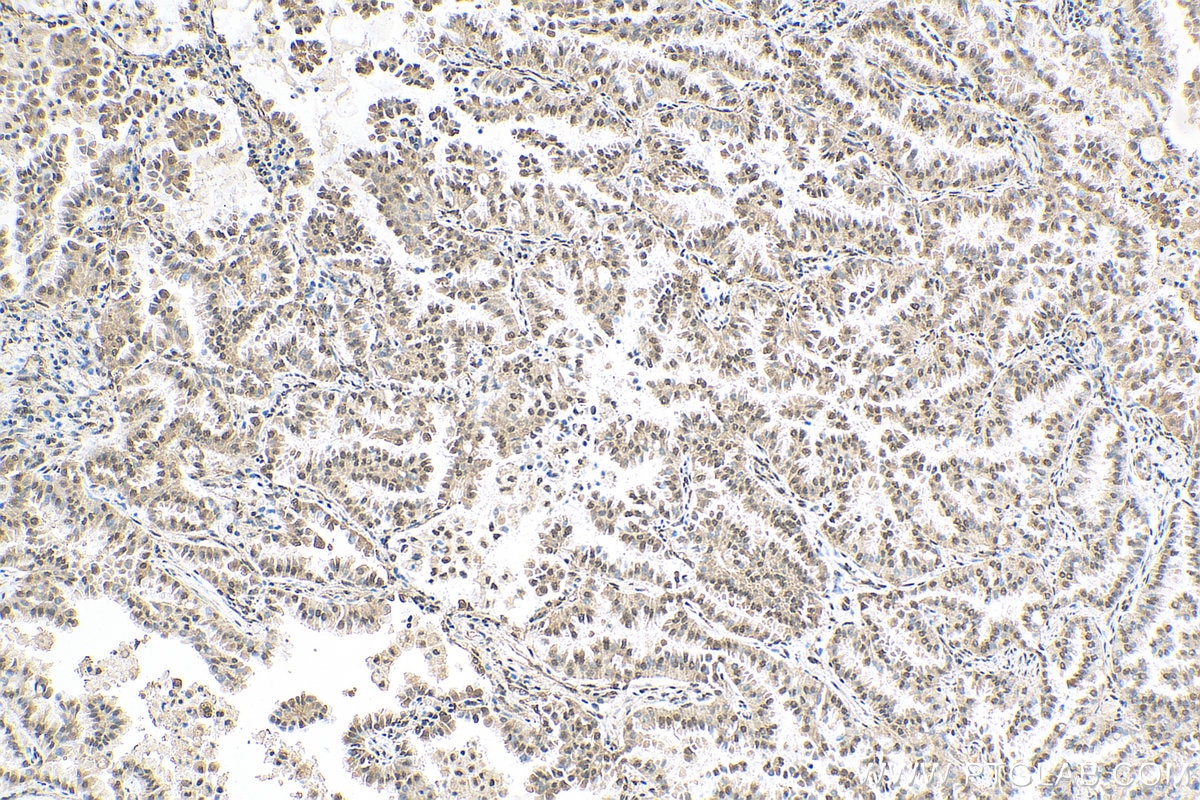
| Positive IHC detected in | human lung cancer tissue Note: suggested antigen retrieval with TE buffer pH 9.0; (*) Alternatively, antigen retrieval may be performed with citrate buffer pH 6.0 |
Recommended dilution
| Application | Dilution |
|---|---|
| Western Blot (WB) | WB : 1:500-1:1000 |
| Immunohistochemistry (IHC) | IHC : 1:50-1:500 |
| It is recommended that this reagent should be titrated in each testing system to obtain optimal results. | |
| Sample-dependent, Check data in validation data gallery. | |
Product Information
55374-1-AP targets TRIM33 in WB, IHC, IF, IP, ELISA applications and shows reactivity with human samples.
| Tested Reactivity | human |
| Cited Reactivity | human |
| Host / Isotype | Rabbit / IgG |
| Class | Polyclonal |
| Type | Antibody |
| Immunogen |
Peptide Predict reactive species |
| Full Name | tripartite motif-containing 33 |
| Calculated Molecular Weight | 122 kDa |
| Observed Molecular Weight | 140-150 kDa |
| GenBank Accession Number | NM_015906 |
| Gene Symbol | TRIM33 |
| Gene ID (NCBI) | 51592 |
| RRID | AB_11183035 |
| Conjugate | Unconjugated |
| Form | Liquid |
| Purification Method | Antigen affinity purification |
| UNIPROT ID | Q9UPN9 |
| Storage Buffer | PBS with 0.02% sodium azide and 50% glycerol, pH 7.3. |
| Storage Conditions | Store at -20°C. Stable for one year after shipment. Aliquoting is unnecessary for -20oC storage. 20ul sizes contain 0.1% BSA. |
Background Information
TRIM33, also named as KIAA1113, RFG7 and TIF1G, belongs to the TRIM/RBCC family. It acts as an E3 ubiquitin-protein ligase. TRIM33 promotes SMAD4 ubiquitination, nuclear exclusion and degradation via the ubiquitin proteasome pathway. It may act as a transcriptional repressor. It inhibits the transcriptional response to TGF-beta/BMP signaling cascade. TRIM33 plays a role in the control of cell proliferation. Its association with SMAD2 and SMAD3, TRIM33 stimulates erythroid differentiation of hematopoietic stem/progenitor. Defects in TRIM33 are a cause of thyroid papillary carcinoma (TPC). This antibody is specific to TRIM33. The calculated molecular weight of TRIM33 is 122kDa, but the molecular weight of detected is about 140-150 kDa as the same as the result from the paper(PMID:25639486;26592194).
Protocols
| Product Specific Protocols | |
|---|---|
| IHC protocol for TRIM33 antibody 55374-1-AP | Download protocol |
| WB protocol for TRIM33 antibody 55374-1-AP | Download protocol |
| Standard Protocols | |
|---|---|
| Click here to view our Standard Protocols |
Publications
What published studies show
The TRIM33 Polyclonal antibody (catalog no. 55374-1-AP) has 8 citations. Published work appears in Nature Communications, Nature Chemical Biology, Cell Death & Disease, Molecular Therapy, Journal of Translational Medicine, Experimental Dermatology, and Technology in Cancer Research & Treatment. Research fields include SUMO-dependent protein interactions, cellular kinase activity recording, tumor suppression in renal carcinoma and gastric cancer, metabolic reprogramming in cancer and psoriasis, glioma stem cell growth, viral reactivation, and leukemia chemoresistance. Applications documented include WB, IF, IHC, and IP.
| Species | Application | Title |
|---|---|---|
Nat Chem Biol Molecular recording of cellular protein kinase activity with chemical labeling
| ||
Cell Death Dis The deubiquitinase YOD1 suppresses tumor progression by stabilizing ZNF24 in clear cell renal carcinoma | ||
Mol Ther Lactate-induced miR-7-5p/TRIM33 reprograms metabolic flux to suppress tumor growth and viral reactivation.
| ||
J Transl Med DMC-BH derivative DMC-GF inhibits the growth of glioma stem cells by targeting the TRIM33/SLC25A1/mitochondrial oxidative phosphorylation pathway | ||
Exp Dermatol Nuclear translocation of PKM2 mediates keratinocyte metabolic reprogramming in psoriasis |

