





Tested Applications
| Positive WB detected in | mouse heart tissue, MCF-7 cells, rat heart tissue |
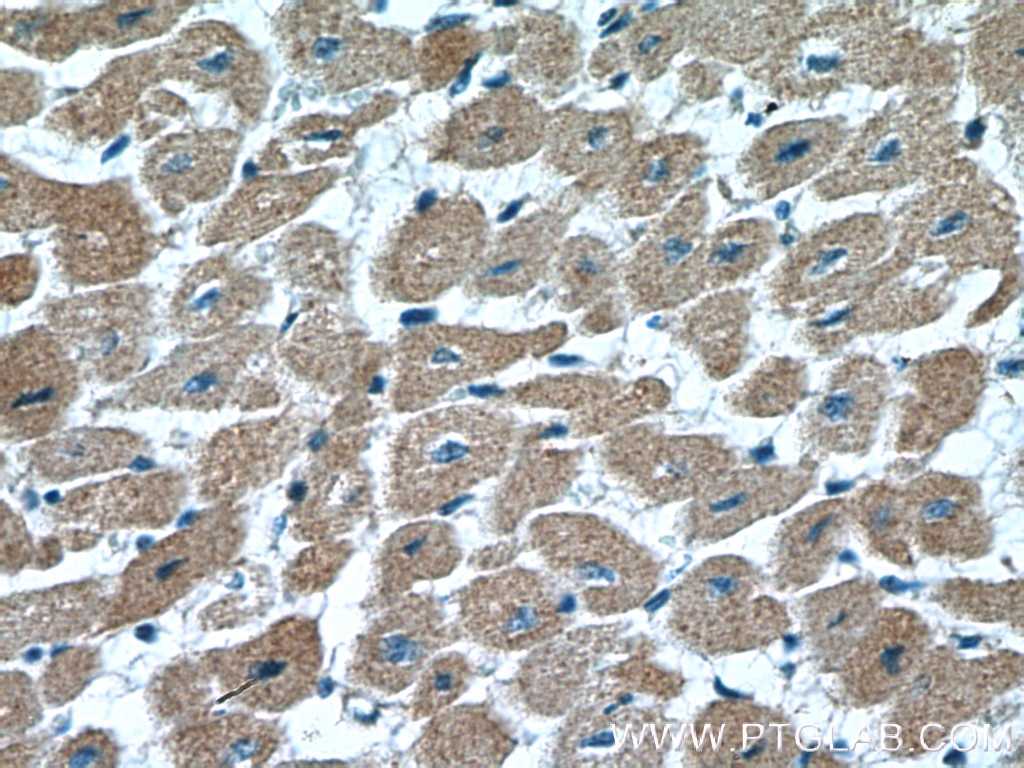
| Positive IHC detected in | human lung cancer tissue, human heart tissue, human thyroid cancer tissue, human colon cancer tissue Note: suggested antigen retrieval with TE buffer pH 9.0; (*) Alternatively, antigen retrieval may be performed with citrate buffer pH 6.0 |
Recommended dilution
| Application | Dilution |
|---|---|
| Western Blot (WB) | WB : 1:500-1:1000 |
| Immunohistochemistry (IHC) | IHC : 1:250-1:1000 |
| It is recommended that this reagent should be titrated in each testing system to obtain optimal results. | |
| Sample-dependent, Check data in validation data gallery. | |
Product Information
26915-1-AP targets VEGFD in WB, IHC, IF, ELISA applications and shows reactivity with human, mouse, rat samples.
| Tested Reactivity | human, mouse, rat |
| Cited Reactivity | human, mouse, rat |
| Host / Isotype | Rabbit / IgG |
| Class | Polyclonal |
| Type | Antibody |
| Immunogen |
CatNo: Ag25552 Product name: Recombinant human FIGF protein Source: e coli.-derived, PGEX-4T Tag: GST Domain: 90-128 aa of BC027948 Sequence: AATFYDIETLKVIDEEWQRTQCSPRETCVEVASELGKST Predict reactive species |
| Full Name | c-fos induced growth factor (vascular endothelial growth factor D) |
| Calculated Molecular Weight | 40 kDa |
| Observed Molecular Weight | 40 kDa |
| GenBank Accession Number | BC027948 |
| Gene Symbol | FIGF |
| Gene ID (NCBI) | 2277 |
| RRID | AB_2880683 |
| Conjugate | Unconjugated |
| Form | Liquid |
| Purification Method | Antigen affinity purification |
| UNIPROT ID | O43915 |
| Storage Buffer | PBS with 0.02% sodium azide and 50% glycerol, pH 7.3. |
| Storage Conditions | Store at -20°C. Stable for one year after shipment. Aliquoting is unnecessary for -20oC storage. 20ul sizes contain 0.1% BSA. |
Background Information
VEGFD is a member of the platelet-derived growth factor/vascular endothelial growth factor (PDGF/VEGF) family and is active in angiogenesis, lymphangiogenesis, and endothelial cell growth. This secreted protein undergoes a complex proteolytic maturation, generating multiple processed forms which bind and activate VEGFR-2 and VEGFR-3 receptors. This protein is structurally and functionally similar to vascular endothelial growth factor C.
Protocols
| Product Specific Protocols | |
|---|---|
| IHC protocol for VEGFD antibody 26915-1-AP | Download protocol |
| WB protocol for VEGFD antibody 26915-1-AP | Download protocol |
| Standard Protocols | |
|---|---|
| Click here to view our Standard Protocols |
Publications
What published studies show
VEGFD Polyclonal antibody (26915-1-AP) has 13 citations.
The citations span journals including Theranostics, Phytomedicine, Advanced Healthcare Materials, International Journal of Biological Macromolecules, ACS Applied Materials & Interfaces, Gastric Cancer, Frontiers in Pharmacology, BBA Molecular Basis of Disease, BMC Complementary Medicine and Therapies, FASEB Journal, Experimental Cell Research, Annals of Translational Medicine, and Cerebral Cortex.
Associated research fields include angiogenesis and lymphatic vessel formation, cancer (triple-negative breast, gastric), pulmonary hypertension, wound healing, corneal/retinal neovascularization, colitis, and cognitive function. Applications covered WB, IHC, and IF across human, mouse, and rat samples.
| Species | Application | Title |
|---|---|---|
Phytomedicine Calycosin inhibits triple-negative breast cancer progression through down-regulation of the novel estrogen receptor-α splice variant ER-α30-mediated PI3K/AKT signaling pathway | ||
Adv Healthc Mater Self-Assembled Tetrahedral Framework Nucleic Acids Alleviate Pulmonary Hypertension by Regulating Calcium Homeostasis. | ||
Int J Biol Macromol Analysis of differential transcriptome expression reveals ISG15 provided support for embryo development via promoting angiogenesis in porcine mesometrium | ||
ACS Appl Mater Interfaces Bioactive-Enriched Nanovesicles from American Cockroaches Enhance Wound Healing by Promoting Angiogenesis | ||
Gastric Cancer Cathepsin L promotes angiogenesis by regulating the CDP/Cux/VEGF-D pathway in human gastric cancer. |


