
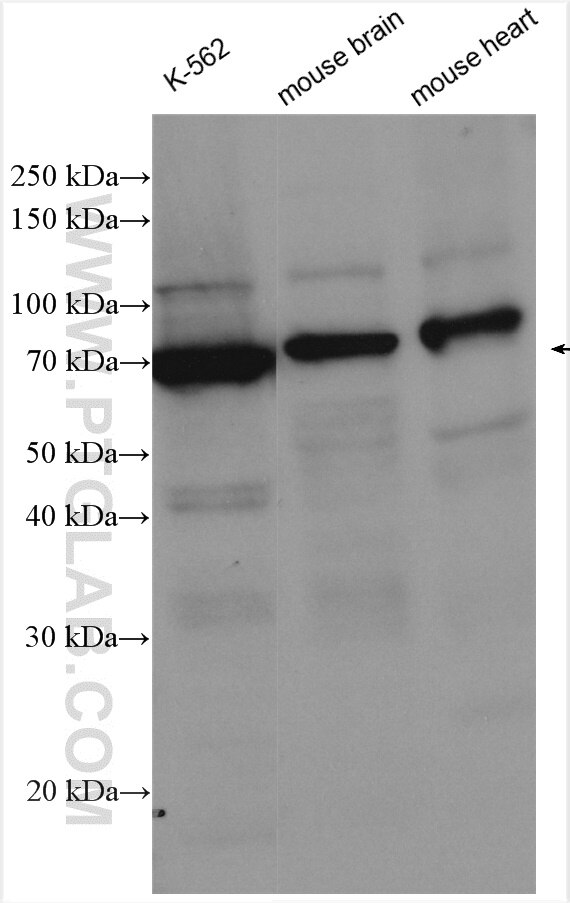

Tested Applications
| Positive WB detected in | K-562 cells, nouse brain tissue, mouse heart tissue |
Recommended dilution
| Application | Dilution |
|---|---|
| Western Blot (WB) | WB : 1:500-1:2000 |
| It is recommended that this reagent should be titrated in each testing system to obtain optimal results. | |
| Sample-dependent, Check data in validation data gallery. | |
Product Information
29474-1-AP targets WEE1 in WB, IF, CoIP, ELISA applications and shows reactivity with Human, mouse samples.
| Tested Reactivity | Human, mouse |
| Cited Reactivity | human, mouse, pig |
| Host / Isotype | Rabbit / IgG |
| Class | Polyclonal |
| Type | Antibody |
| Immunogen |
CatNo: Ag30194 Product name: Recombinant human WEE1 protein Source: e coli.-derived, PET28a Tag: 6*His Domain: 515-646 aa of BC051831 Sequence: PLPRNGDQWHEIRQGRLPRIPQVLSQEFTELLKVMIHPDPERRPSAMALVKHSVLLSASRKSAEQLRIELNAEKFKNSLLQKELKKAQMAKAAAEERALFTDRMATRSTTQSNRTSRLIGKKMNRSVSLTIY Predict reactive species |
| Full Name | WEE1 homolog (S. pombe) |
| Calculated Molecular Weight | 72 kDa |
| Observed Molecular Weight | 72 kDa,110 kDa |
| GenBank Accession Number | BC051831 |
| Gene Symbol | WEE1 |
| Gene ID (NCBI) | 7465 |
| RRID | AB_2918314 |
| Conjugate | Unconjugated |
| Form | Liquid |
| Purification Method | Antigen affinity purification |
| UNIPROT ID | P30291 |
| Storage Buffer | PBS with 0.02% sodium azide and 50% glycerol, pH 7.3. |
| Storage Conditions | Store at -20°C. Aliquoting is unnecessary for -20oC storage. 20ul sizes contain 0.1% BSA. |
Background Information
WEE1 kinase is a serine-threonine kinase that regulates G2/M checkpoint transition. WEE1 triggers G2/M arrest through inhibitory phosphorylation on Tyr15 of CDK1 (Cdc2) and preventing entry into mitosis to allow DNA repair during DNA damage (PMID: 27427153).The predicted native molecular weight for Wee1 based on the intact human Wee1 cDNA sequence is 72 kDa, whereas the 95-110 kDa protein is a highly modified product (PMID: 7568188). Others have shown that Wee1 is 70-72 kDa and 49-55 kDa (PMID: 12214061).
Protocols
| Product Specific Protocols | |
|---|---|
| WB protocol for WEE1 antibody 29474-1-AP | Download protocol |
| Standard Protocols | |
|---|---|
| Click here to view our Standard Protocols |
Publications
What published studies show
The WEE1 Polyclonal antibody (29474-1-AP) has accumulated 10 citations across the following journals: Nucleic Acids Research, Molecular Biomedicine, Cells, Journal of Cellular and Molecular Medicine, Oncology Research, Renal Failure, Journal of Pharmacy and Pharmacology, Reproductive Toxicology, Analytical Cellular Pathology, and Inflammation Research. The associated research fields encompass DNA damage and cell cycle regulation, oncology (colorectal, pancreatic, glioma, and leukemia), oocyte maturation and female fertility, kidney/podocyte injury in diabetic nephropathy, and spleen development, using applications including WB, IF, and CoIP across human, mouse, and pig samples.
| Species | Application | Title |
|---|---|---|
Nucleic Acids Res DIS3L2 ribonuclease degrades terminal-uridylated RNA to ensure oocyte maturation and female fertility | ||
Mol Biomed Malate targets pyruvate kinase M2 to promote colorectal cancer cell cycle arrest and tumor suppression. | ||
Cells Role of Alternative Splicing and Polyadenylation in Regulation of Spleen Development. | ||
J Cell Mol Med Venetoclax enhances DNA damage induced by XPO1 inhibitors: A novel mechanism underlying the synergistic antileukaemic effect in acute myeloid leukaemia. | ||
Oncol Res SORBS1 Knockdown Resists S/G2 Arrest and Apoptosis Caused by Polyphyllin H-Induced DNA Damage in Pancreatic Cancer | ||
Ren Fail Hyperactivation of p53 contributes to mitotic catastrophe in podocytes through regulation of the Wee1/CDK1/cyclin B1 axis |

