



"YY1 Antibodies" Comparison
View side-by-side comparison of YY1 antibodies from other vendors to find the one that best suits your research needs.

Tested Applications
| Positive WB detected in | Jurkat cells, A549 cells, HEK-293 cells, HeLa cells, MCF-7 cells |
| Positive IP detected in | HeLa cells |
| Positive IHC detected in | human breast cancer tissue Note: suggested antigen retrieval with TE buffer pH 9.0; (*) Alternatively, antigen retrieval may be performed with citrate buffer pH 6.0 |
| Positive IF/ICC detected in | HepG2 cells |
Recommended dilution
| Application | Dilution |
|---|---|
| Western Blot (WB) | WB : 1:500-1:2000 |
| Immunoprecipitation (IP) | IP : 0.5-4.0 ug for 1.0-3.0 mg of total protein lysate |
| Immunohistochemistry (IHC) | IHC : 1:50-1:500 |
| Immunofluorescence (IF)/ICC | IF/ICC : 1:50-1:500 |
| It is recommended that this reagent should be titrated in each testing system to obtain optimal results. | |
| Sample-dependent, Check data in validation data gallery. | |
Product Information
22156-1-AP targets YY1 in WB, IHC, IF/ICC, IP, CoIP, ChIP, ELISA applications and shows reactivity with human samples.
| Tested Reactivity | human |
| Cited Reactivity | human, mouse, rat, pig, bovine |
| Host / Isotype | Rabbit / IgG |
| Class | Polyclonal |
| Type | Antibody |
| Immunogen |
CatNo: Ag17792 Product name: Recombinant human YY1 protein Source: e coli.-derived, PGEX-4T Tag: GST Domain: 1-414 aa of BC037308 Sequence: MASGDTLYIATDGSEMPAEIVELHEIEVETIPVETIETTVVGEEEEEDDDDEDGGGGDHGGGGGHGHAGHHHHHHHHHHHPPMIALQPLVTDDPTQVHHHQEVILVQTREEVVGGDDSDGLRAEDGFEDQILIPVPAPAGGDDDYIEQTLVTVAAAGKSGGGGSSSSGGGRVKKGGGKKSGKKSYLSGGAGAAGGGGADPGNKKWEQKQVQIKTLEGEFSVTMWSSDEKKDIDHETVVEEQIIGENSPPDYSEYMTGKKLPPGGIPGIDLSDPKQLAEFARMKPRKIKEDDAPRTIACPHKGCTKMFRDNSAMRKHLHTHGPRVHVCAECGKAFVESSKLKRHQLVHTGEKPFQCTFEGCGKRFSLDFNLRTHVRIHTGDRPYVCPFDGCNKKFAQSTNLKSHILTHAKAKNNQ Predict reactive species |
| Full Name | YY1 transcription factor |
| Calculated Molecular Weight | 414 aa, 45 kDa |
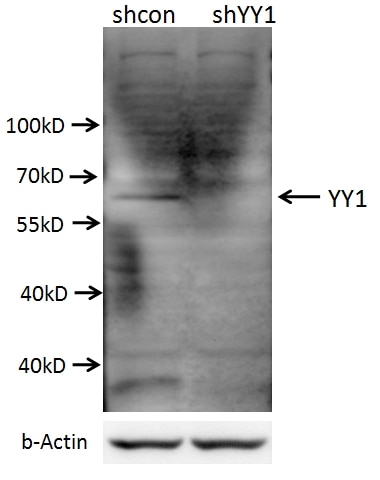
| Observed Molecular Weight | 65-70 kDa |
| GenBank Accession Number | BC037308 |
| Gene Symbol | YY1 |
| Gene ID (NCBI) | 7528 |
| RRID | AB_11182932 |
| Conjugate | Unconjugated |
| Form | Liquid |
| Purification Method | Antigen affinity purification |
| UNIPROT ID | P25490 |
| Storage Buffer | PBS with 0.02% sodium azide and 50% glycerol, pH 7.3. |
| Storage Conditions | Store at -20°C. Stable for one year after shipment. Aliquoting is unnecessary for -20oC storage. 20ul sizes contain 0.1% BSA. |
Background Information
YY1, also named as DELTA, INO80S and NF-E1, contains four C2H2-type zinc fingers and belongs to the YY transcription factor family. YY1 is a multifunctional transcription factor that exhibits positive and negative control on a large number of cellular and viral genes by binding to sites overlapping the transcription start site. YY1 may direct histone deacetylases and histone acetyltransferases to a promoter in order to activate or repress the promoter, thus implicating histone modification in the YY1. The open reading frame of the human YY1 cDNA encodes a protein of 414 amino acids with a predicted molecular weight of 44 kDa. However, YY1 migrates on SDS gels as a 65-68 kDa protein, probably due to the structure of the protein. It is a ubiquitously expressed transcription factor with fundamental roles in embryogenesis, differentiation, replication and proliferation. This is a rabbit polyclonal antibody raised against full length YY1 of human origin.
Protocols
| Product Specific Protocols | |
|---|---|
| IF protocol for YY1 antibody 22156-1-AP | Download protocol |
| IHC protocol for YY1 antibody 22156-1-AP | Download protocol |
| IP protocol for YY1 antibody 22156-1-AP | Download protocol |
| WB protocol for YY1 antibody 22156-1-AP | Download protocol |
| Standard Protocols | |
|---|---|
| Click here to view our Standard Protocols |
Publications
What published studies show
The YY1 Polyclonal antibody (Cat. No. 22156-1-AP) has 64 citations. Publications appear in journals including Nature Communications, Molecular Cell, Science Translational Medicine, Journal of Extracellular Vesicles, Redox Biology, Cell Death & Disease, Advanced Science, Genes & Development, Metabolism, and International Journal of Biological Sciences, among others. The research spans oncology (hepatocellular carcinoma, gastric, colorectal, lung, breast, ovarian cancers), epigenetics and transcriptional regulation, diabetic nephropathy and fatty liver disease, cardiovascular/myocardial injury, neurobiology, immunology/rheumatoid arthritis, and reproductive biology.
| Species | Application | Title |
|---|---|---|
J Extracell Vesicles Salvianolic Acid B Upregulates miR-744-5p Expression in Peripheral Blood Mononuclear Cell-Derived Extracellular Vesicles to Alleviate Uremic Cardiomyopathy. | ||
Nat Commun Mutant huntingtin induces neuronal apoptosis via derepressing the non-canonical poly(A) polymerase PAPD5 | ||
Nat Commun Mutant GGGGCC RNA prevents YY1 from binding to Fuzzy promoter which stimulates Wnt/β-catenin pathway in C9ALS/FTD | ||
Metabolism Mitochondrial ribosomal protein L12 potentiates hepatocellular carcinoma by regulating mitochondrial biogenesis and metabolic reprogramming | ||
Redox Biol YY1 nitration participates in DbCM cardiomyocyte lipotoxicity by inhibiting ANXA3-induced microlipophagy. | ||
Mol Cell Dynamic control of chromatin-associated m6A methylation regulates nascent RNA synthesis. |


