
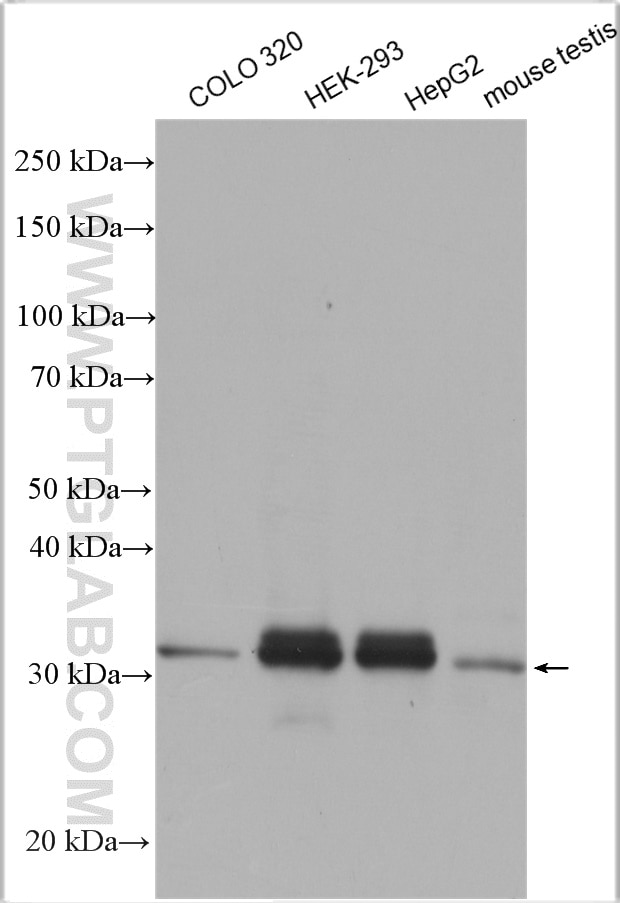
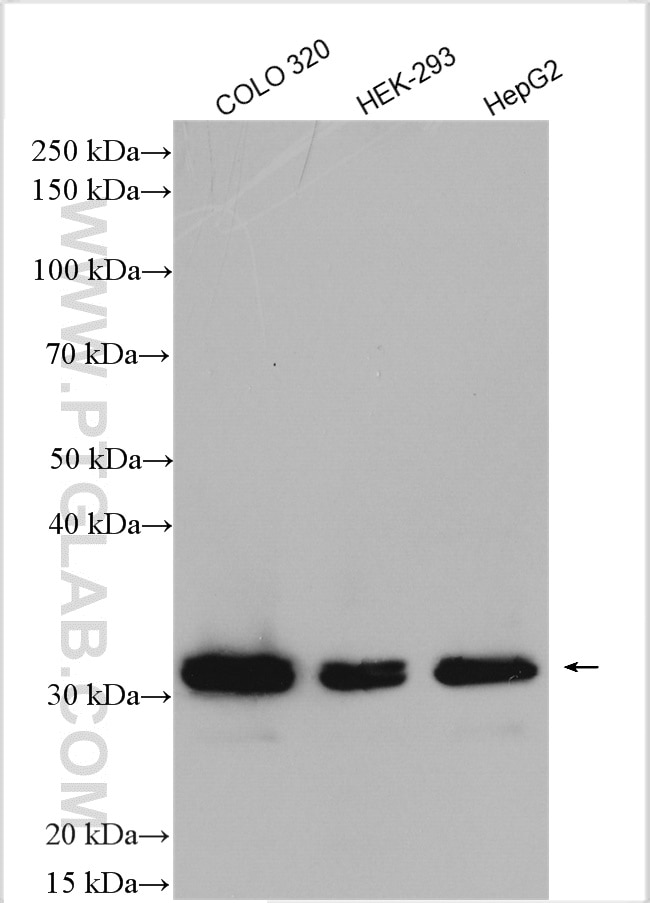
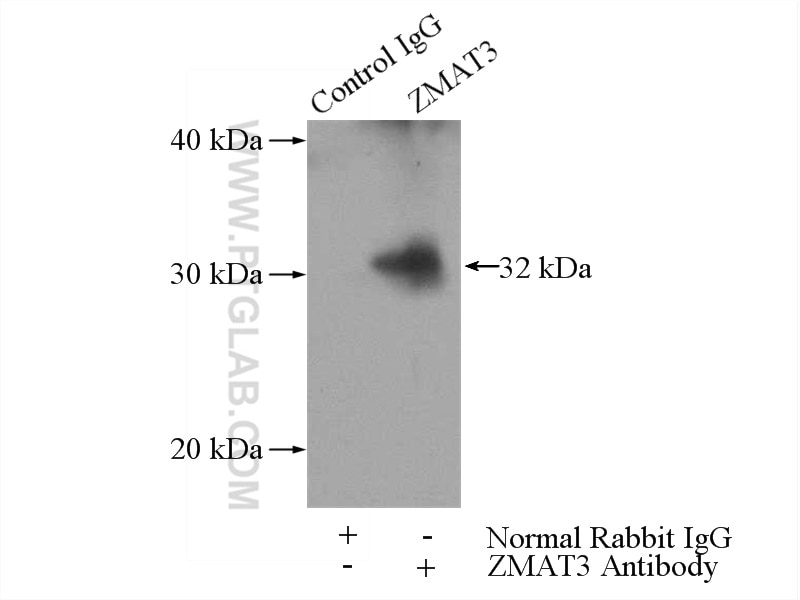

Tested Applications
| Positive WB detected in | COLO 320 cells, rat testis tissue, HEK-293 cells, HepG2 cells, mouse testis tissue |
| Positive IP detected in | mouse testis tissue |
Recommended dilution
| Application | Dilution |
|---|---|
| Western Blot (WB) | WB : 1:2000-1:16000 |
| Immunoprecipitation (IP) | IP : 0.5-4.0 ug for 1.0-3.0 mg of total protein lysate |
| It is recommended that this reagent should be titrated in each testing system to obtain optimal results. | |
| Sample-dependent, Check data in validation data gallery. | |
Product Information
10504-1-AP targets ZMAT3 in WB, IHC, IF, IP, ELISA applications and shows reactivity with human, mouse, rat samples.
| Tested Reactivity | human, mouse, rat |
| Cited Reactivity | human, mouse, rat |
| Host / Isotype | Rabbit / IgG |
| Class | Polyclonal |
| Type | Antibody |
| Immunogen |
CatNo: Ag0780 Product name: Recombinant human ZMAT3 protein Source: e coli.-derived, PGEX-4T Tag: GST Domain: 1-289 aa of BC002896 Sequence: MILLQHAVLPPPKQPSPSPPMSVATRSTGTLQLPPQKPFGQEASLPLAGEEELSKGGEQDCALEELCKPLYCKLCNVTLNSAQQAQAHYQGKNHGKKLRNYYAANSCPPPARMSNVVEPAATPVVPVPPQMGSFKPGGRVILATENDYCKLCDASFSSPAVAQAHYQGKNHAKRLRLAEAQSNSFSESSELGQRRARKEGNEFKMMPNRRNMYTVQNNSAGPYFNPRSRQRIPRDLAMCVTPSGQFYCSMCNVGAGEEMEFRQHLESKQHKSKVSEQRYRNEMENLGYV Predict reactive species |
| Full Name | zinc finger, matrin type 3 |
| Calculated Molecular Weight | 32 kDa |
| Observed Molecular Weight | 32 kDa |
| GenBank Accession Number | BC002896 |
| Gene Symbol | ZMAT3 |
| Gene ID (NCBI) | 64393 |
| RRID | AB_2217579 |
| Conjugate | Unconjugated |
| Form | Liquid |
| Purification Method | Antigen affinity purification |
| UNIPROT ID | Q9HA38 |
| Storage Buffer | PBS with 0.02% sodium azide and 50% glycerol, pH 7.3. |
| Storage Conditions | Store at -20°C. Stable for one year after shipment. Aliquoting is unnecessary for -20oC storage. 20ul sizes contain 0.1% BSA. |
Background Information
ZMAT3 is a p53-induced zinc finger protein, and a role in the TP53-dependent growth regulatory pathway, contribute to TP53-mediated apoptosis by regulation of TP53 expression and translocation to the nucleus and nucleolus. Acts as a bona fide target gene of p53/TP53.
Protocols
| Product Specific Protocols | |
|---|---|
| IP protocol for ZMAT3 antibody 10504-1-AP | Download protocol |
| WB protocol for ZMAT3 antibody 10504-1-AP | Download protocol |
| Standard Protocols | |
|---|---|
| Click here to view our Standard Protocols |
Publications
What published studies show
The ZMAT3 Polyclonal antibody (Catalog #10504-1-AP) has 11 citations across journals including Molecular Cell, Cell Death & Disease, PNAS, Aging Cell, Cell Reports, Scientific Reports, Journal of Cellular and Molecular Medicine, Journal of Physiological Sciences, FEBS Letters, International Journal of General Medicine, and Cancer Biotherapy and Radiopharmaceuticals. Research fields span p53 tumor suppression and splicing regulation, trophoblast apoptosis and spontaneous abortion, HPV-driven tumorigenesis, age-related autoimmunity, nucleolar stress responses, thyroid carcinoma, NSCLC chemoresistance, neuroprotection, breast cancer prognosis, and cholangiocarcinoma radiosensitization, using WB, IHC, IF, and IP across human, mouse, and rat samples.
| Species | Application | Title |
|---|---|---|
Cell Death Dis MicroRNA-184 promotes apoptosis of trophoblast cells via targeting WIG1 and induces early spontaneous abortion. | ||
Proc Natl Acad Sci U S A Covalent inhibitors of human papillomavirus type 16 E6 protein restore p53 function and suppress growth of HPV-driven tumors in vivo. | ||
Aging Cell Perp Deficiency Induces Defective Negative Selection and Autoimmune Arthritis in Aged Mice. | ||
Cell Rep The ribosomal protein L22 binds the MDM4 pre-mRNA and promotes exon skipping to activate p53 upon nucleolar stress | ||
Sci Rep FN1 shapes the behavior of papillary thyroid carcinoma through alternative splicing of EDB region |

