


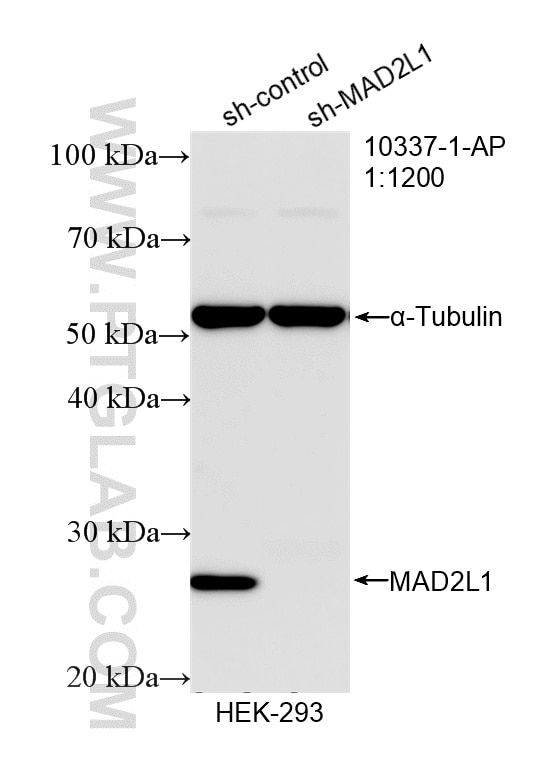



Tested Applications
| Positive WB detected in | Daudi cells, rat liver tissue, HEK-293 cells, HepG2 cells, Raji cells, THP-1 cells, HeLa cells, L02 cells |
| Positive IP detected in | HEK-293 cells |
| Positive IHC detected in | mouse ovary tissue, human liver cancer tissue, human ovary tumor tissue Note: suggested antigen retrieval with TE buffer pH 9.0; (*) Alternatively, antigen retrieval may be performed with citrate buffer pH 6.0 |
| Positive IF/ICC detected in | HepG2 cells, HEK-293 cells |
Recommended dilution
| Application | Dilution |
|---|---|
| Western Blot (WB) | WB : 1:1000-1:5000 |
| Immunoprecipitation (IP) | IP : 0.5-4.0 ug for 1.0-3.0 mg of total protein lysate |
| Immunohistochemistry (IHC) | IHC : 1:500-1:2000 |
| Immunofluorescence (IF)/ICC | IF/ICC : 1:200-1:800 |
| It is recommended that this reagent should be titrated in each testing system to obtain optimal results. | |
| Sample-dependent, Check data in validation data gallery. | |
Product Information
10337-1-AP targets MAD2L1 in WB, IHC, IF/ICC, IP, ELISA applications and shows reactivity with human, mouse, rat samples.
| Tested Reactivity | human, mouse, rat |
| Cited Reactivity | human, mouse, rat |
| Host / Isotype | Rabbit / IgG |
| Class | Polyclonal |
| Type | Antibody |
| Immunogen |
CatNo: Ag0307 Product name: Recombinant human MAD2L1 protein Source: e coli.-derived, PGEX-4T Tag: GST Domain: 16-185 aa of BC000356 Sequence: SAEIVAEFFSFGINSILYQRGIYPSETFTRVQKYGLTLLVTTDLELIKYLNNVVEQLKDWLYKCSVQKLVVVISNIESGEVLERWQFDIECDKTAKDDSAPREKSQKAIQDEIRSVIRQITATVTFLPLLEVSCSFDLLIYTDKDLVVPEKWEESGPQFITNSEEVRLRS Predict reactive species |
| Full Name | MAD2 mitotic arrest deficient-like 1 (yeast) |
| Calculated Molecular Weight | 24 kDa |
| Observed Molecular Weight | 25-30 kDa |
| GenBank Accession Number | BC000356 |
| Gene Symbol | MAD2L1 |
| Gene ID (NCBI) | 4085 |
| RRID | AB_2139365 |
| Conjugate | Unconjugated |
| Form | Liquid |
| Purification Method | Antigen affinity purification |
| UNIPROT ID | Q13257 |
| Storage Buffer | PBS with 0.02% sodium azide and 50% glycerol, pH 7.3. |
| Storage Conditions | Store at -20°C. Stable for one year after shipment. Aliquoting is unnecessary for -20oC storage. 20ul sizes contain 0.1% BSA. |
Background Information
MAD2 mitotic arrest deficient-like 1 (yeast) (MAD2L1, synonyms: MAD2, HSMAD2) is a component of the mitotic spindle assembly checkpoint that prevents the onset of anaphase until all chromosomes are properly aligned at the metaphase plate. MAD2L1 is localized to human chromosome band 5q23.3 by in situ hybridization.
Protocols
| Product Specific Protocols | |
|---|---|
| IF protocol for MAD2L1 antibody 10337-1-AP | Download protocol |
| IHC protocol for MAD2L1 antibody 10337-1-AP | Download protocol |
| IP protocol for MAD2L1 antibody 10337-1-AP | Download protocol |
| WB protocol for MAD2L1 antibody 10337-1-AP | Download protocol |
| Standard Protocols | |
|---|---|
| Click here to view our Standard Protocols |
Publications
What published studies show
The MAD2L1 Polyclonal antibody (catalog number 10337-1-AP) has 42 citations. These appear in journals including Cancer Research, Nucleic Acids Research, Advanced Science, Science Advances, Neuro-Oncology, Cell Death & Disease, Cell Death Discovery, Oncogene, International Journal of Surgery, and International Journal of Biological Macromolecules. The associated research fields center on cancer biology (hepatocellular, gastric, ovarian, glioblastoma, and other carcinomas), cell cycle regulation, and the spindle assembly checkpoint, with applications mainly in Western blot and immunohistochemistry.
| Species | Application | Title |
|---|---|---|
Cancer Res Deficiency of pRb family proteins and p53 in invasive urothelial tumorigenesis. | ||
Adv Sci (Weinh) A Novel FGFR3-Targeting Antibody-Drug Conjugate Induces Tumor Cell Apoptosis through the cGAS-STING Pathway in Bladder Cancer.
| ||
Adv Sci (Weinh) CCDC68 Maintains Mitotic Checkpoint Activation by Promoting CDC20 Integration into the MCC | ||
Adv Sci (Weinh) A Microtubule-Associated Protein Functions in Preventing Oocytes from Evading the Spindle Assembly Checkpoint |


