

Tested Applications
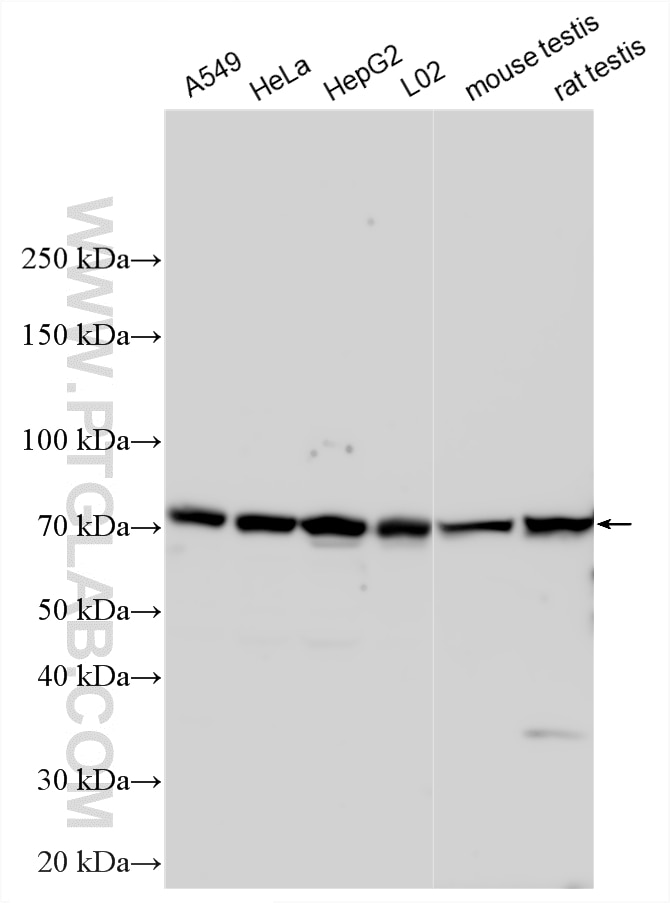
| Positive WB detected in | A549 cells, HeLa cells, HepG2 cells, L02 cells, mouse testis tissue, rat testis tissue |
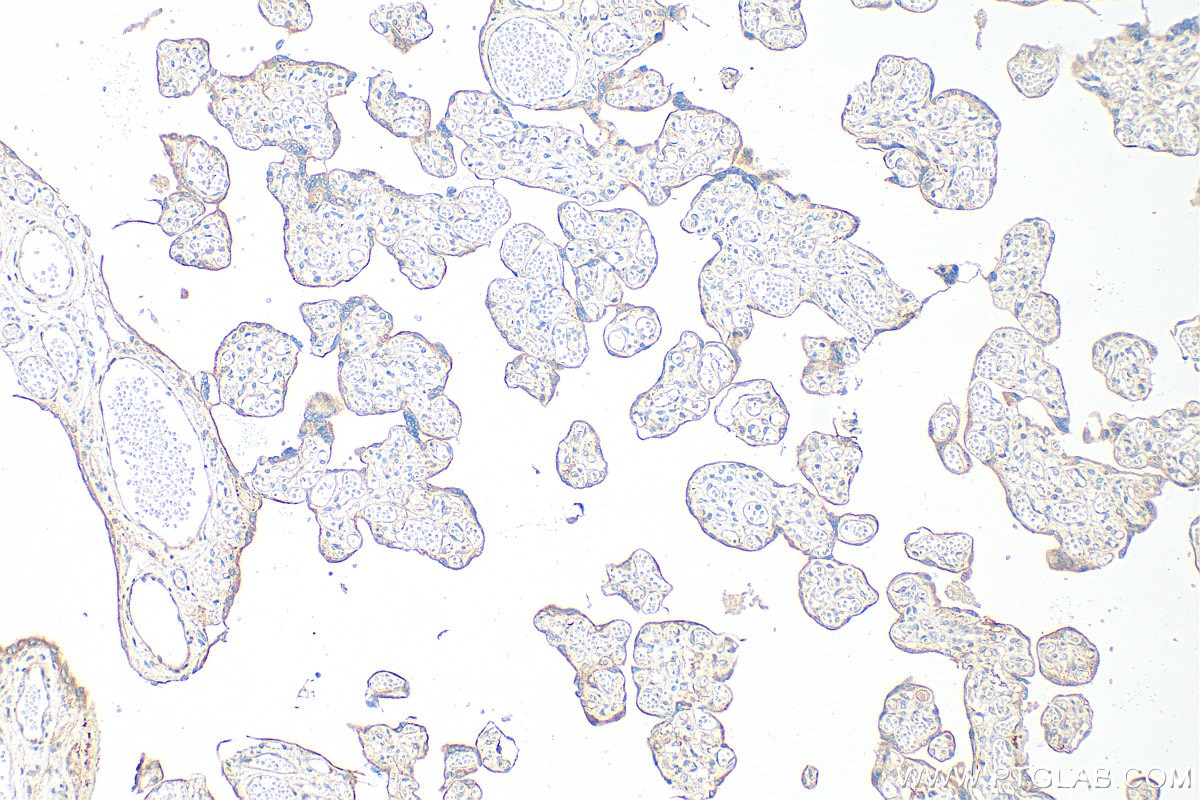
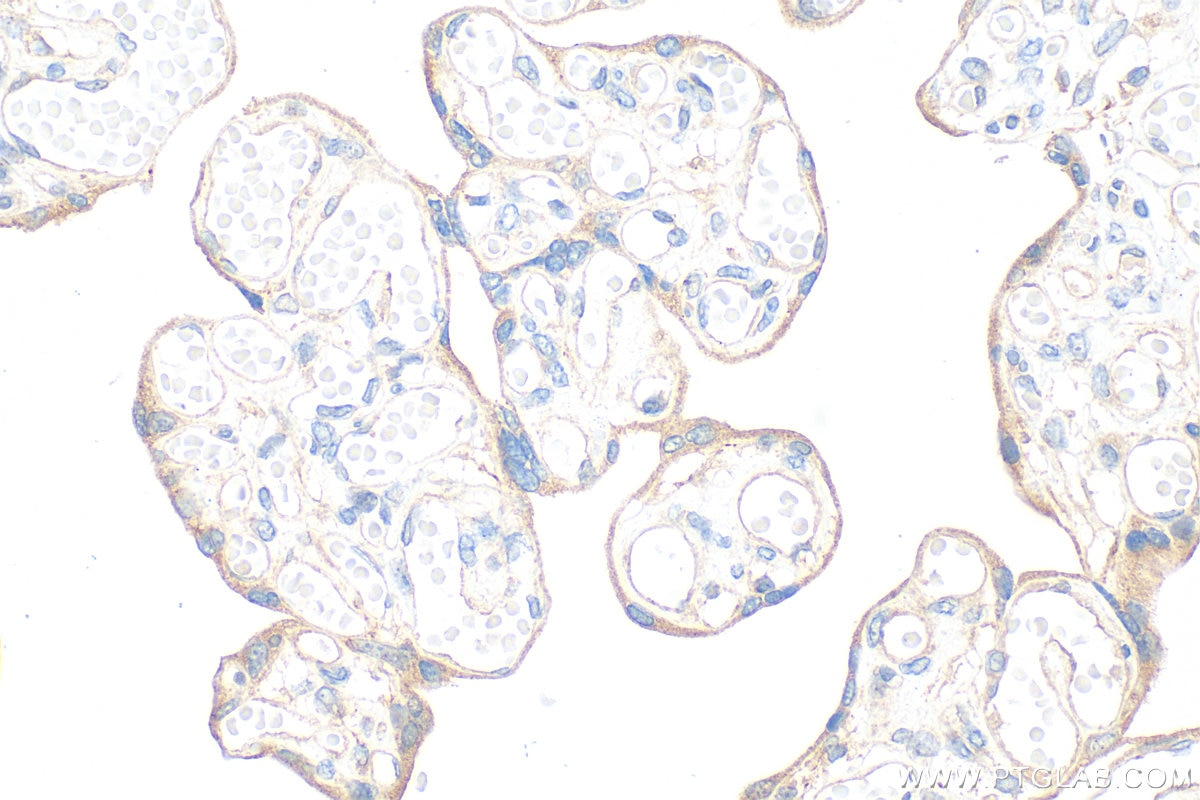
| Positive IHC detected in | human placenta tissue Note: suggested antigen retrieval with TE buffer pH 9.0; (*) Alternatively, antigen retrieval may be performed with citrate buffer pH 6.0 |
Recommended dilution
| Application | Dilution |
|---|---|
| Western Blot (WB) | WB : 1:500-1:3000 |
| Immunohistochemistry (IHC) | IHC : 1:300-1:1200 |
| It is recommended that this reagent should be titrated in each testing system to obtain optimal results. | |
| Sample-dependent, Check data in validation data gallery. | |
Product Information
15091-1-AP targets ANTXR1 in WB, IHC, IF, ELISA applications and shows reactivity with human, mouse, rat samples.
| Tested Reactivity | human, mouse, rat |
| Cited Reactivity | human, mouse, rat |
| Host / Isotype | Rabbit / IgG |
| Class | Polyclonal |
| Type | Antibody |
| Immunogen |
CatNo: Ag4626 Product name: Recombinant human ANTXR1 protein Source: e coli.-derived, PGEX-4T Tag: GST Domain: 1-318 aa of BC012074 Sequence: MATAERRALGIGFQWLSLATLVLICAGQGGRREDGGPACYGGFDLYFILDKSGSVLHHWNEIYYFVEQLAHKFISPQLRMSFIVFSTRGTTLMKLTEDREQIRQGLEELQKVLPGGDTYMHEGFERASEQIYYENRQGYRTASVIIALTDGELHEDLFFYSEREANRSRDLGAIVYCVGVKDFNETQLARIADSKDHVFPVNDGFQALQGIIHSILKKSCIEILAAEPSTICAGESFQVVVRGNGFRHARNVDRVLCSFKINDSVTLNEKPFSVEDTYLLCPAPILKEVGMKAALQVSMNDGLSFISSSVIITTTHCS Predict reactive species |
| Full Name | anthrax toxin receptor 1 |
| Calculated Molecular Weight | 63 kDa |
| Observed Molecular Weight | 70 kDa |
| GenBank Accession Number | BC012074 |
| Gene Symbol | ANTXR1 |
| Gene ID (NCBI) | 84168 |
| RRID | AB_2056891 |
| Conjugate | Unconjugated |
| Form | Liquid |
| Purification Method | Antigen affinity purification |
| UNIPROT ID | Q9H6X2 |
| Storage Buffer | PBS with 0.02% sodium azide and 50% glycerol, pH 7.3. |
| Storage Conditions | Store at -20°C. Stable for one year after shipment. Aliquoting is unnecessary for -20oC storage. 20ul sizes contain 0.1% BSA. |
Background Information
Tumor endothelial marker 8 (TEM8, ANTXR1) and capillary morphogenesis protein 2 (CMG2, ANTXR2) are the two well-characterized anthrax toxin receptors, each containing a von Willebrand factor A (vWA) domain responsible for anthrax protective antigen (PA) binding (PMID: 23271637). TEM8 is a highly-conserved single-pass cell-surface protein overexpressed on tumor-infiltrating vasculature, and is thought to play a positive role in endothelial cell activities related to angiogenesis (PMID: 11559528; 15777794 ). The long isoforms of TEM8 have been identified as an 80-85 kDa doublet, and experimental deglycosylation reduced the molecular mass to 70 kDa, indicating that TEM8 undergoes multiple glycosylations (PMID: 14871805; 15689409).
Protocols
| Product Specific Protocols | |
|---|---|
| IHC protocol for ANTXR1 antibody 15091-1-AP | Download protocol |
| WB protocol for ANTXR1 antibody 15091-1-AP | Download protocol |
| Standard Protocols | |
|---|---|
| Click here to view our Standard Protocols |
Publications
What published studies show
The ANTXR1 Polyclonal antibody (Cat# 15091-1-AP) has 8 citations. These appear in journals including Stem Cell Research & Therapy, Scientific Reports, Journal of Cellular Physiology, Discovery Oncology, Science Progress, Cancer Management & Research, American Journal of Translational Research, and Computational and Mathematical Methods in Medicine. Research fields span ovarian failure, erythroid differentiation, osteogenesis, angiogenesis, and cancer (breast, gastric, glioma), with applications mainly in Western blot and immunohistochemistry across human, mouse, and rat species.
| Species | Application | Title |
|---|---|---|
Stem Cell Res Ther Mechanism of platelet-rich plasma in improving cyclophosphamide-induced premature ovarian failure in rats. | ||
Sci Rep BMSC-derived exosomal ANTXR1 inhibits erythroid differentiation by suppressing the TLR4/MyD88/NF-κB signaling pathway. | ||
J Cell Physiol Mechanical strain regulates osteogenesis via Antxr1/LncRNA H19/Wnt/β-catenin axis | ||
Discov Oncol iRGD-modified co-loaded curcumin piperine liposomes inhibit angiogenesis in non-small cell lung cancer through the VEGFR2/P38/MK2 signaling axis. | ||
Cancer Manag Res KLF7 Promotes Gastric Carcinogenesis Through Regulation of ANTXR1.
| ||
Sci Prog Expression and clinical significance of TEM8 protein in triple-negative breast cancer. |

