
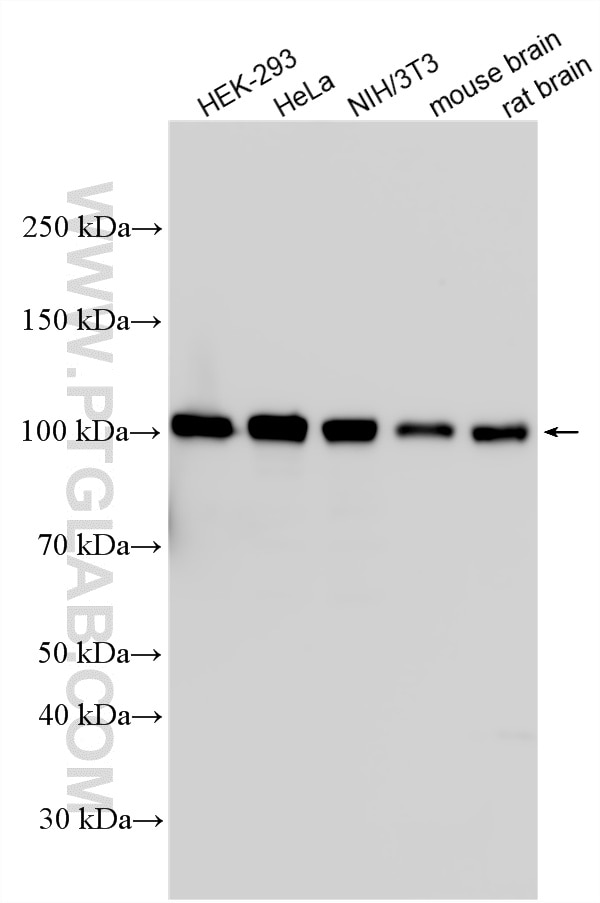



Tested Applications
| Positive WB detected in | HEK-293 cells, mouse brain tissue, HEK-293T cells, rat brain tissue, HeLa cells, Jurkat cells, NIH/3T3 cells |
| Positive IP detected in | HeLa cells |
| Positive IHC detected in | human breast cancer tissue, human prostate cancer tissue, human testis tissue, mouse testis tissue Note: suggested antigen retrieval with TE buffer pH 9.0; (*) Alternatively, antigen retrieval may be performed with citrate buffer pH 6.0 |
| Positive IF/ICC detected in | sodium arsenite treated HeLa cells, OC2 cells, HepG2 cells, HeLa cells |
| Positive FC (Intra) detected in | NIH/3T3 cells |
Recommended dilution
| Application | Dilution |
|---|---|
| Western Blot (WB) | WB : 1:5000-1:50000 |
| Immunoprecipitation (IP) | IP : 0.5-4.0 ug for 1.0-3.0 mg of total protein lysate |
| Immunohistochemistry (IHC) | IHC : 1:500-1:2000 |
| Immunofluorescence (IF)/ICC | IF/ICC : 1:200-1:800 |
| Flow Cytometry (FC) (INTRA) | FC (INTRA) : 0.20 ug per 10^6 cells in a 100 ul suspension |
| It is recommended that this reagent should be titrated in each testing system to obtain optimal results. | |
| Sample-dependent, Check data in validation data gallery. | |
Product Information
15112-1-AP targets CAPRIN1 in WB, IHC, IF/ICC, FC (Intra), IP, CoIP, RIP, ELISA applications and shows reactivity with human, mouse, rat samples.
| Tested Reactivity | human, mouse, rat |
| Cited Reactivity | human, mouse, rat, pig, rabbit, canine, monkey, zebrafish |
| Host / Isotype | Rabbit / IgG |
| Class | Polyclonal |
| Type | Antibody |
| Immunogen |
CatNo: Ag7099 Product name: Recombinant human CAPRIN1 protein Source: e coli.-derived, PGEX-4T Tag: GST Domain: 356-709 aa of BC001731 Sequence: RQRVQDLMAQMQGPYNFIQDSMLDFENQTLDPAIVSAQPMNPTQNMDMPQLVCPPVHSESRLAQPNQVPVQPEATQVPLVSSTSEGYTASQPLYQPSHATEQRPQKEPIDQIQATISLNTDQTTASSSLPAASQPQVFQAGTSKPLHSSGINVNAAPFQSMQTVFNMNAPVPPVNEPETLKQQNQYQASYNQSFSSQPHQVEQTELQQEQLQTVVGTYHGSPDQSHQVTGNHQQPPQQNTGFPRSNQPYYNSRGVSRGGSRGARGLMNGYRGPANGFRGGYDGYRPSFSNTPNSGYTQSQFSAPRDYSGYQRDGYQQNFKRGSGQSGPRGAPRGRGGPPRPNRGMPQMNTQQVN Predict reactive species |
| Full Name | cell cycle associated protein 1 |
| Calculated Molecular Weight | 78 kDa |
| Observed Molecular Weight | 116 kDa |
| GenBank Accession Number | BC001731 |
| Gene Symbol | CAPRIN1 |
| Gene ID (NCBI) | 4076 |
| RRID | AB_2070016 |
| Conjugate | Unconjugated |
| Form | Liquid |
| Purification Method | Antigen affinity purification |
| UNIPROT ID | Q14444 |
| Storage Buffer | PBS with 0.02% sodium azide and 50% glycerol, pH 7.3. |
| Storage Conditions | Store at -20°C. Stable for one year after shipment. Aliquoting is unnecessary for -20oC storage. 20ul sizes contain 0.1% BSA. |
Background Information
CAPRIN1 (Caprin-1) is a cytoplasmic phosphoprotein which may regulate the transport and translation of mRNAs of proteins involved in synaptic plasticity in neurons and cell proliferation and migration in multiple cell types. Its levels, except in the brain, are tightly correlated with cellular proliferation. Suppression of expression of human Caprin-1 resulted in slowing of the proliferation rate,which suggests its essential for normal cellular proliferation.
Protocols
| Product Specific Protocols | |
|---|---|
| FC protocol for CAPRIN1 antibody 15112-1-AP | Download protocol |
| IF protocol for CAPRIN1 antibody 15112-1-AP | Download protocol |
| IHC protocol for CAPRIN1 antibody 15112-1-AP | Download protocol |
| IP protocol for CAPRIN1 antibody 15112-1-AP | Download protocol |
| WB protocol for CAPRIN1 antibody 15112-1-AP | Download protocol |
| Standard Protocols | |
|---|---|
| Click here to view our Standard Protocols |
Publications
What published studies show
I'll search for citations for this product.The CAPRIN1 Polyclonal antibody (15112-1-AP, rabbit IgG, produced in rabbit) has 103 total citations. It appears in high-impact journals including Cell, Molecular Cell, Nature Communications, Neuron, Nature Immunology, Nature Genetics, Cell Reports, Developmental Cell, Oncogene, JCB, and JBC, among others. The research fields span stress granule biology, RNA-binding proteins, virus–host interactions, neurodegenerative diseases (ALS/FTD/TDP-43), cancer biology, neurodevelopment, and immunology, with applications primarily in Western blotting, immunofluorescence, immunoprecipitation, and RIP across human, mouse, rat, and other species.
| Species | Application | Title |
|---|---|---|
Cell In vivo structural characterization of the SARS-CoV-2 RNA genome identifies host proteins vulnerable to repurposed drugs. | ||
Cell G3BP1 Is a Tunable Switch that Triggers Phase Separation to Assemble Stress Granules.
| ||
Cell Competing Protein-RNA Interaction Networks Control Multiphase Intracellular Organization. | ||
Nat Immunol Inducible degradation of lncRNA Sros1 promotes IFN-γ-mediated activation of innate immune responses by stabilizing Stat1 mRNA. | ||
Nat Genet Computational prediction and experimental validation identify functionally conserved lncRNAs from zebrafish to human | ||
Nat Commun Stress granule phase separation in stress-responsive cytosolic extract-in-oil droplets. |
Reviews
What customers say
Able is busy answering your previous question. Please try again later.
The reviews below have been submitted by verified Proteintech customers who received an incentive for providing their feedback.
Katherine (Verified Customer) (10-31-2023) | The antibody worked well with 1:5000 dilution.
|
Lisa (Verified Customer) (02-20-2020) | The antibody works very well, giving specific bands in WB and a very good staining in IF.
 |
Paul (Verified Customer) (04-30-2019) | Product works very well for WB, IP and IF using rat brain tissue samples.
 |


