


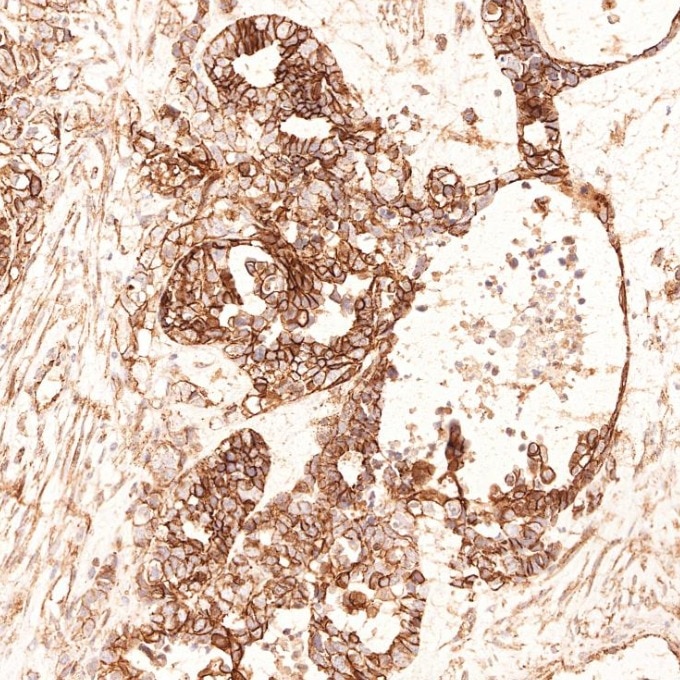



Tested Applications
| Positive WB detected in | A431 cells, pig brain tissue, rat brain tissue, mouse brain tissue, HeLa cells, HEK-293 cells, MCF-7 cells, LNCaP cells, HSC-T6 cells, NIH/3T3 cells, rabbit brain tissue |
| Positive IP detected in | mouse brain tissue |
| Positive IHC-Autostainer detected in | human ovary cancer tissue, human stomach cancer tissue, human placenta tissue, human liver cancer tissue, human breast cancer tissue, human pancreas cancer tissue, human appendicitis tissue, human colorectal cancer tissue |
| Positive IHC detected in | mouse colon tissue, human ovary cancer tissue, human cervical cancer tissue, human colon tissue, rat colon tissue, human breast cancer tissue, human colorectal cancer tissue, human liver cancer tissue, human pancreas cancer tissue, human stomach cancer tissue, human appendicitis tissue, human skin cancer tissue, mouse colon tissue Note: suggested antigen retrieval with TE buffer pH 9.0; (*) Alternatively, antigen retrieval may be performed with citrate buffer pH 6.0 |
| Positive IF-P detected in | human colon cancer tissue, human skin cancer tissue, mouse liver tissue |
| Positive IF/ICC detected in | MCF-7 cells, human liver cancer tissue, human skin cancer tissue |
| Positive FC (Intra) detected in | MCF-7 cells |
Recommended dilution
| Application | Dilution |
|---|---|
| Western Blot (WB) | WB : 1:5000-1:50000 |
| Immunoprecipitation (IP) | IP : 0.5-4.0 ug for 1.0-3.0 mg of total protein lysate |
| Immunohistochemistry (IHC)-AUTOSTAINER | IHC-AUTOSTAINER : 1:20000-1:80000 |
| Immunohistochemistry (IHC) | IHC : 1:10000-1:40000 |
| Immunofluorescence (IF)-P | IF-P : 1:200-1:800 |
| Immunofluorescence (IF)/ICC | IF/ICC : 1:750-1:3000 |
| Flow Cytometry (FC) (INTRA) | FC (INTRA) : 0.50 ug per 10^6 cells in a 100 ul suspension |
| It is recommended that this reagent should be titrated in each testing system to obtain optimal results. | |
| Sample-dependent, Check data in validation data gallery. | |
Product Information
66379-1-Ig targets Beta Catenin in WB, IHC, IHC-Autostainer, IF/ICC, IF-P, FC (Intra), IP, CoIP, ELISA applications and shows reactivity with human, mouse, rat, pig samples.
| Tested Reactivity | human, mouse, rat, pig |
| Cited Reactivity | human, mouse, rat, pig, rabbit, chicken, sheep |
| Host / Isotype | Mouse / IgG1 |
| Class | Monoclonal |
| Type | Antibody |
| Immunogen |
Peptide Predict reactive species |
| Full Name | catenin (cadherin-associated protein), beta 1, 88kDa |
| Calculated Molecular Weight | 781 aa, 86 kDa |
| Observed Molecular Weight | 92 kDa |
| GenBank Accession Number | NM_001904 |
| Gene Symbol | Beta Catenin |
| Gene ID (NCBI) | 1499 |
| ENSEMBL Gene ID | ENSG00000168036 |
| RRID | AB_2857358 |
| Conjugate | Unconjugated |
| Form | Liquid |
| Purification Method | Protein G purification |
| UNIPROT ID | P35222 |
| Storage Buffer | PBS with 0.02% sodium azide and 50% glycerol, pH 7.3. |
| Storage Conditions | Store at -20°C. Stable for one year after shipment. Aliquoting is unnecessary for -20oC storage. 20ul sizes contain 0.1% BSA. |
Background Information
β-Catenin, also known as CTNNB1, is an evolutionarily conserved, multifunctional intracellular protein. β-Catenin was originally identified in cell adherens junctions (AJs) where it functions to bridge the cytoplasmic domain of cadherins to a-catenin and the actin cytoskeleton. Besides its essential role in the AJs, β-catenin is also a key downstream component of the canonical Wnt pathway that plays diverse and critical roles in embryonic development and adult tissue homeostasis. The Wnt/β-catenin pathway is also involved in the activation of other intracellular messengers such as calcium fluxes, JNK, and SRC kinases. Deregulation of β-catenin activity is associated with multiple diseases including cancers. (PMID: 22617422; 18334222)
Protocols
| Product Specific Protocols | |
|---|---|
| FC protocol for Beta Catenin antibody 66379-1-Ig | Download protocol |
| IF protocol for Beta Catenin antibody 66379-1-Ig | Download protocol |
| IHC protocol for Beta Catenin antibody 66379-1-Ig | Download protocol |
| IP protocol for Beta Catenin antibody 66379-1-Ig | Download protocol |
| WB protocol for Beta Catenin antibody 66379-1-Ig | Download protocol |
| Standard Protocols | |
|---|---|
| Click here to view our Standard Protocols |
Publications
What published studies show
Beta Catenin Monoclonal Antibody (66379-1-Ig) has 195 citations. Published in high-impact journals including Nature, Gastroenterology, Advanced Materials, Nature Communications, Oncogene, Cell Reports, Journal of Experimental Medicine, and many more. The research spans oncology (colorectal, gastric, pancreatic, liver, breast, lung cancers), Wnt/β-catenin signaling, stem cell biology and differentiation, cardiovascular disease, fibrosis, neurobiology (Alzheimer's, depression), bone/osteogenesis, and metabolic disorders. Applications include WB, IF, IHC, IP, and CoIP across human, mouse, rat, chicken, pig, sheep, and rabbit samples.
| Species | Application | Title |
|---|---|---|
Gastroenterology Cell-in-Cell-Mediated Entosis Reveals A Progressive Mechanism in Pancreatic Cancer | ||
Adv Mater Noninvasive Optogenetics Realized by iPSC-Derived Tentacled Carrier in Alzheimer's Disease Treatment | ||
Nat Commun Cholecystectomy-related gut microbiota dysbiosis exacerbates colorectal tumorigenesis | ||
Redox Biol Riboflavin deficiency leads to irreversible cellular changes in the RPE and disrupts retinal function through alterations in cellular metabolic homeostasis. |
Reviews
What customers say
Able is busy answering your previous question. Please try again later.
The reviews below have been submitted by verified Proteintech customers who received an incentive for providing their feedback.
Bruna (Verified Customer) (05-30-2024) | Great antibody! In our lab, it was used for Western blot and immunofluorescence detection. In both cases, the results were excellent.
|


