
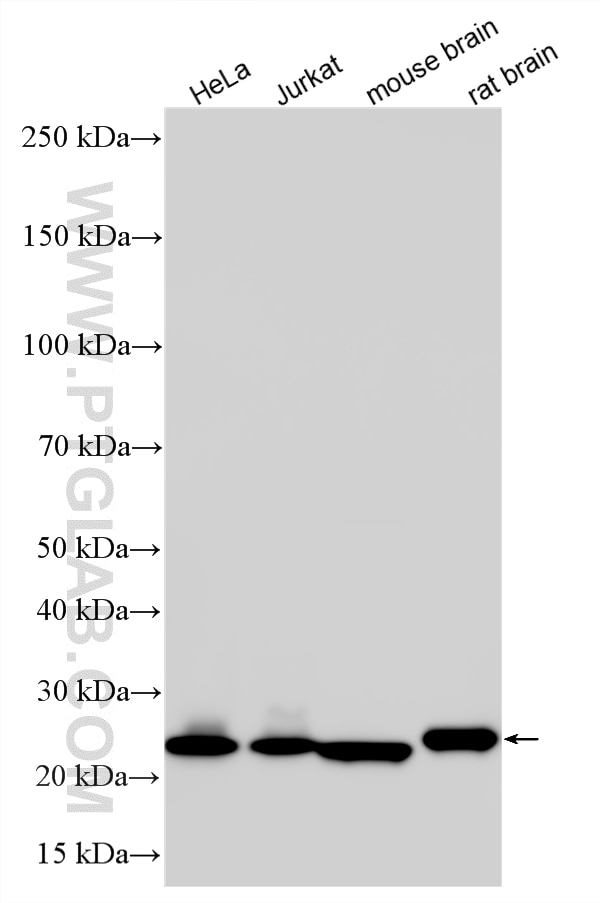



Tested Applications
| Positive WB detected in | HeLa cells, A549 cells, HEK-293 cells, MCF-7 cells, mouse liver tissue, Jurkat cells, mouse brain tissue, rat brain tissue, HepG2 cells, Y79 cells, NIH/3T3 cells |
| Positive IP detected in | mouse brain tissue |
| Positive IHC detected in | mouse brain tissue, human liver cancer tissue, human pancreas tissue Note: suggested antigen retrieval with TE buffer pH 9.0; (*) Alternatively, antigen retrieval may be performed with citrate buffer pH 6.0 |
| Positive IF/ICC detected in | HeLa cells |
| Positive FC (Intra) detected in | HeLa cells |
Recommended dilution
| Application | Dilution |
|---|---|
| Western Blot (WB) | WB : 1:5000-1:50000 |
| Immunoprecipitation (IP) | IP : 0.5-4.0 ug for 1.0-3.0 mg of total protein lysate |
| Immunohistochemistry (IHC) | IHC : 1:200-1:800 |
| Immunofluorescence (IF)/ICC | IF/ICC : 1:200-1:800 |
| Flow Cytometry (FC) (INTRA) | FC (INTRA) : 0.40 ug per 10^6 cells in a 100 ul suspension |
| It is recommended that this reagent should be titrated in each testing system to obtain optimal results. | |
| Sample-dependent, Check data in validation data gallery. | |
Product Information
15059-1-AP targets HPRT in WB, IHC, IF/ICC, FC (Intra), IP, ELISA applications and shows reactivity with human, mouse, rat samples.
| Tested Reactivity | human, mouse, rat |
| Cited Reactivity | human, mouse, rat |
| Host / Isotype | Rabbit / IgG |
| Class | Polyclonal |
| Type | Antibody |
| Immunogen |
CatNo: Ag7044 Product name: Recombinant human HPRT1 protein Source: e coli.-derived, PET28a Tag: 6*His Domain: 1-218 aa of BC000578 Sequence: MATRSPGVVISDDEPGYDLDLFCIPNHYAEDLERVFIPHGLIMDRTERLARDVMKEMGGHHIVALCVLKGGYKFFADLLDYIKALNRNSDRSIPMTVDFIRLKSYCNDQSTGDIKVIGGDDLSTLTGKNVLIVEDIIDTGKTMQTLLSLVRQYNPKMVKVASLLVKRTPRSVGYKPDFVGFEIPDKFVVGYALDYNEYFRDLNHVCVISETGKAKYKA Predict reactive species |
| Full Name | hypoxanthine phosphoribosyltransferase 1 |
| Calculated Molecular Weight | 25 kDa |
| Observed Molecular Weight | 24-28 kDa |
| GenBank Accession Number | BC000578 |
| Gene Symbol | HPRT1 |
| Gene ID (NCBI) | 3251 |
| RRID | AB_10638622 |
| Conjugate | Unconjugated |
| Form | Liquid |
| Purification Method | Antigen affinity purification |
| UNIPROT ID | P00492 |
| Storage Buffer | PBS with 0.02% sodium azide and 50% glycerol, pH 7.3. |
| Storage Conditions | Store at -20°C. Stable for one year after shipment. Aliquoting is unnecessary for -20oC storage. 20ul sizes contain 0.1% BSA. |
Background Information
HPRT, also named HPRT1 and HGPRT, plays a central role in the generation of purine nucleotides through the purine salvage pathway. Mutation of HPRT1 is associated with Lesch-Nyhan syndrome (LNS) which is an X-linked inherited neurogenetic disorder of purine metabolism. It has been reported that HPRT1 also plays an important role in HPRT-related gout.
Protocols
| Product Specific Protocols | |
|---|---|
| FC protocol for HPRT antibody 15059-1-AP | Download protocol |
| IF protocol for HPRT antibody 15059-1-AP | Download protocol |
| IHC protocol for HPRT antibody 15059-1-AP | Download protocol |
| IP protocol for HPRT antibody 15059-1-AP | Download protocol |
| WB protocol for HPRT antibody 15059-1-AP | Download protocol |
| Standard Protocols | |
|---|---|
| Click here to view our Standard Protocols |
Publications
What published studies show
The HPRT Polyclonal antibody (Cat# 15059-1-AP) has accumulated 48 citations in high-impact journals including Nature, Cell, Nature Immunology, Nature Communications, Molecular Cell, Journal of Clinical Investigation, Science Advances, Cell Reports, and eLife. Research fields encompass purine metabolism, cancer biology (glioblastoma, breast, colorectal, head and neck, oral, and prostate cancers), cardiovascular disease, neurology, immunology, mitochondrial biology, developmental biology, and reproductive physiology. Primary applications include Western blot, IHC, and IF.
| Species | Application | Title |
|---|---|---|
Cell A commonly inherited human PCSK9 germline variant drives breast cancer metastasis via LRP1 receptor | ||
Cell Dietary arginine drives codon-dependent MHC class I translation and improves immunity in colon tumorigenesis and respiratory viral infection. | ||
Nat Commun Hypoxanthine phosphoribosyl transferase 1 metabolizes temozolomide to activate AMPK for driving chemoresistance of glioblastomas
|
Reviews
What customers say
Able is busy answering your previous question. Please try again later.
The reviews below have been submitted by verified Proteintech customers who received an incentive for providing their feedback.
Andrea (Verified Customer) (07-24-2026) | It works properly by WB on cerebellar lysates (20ug of proteins loaded)
|


