
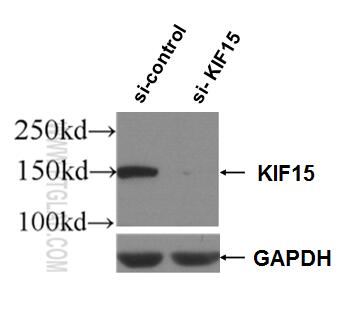
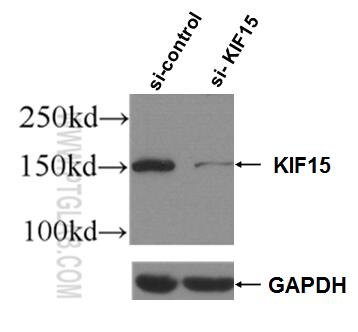
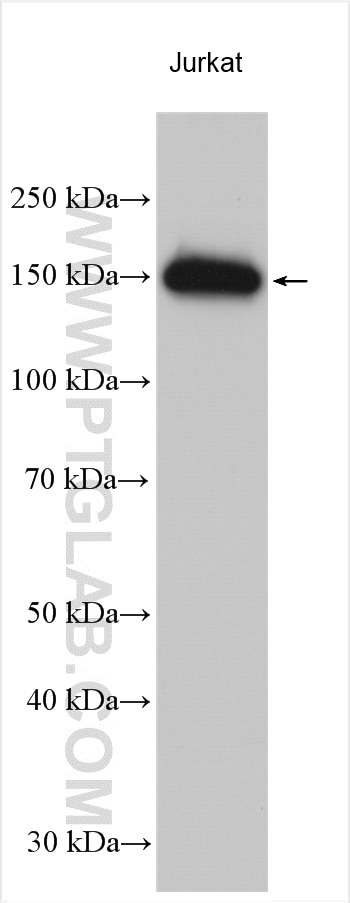
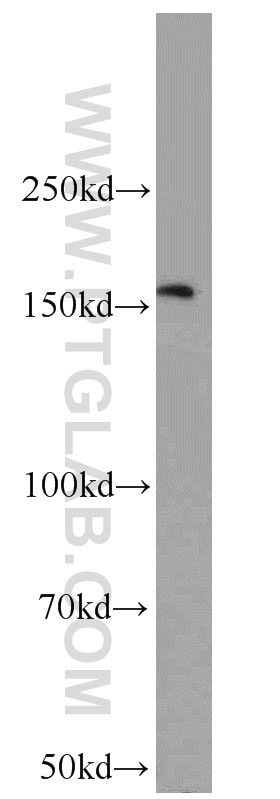

Tested Applications
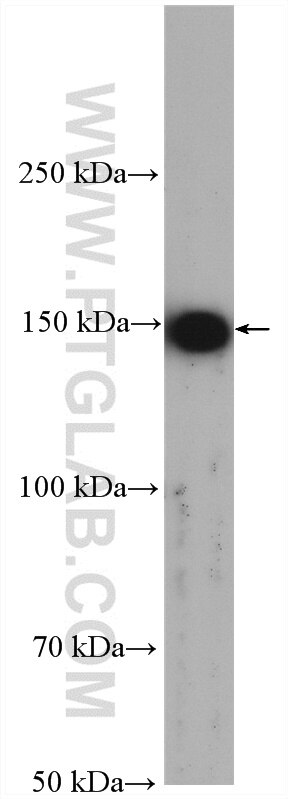
| Positive WB detected in | Jurkat cells, mouse thymus tissue, HEK-293 cells, MDA-MB-453s cells |
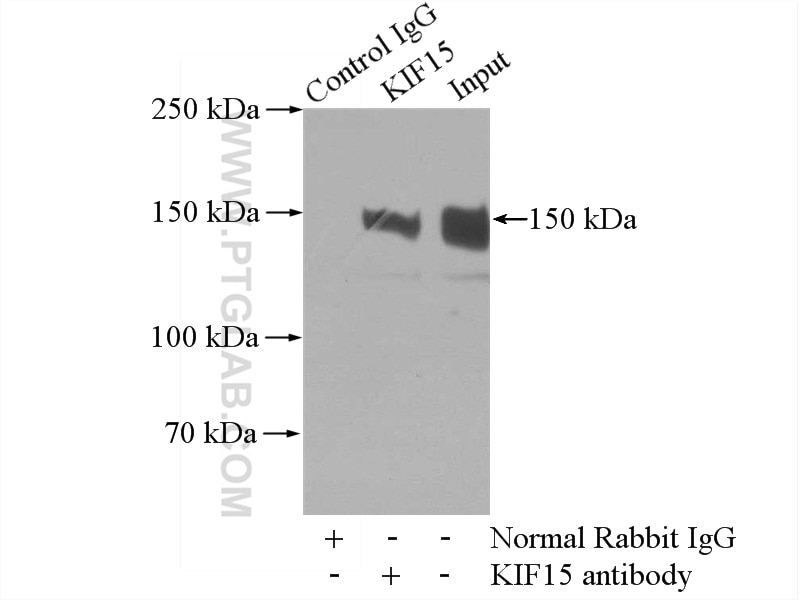
| Positive IP detected in | mouse thymus tissue |
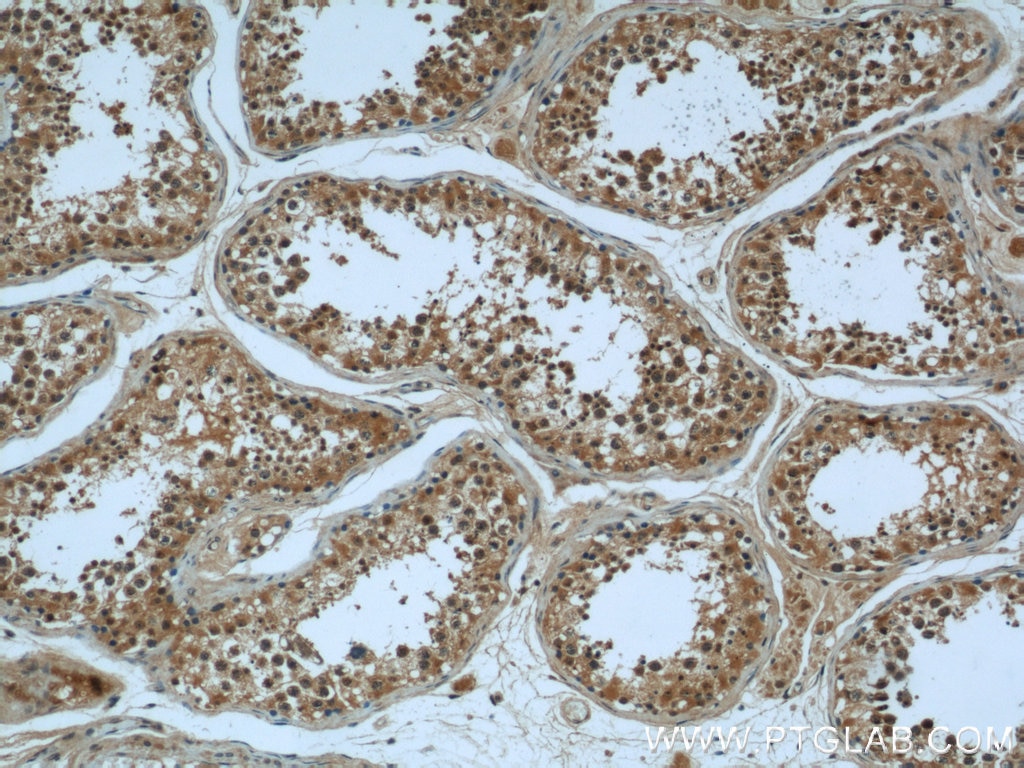
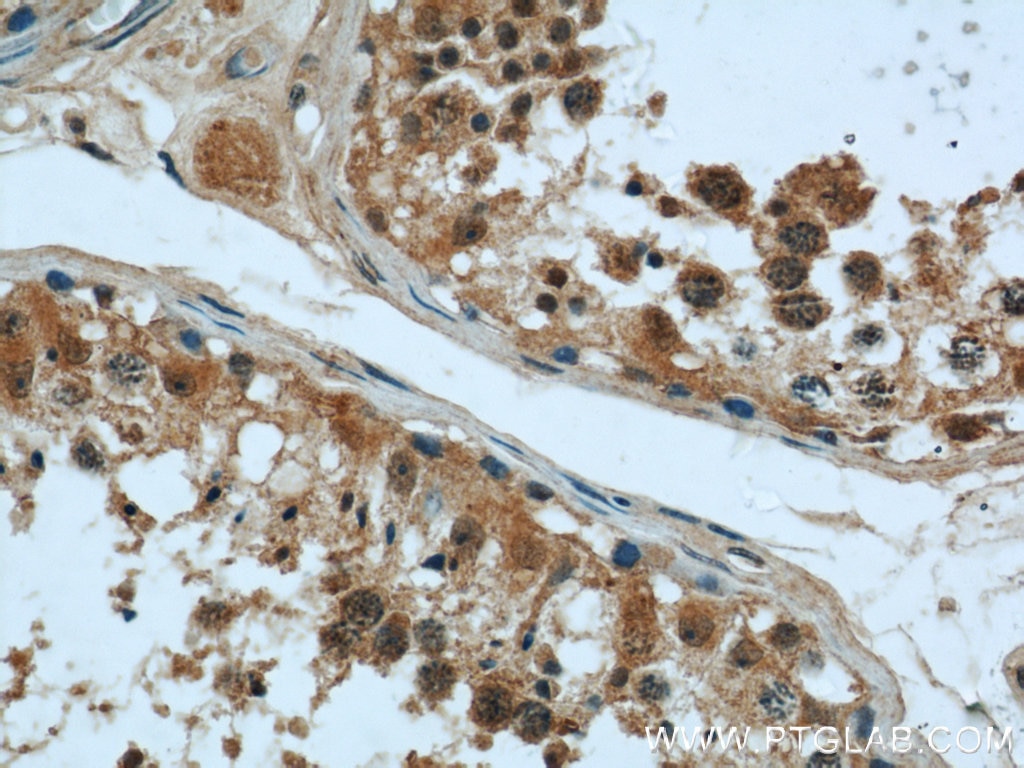
| Positive IHC detected in | human testis tissue Note: suggested antigen retrieval with TE buffer pH 9.0; (*) Alternatively, antigen retrieval may be performed with citrate buffer pH 6.0 |
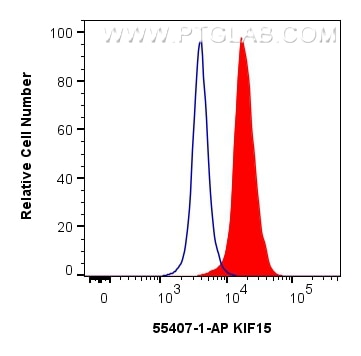
| Positive FC (Intra) detected in | HEK-293 cells |
Recommended dilution
| Application | Dilution |
|---|---|
| Western Blot (WB) | WB : 1:2000-1:10000 |
| Immunoprecipitation (IP) | IP : 0.5-4.0 ug for 1.0-3.0 mg of total protein lysate |
| Immunohistochemistry (IHC) | IHC : 1:20-1:200 |
| Flow Cytometry (FC) (INTRA) | FC (INTRA) : 0.40 ug per 10^6 cells in a 100 ul suspension |
| It is recommended that this reagent should be titrated in each testing system to obtain optimal results. | |
| Sample-dependent, Check data in validation data gallery. | |
Product Information
55407-1-AP targets KIF15 in WB, IHC, IF, FC (Intra), IP, ELISA applications and shows reactivity with human, mouse samples.
| Tested Reactivity | human, mouse |
| Cited Reactivity | human, mouse, rat, zebrafish |
| Host / Isotype | Rabbit / IgG |
| Class | Polyclonal |
| Type | Antibody |
| Immunogen |
Peptide Predict reactive species |
| Full Name | kinesin family member 15 |
| Calculated Molecular Weight | 160 kDa |
| Observed Molecular Weight | 150-165 kDa |
| GenBank Accession Number | NM_020242 |
| Gene Symbol | KIF15 |
| Gene ID (NCBI) | 56992 |
| RRID | AB_11182836 |
| Conjugate | Unconjugated |
| Form | Liquid |
| Purification Method | Antigen affinity purification |
| UNIPROT ID | Q9NS87 |
| Storage Buffer | PBS with 0.02% sodium azide and 50% glycerol, pH 7.3. |
| Storage Conditions | Store at -20°C. Stable for one year after shipment. Aliquoting is unnecessary for -20oC storage. 20ul sizes contain 0.1% BSA. |
Background Information
KIF15, also named as KLP2 and KNSL7, belongs to the kinesin-like protein family and KLP2 subfamily. It is a plus-end directed kinesin-like motor enzyme which involved in mitotic spindle assembly. Several isoforms of KIF15 exist due to the alternative splicing, with molecular weight between 130-160 kDa. Sometimes higher molecular weight around 200 kDa can also be observed, which may be a modified variant of KIF15. (14618103)
Protocols
| Product Specific Protocols | |
|---|---|
| FC protocol for KIF15 antibody 55407-1-AP | Download protocol |
| IHC protocol for KIF15 antibody 55407-1-AP | Download protocol |
| IP protocol for KIF15 antibody 55407-1-AP | Download protocol |
| WB protocol for KIF15 antibody 55407-1-AP | Download protocol |
| Standard Protocols | |
|---|---|
| Click here to view our Standard Protocols |
Publications
What published studies show
KIF15 Polyclonal antibody (55407-1-AP) has 33 citations. Citations appear in diverse journals including Cancer Research, Am J Respir Crit Care Med, Cell Death & Disease, Int J Biol Sci, Journal of Translational Medicine, Journal of Environmental Management, Cell Reports, Cancer Cell International, Endocrinology, Journal of Biological Chemistry, Frontiers in Oncology, PLoS One, and Cancer Management Research. Research fields span oncology (prostate, breast, colorectal, lung, bladder, liver, melanoma, glioblastoma, nasopharyngeal carcinoma), pulmonary fibrosis, spermatogenesis/Sertoli-cell function, auditory development (zebrafish), cardiac hypertrophy, neuropathic pain/nerve regeneration, and toxicology (nanoplastics, PFOA).
| Species | Application | Title |
|---|---|---|
Cancer Res KIF15-mediated stabilization of AR and AR-V7 contributes to enzalutamide resistance in prostate cancer.
| ||
Am J Respir Crit Care Med Rare and Common Variants in KIF15 Contribute to Genetic Risk of Idiopathic Pulmonary Fibrosis | ||
Cell Death Dis B7-H3 regulates KIF15-activated ERK1/2 pathway and contributes to radioresistance in colorectal cancer.
| ||
Int J Biol Sci KIF15 promotes human glioblastoma progression under the synergistic transactivation of REST and P300
| ||
Int J Biol Sci ZNF367-induced transcriptional activation of KIF15 accelerates the progression of breast cancer. | ||
J Transl Med Inhibition of the FEN1-PBX1 axis elicits cellular senescence in breast cancer via the increased intracellular reactive oxygen species levels |

