





Tested Applications
| Positive WB detected in | mouse pancreas tissue |
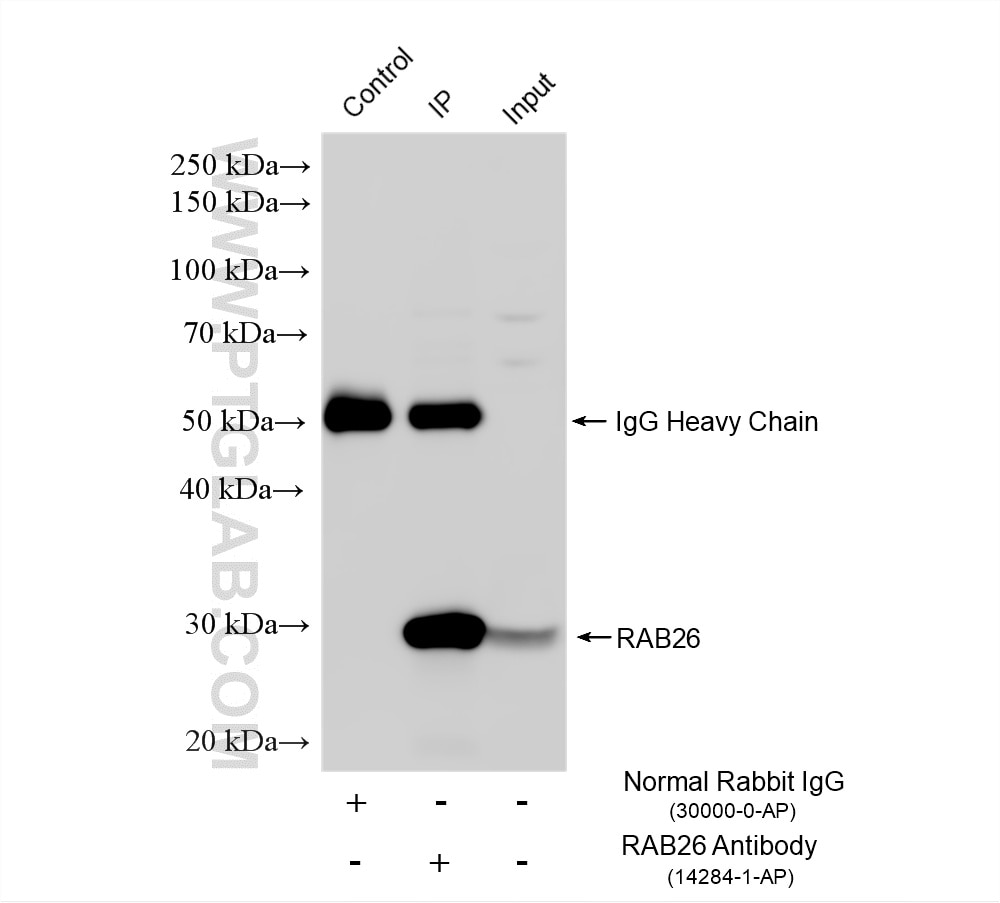
| Positive IP detected in | mouse pancreas tissue |
| Positive IHC detected in | human pancreas tissue Note: suggested antigen retrieval with TE buffer pH 9.0; (*) Alternatively, antigen retrieval may be performed with citrate buffer pH 6.0 |
| Positive IF/ICC detected in | MCF-7 cells, BxPC-3 cells |
| Positive FC (Intra) detected in | MCF-7 cells |
Recommended dilution
| Application | Dilution |
|---|---|
| Western Blot (WB) | WB : 1:500-1:1000 |
| Immunoprecipitation (IP) | IP : 0.5-4.0 ug for 1.0-3.0 mg of total protein lysate |
| Immunohistochemistry (IHC) | IHC : 1:50-1:500 |
| Immunofluorescence (IF)/ICC | IF/ICC : 1:200-1:800 |
| Flow Cytometry (FC) (INTRA) | FC (INTRA) : 0.40 ug per 10^6 cells in a 100 ul suspension |
| It is recommended that this reagent should be titrated in each testing system to obtain optimal results. | |
| Sample-dependent, Check data in validation data gallery. | |
Product Information
14284-1-AP targets RAB26 in WB, IHC, IF/ICC, FC (Intra), IP, ELISA applications and shows reactivity with human, mouse samples.
| Tested Reactivity | human, mouse |
| Cited Reactivity | human, mouse, rat |
| Host / Isotype | Rabbit / IgG |
| Class | Polyclonal |
| Type | Antibody |
| Immunogen |
CatNo: Ag5581 Product name: Recombinant human RAB26 protein Source: e coli.-derived, PGEX-4T Tag: GST Domain: 1-256 aa of BC066913 Sequence: MSRKKTPKSKGASTPAASTLPTANGARPARSGTALSGPDAPPNGPLQPGRPSLGGGVDFYDVAFKVMLVGDSGVGKTCLLVRFKDGAFLAGTFISTVGIDFRNKVLDVDGVKVKLQMWDTAGQERFRSVTHAYYRDAHALLLLYDVTNKASFDNIQAWLTEIHEYAQHDVALMLLGNKVDSAHERVVKREDGEKLAKEYGLPFMETSAKTGLNVDLAFTAIAKELKRRSMKAPSEPRFRLHDYVKREGRGASCCRP Predict reactive species |
| Full Name | RAB26, member RAS oncogene family |
| Calculated Molecular Weight | 28 kDa |
| Observed Molecular Weight | 27-30 kDa |
| GenBank Accession Number | BC066913 |
| Gene Symbol | RAB26 |
| Gene ID (NCBI) | 25837 |
| RRID | AB_2176709 |
| Conjugate | Unconjugated |
| Form | Liquid |
| Purification Method | Antigen affinity purification |
| UNIPROT ID | Q9ULW5 |
| Storage Buffer | PBS with 0.02% sodium azide and 50% glycerol, pH 7.3. |
| Storage Conditions | Store at -20°C. Stable for one year after shipment. Aliquoting is unnecessary for -20oC storage. 20ul sizes contain 0.1% BSA. |
Protocols
| Product Specific Protocols | |
|---|---|
| FC protocol for RAB26 antibody 14284-1-AP | Download protocol |
| IF protocol for RAB26 antibody 14284-1-AP | Download protocol |
| IHC protocol for RAB26 antibody 14284-1-AP | Download protocol |
| IP protocol for RAB26 antibody 14284-1-AP | Download protocol |
| WB protocol for RAB26 antibody 14284-1-AP | Download protocol |
| Standard Protocols | |
|---|---|
| Click here to view our Standard Protocols |
Publications
What published studies show
The RAB26 Polyclonal antibody (Cat# 14284-1-AP) has 13 citations. These appear in journals including Genes Dis, Cell Death Dis, Sci Total Environ, Free Radic Biol Med, PLoS Biol, Cell Mol Life Sci, Life Sci, Cancers (Basel), iScience, J Cell Sci, and J Immunol Res. Research fields span cancer biology (prostate, breast, and lung cancers), neurotoxicity and synaptic function, COPD/inflammation, insulin secretion, cardiac remodeling, and lysosomal/mitochondrial trafficking. Applications include WB, IHC, IF, and IP across human, mouse, and rat samples.
| Species | Application | Title |
|---|---|---|
Genes Dis RAB26 promotes prostate cancer progression via the MAPK/ERK-TWIST1 signaling axis | ||
Cell Death Dis SNRPB promotes the tumorigenic potential of NSCLC in part by regulating RAB26.
| ||
Cell Death Dis Rab26 suppresses migration and invasion of breast cancer cells through mediating autophagic degradation of phosphorylated Src. | ||
Sci Total Environ Manganese disrupts the maturation and degradation of axonal autophagosome leading to hippocampal synaptic toxicity in mice via the activation of LRRK2 on phosphorylation of Rab10 | ||
Free Radic Biol Med ROS induced the Rab26 promoter hypermethylation to promote cigarette smoking-induced airway epithelial inflammation of COPD through activation of MAPK signaling
| ||


