APBB1 Polyklonaler Antikörper
APBB1 Polyklonal Antikörper für WB, IP, ELISA
Wirt / Isotyp
Kaninchen / IgG
Getestete Reaktivität
human, Maus, Ratte
Anwendung
WB, IP, ELISA
Konjugation
Unkonjugiert
Kat-Nr. : 27874-1-AP
Synonyme
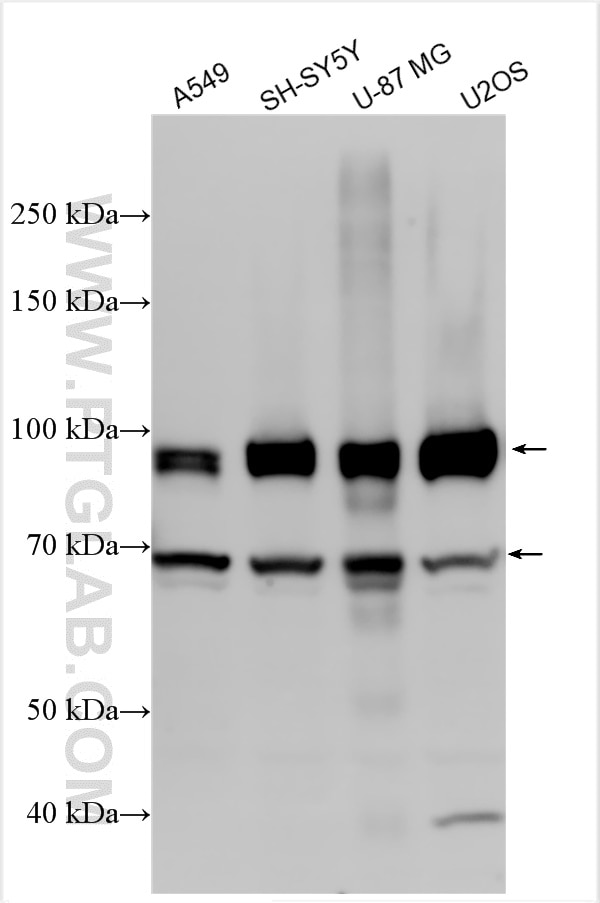
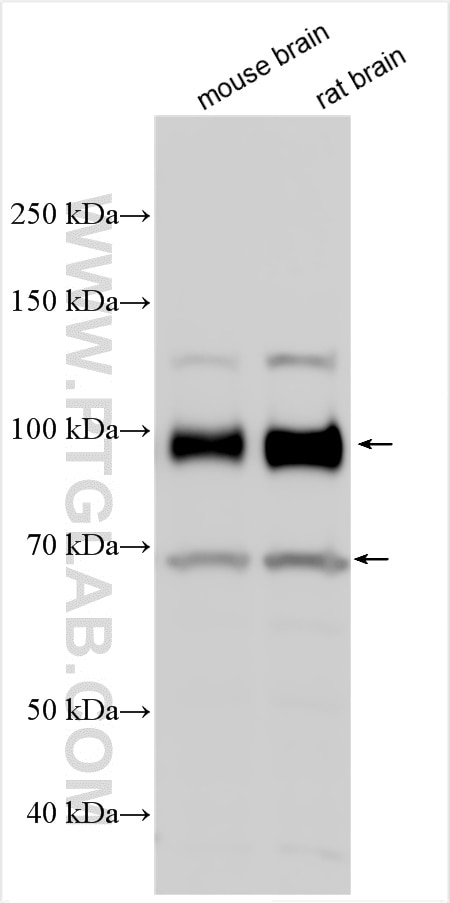
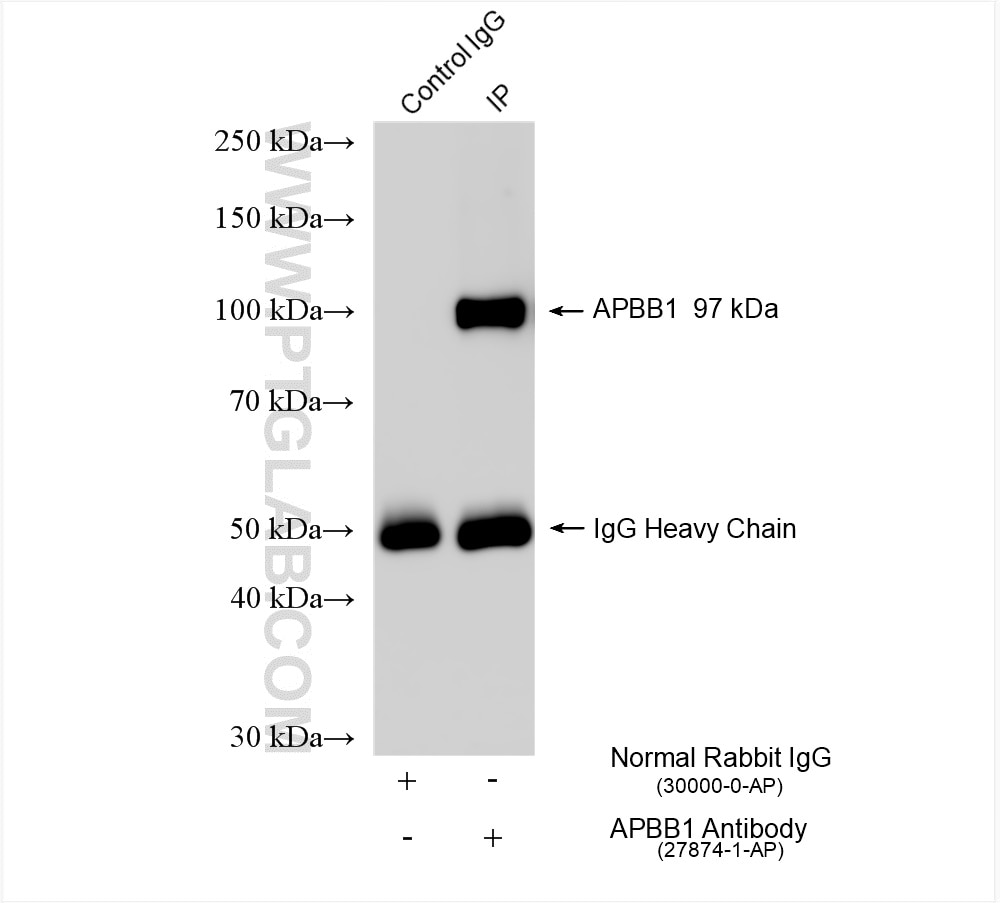
Geprüfte Anwendungen
| Erfolgreiche Detektion in WB | A549-Zellen, Maushirngewebe, Rattenhirngewebe, SH-SY5Y-Zellen, U2OS-Zellen, U-87 MG-Zellen |
| Erfolgreiche IP | Maushirngewebe |
Empfohlene Verdünnung
| Anwendung | Verdünnung |
|---|---|
| Western Blot (WB) | WB : 1:1000-1:6000 |
| Immunpräzipitation (IP) | IP : 0.5-4.0 ug for 1.0-3.0 mg of total protein lysate |
| It is recommended that this reagent should be titrated in each testing system to obtain optimal results. | |
| Sample-dependent, check data in validation data gallery | |
Produktinformation
27874-1-AP bindet in WB, IP, ELISA APBB1 und zeigt Reaktivität mit human, Maus, Ratten
| Getestete Reaktivität | human, Maus, Ratte |
| Wirt / Isotyp | Kaninchen / IgG |
| Klonalität | Polyklonal |
| Typ | Antikörper |
| Immunogen | APBB1 fusion protein Ag27434 |
| Vollständiger Name | amyloid beta (A4) precursor protein-binding, family B, member 1 (Fe65) |
| Berechnetes Molekulargewicht | 708 aa, 77 kDa |
| Beobachtetes Molekulargewicht | 65 kDa, 97 kDa |
| GenBank-Zugangsnummer | BC010854 |
| Gene symbol | APBB1 |
| Gene ID (NCBI) | 322 |
| Konjugation | Unkonjugiert |
| Form | Liquid |
| Reinigungsmethode | Antigen-Affinitätsreinigung |
| Lagerungspuffer | PBS with 0.02% sodium azide and 50% glycerol |
| Lagerungsbedingungen | Bei -20°C lagern. Nach dem Versand ein Jahr lang stabil Aliquotieren ist bei -20oC Lagerung nicht notwendig. 20ul Größen enthalten 0,1% BSA. |
Hintergrundinformationen
Adaptor protein FE65 (APBB1) specifically binds to the intracellular tail of the type I transmembrane protein, β-amyloid precursor protein (APP). FE65 is a multimodular adaptor protein, consisting of three major protein-protein interaction domains, a WW domain and two phosphotyrosine interaction domains (PID). The interaction between FE65 and APP mainly takes place between the C-terminal PID (PID2) and the APP intracellular domain (AICD) (PMID: 15647266). There is novel evidence that the major isoform of FE65 (97-kDa FE65, p97FE65) can be converted to a 65-kDa N-terminally truncated C-terminal fragment (p65FE65) via endoproteolysis. The cleavage region locates immediately after an acidic residue cluster but before the three major protein-protein binding domains (PMID: 15647266). FE65 is predominantly expressed in central nervous system neurons, and its expression is regulated during development and aging, with high levels corresponding to the timing of neural tissue formation and high neuronal activity (PMID: 7867517, PMID: 10561691, PMID: 14689444). p65FE65 (65kDa) is endoproteolytically cleaved from p97FE65 (97 kDa), the major isoform of FE65 (97-kDa FE65, p97FE65) can be converted to a 65-kDa N-terminally truncated C-terminal fragment (p65FE65) via endoproteolysis (PMID: 15647266).
Protokolle
| PRODUKTSPEZIFISCHE PROTOKOLLE | |
|---|---|
| WB protocol for APBB1 antibody 27874-1-AP | Protokoll herunterladen |
| IP protocol for APBB1 antibody 27874-1-AP | Protokoll herunterladen |
| STANDARD-PROTOKOLLE | |
|---|---|
| Klicken Sie hier, um unsere Standardprotokolle anzuzeigen |

