ARK5 Rekombinanter Antikörper
ARK5 Rekombinant Antikörper für IF/ICC
Wirt / Isotyp
Kaninchen / IgG
Getestete Reaktivität
human
Anwendung
IF/ICC
Konjugation
CoraLite® Plus 488 Fluorescent Dye
CloneNo.
242411F1
Kat-Nr. : CL488-84893-5
Synonyme
Filter:
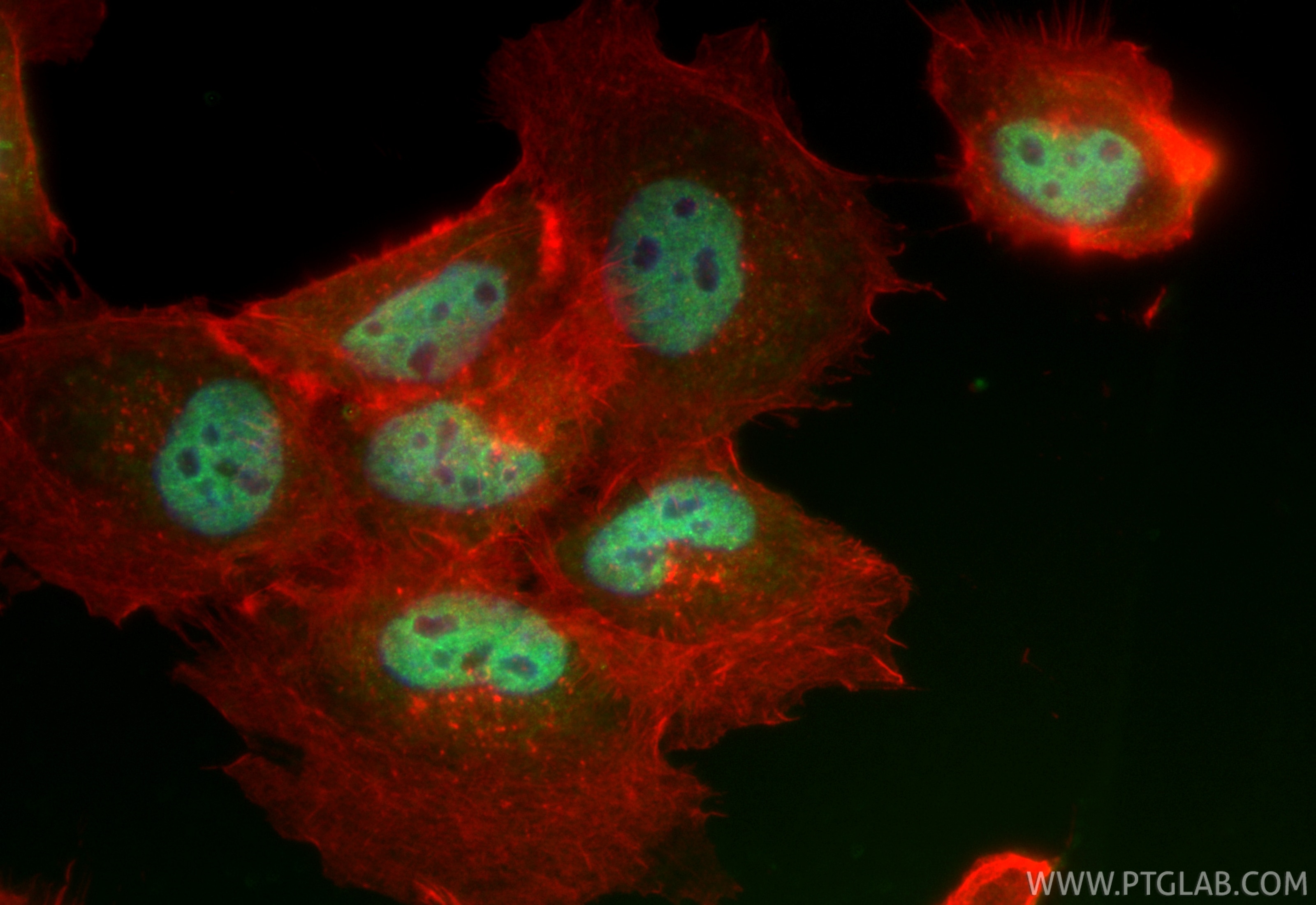
Geprüfte Anwendungen
| Erfolgreiche Detektion in IF/ICC | A431-Zellen |
Empfohlene Verdünnung
| Anwendung | Verdünnung |
|---|---|
| Immunfluoreszenz (IF)/ICC | IF/ICC : 1:50-1:500 |
| It is recommended that this reagent should be titrated in each testing system to obtain optimal results. | |
| Sample-dependent, check data in validation data gallery | |
Produktinformation
CL488-84893-5 bindet in IF/ICC ARK5 und zeigt Reaktivität mit human
| Getestete Reaktivität | human |
| Wirt / Isotyp | Kaninchen / IgG |
| Klonalität | Rekombinant |
| Typ | Antikörper |
| Immunogen | ARK5 fusion protein Ag18832 |
| Vollständiger Name | NUAK family, SNF1-like kinase, 1 |
| Berechnetes Molekulargewicht | 661 aa, 74 kDa |
| GenBank-Zugangsnummer | BC152462 |
| Gene symbol | ARK5 |
| Gene ID (NCBI) | 9891 |
| Konjugation | CoraLite® Plus 488 Fluorescent Dye |
| Excitation/Emission maxima wavelengths | 493 nm / 522 nm |
| Form | Liquid |
| Reinigungsmethode | Protein-A-Reinigung |
| Lagerungspuffer | PBS with 50% glycerol, 0.05% Proclin300, 0.5% BSA |
| Lagerungsbedingungen | Bei -20°C lagern. Vor Licht schützen. Nach dem Versand ein Jahr stabil. Aliquotieren ist bei -20oC Lagerung nicht notwendig. 20ul Größen enthalten 0,1% BSA. |
Hintergrundinformationen
NUAK1 is a member of the human adenosine monophosphate (AMP)-activated protein kinase family that has been identified as a key tumor cell survival factor. It is also named as ARK5, KIAA0537, OMPHK1 and belongs to the protein kinase superfamily. The physiological role of NUAK1 is potentially to suppress glucose uptake through negative regulation of INS signaling in oxidative muscle. This protein has 2 isoforms produced by alternative splicing.
Protokolle
| PRODUKTSPEZIFISCHE PROTOKOLLE | |
|---|---|
| IF protocol for CL Plus 488 ARK5 antibody CL488-84893-5 | Protokoll herunterladen |
| STANDARD-PROTOKOLLE | |
|---|---|
| Klicken Sie hier, um unsere Standardprotokolle anzuzeigen |

