ATP6V0D2 Polyklonaler Antikörper
ATP6V0D2 Polyklonal Antikörper für WB, ELISA
Wirt / Isotyp
Kaninchen / IgG
Getestete Reaktivität
human, Maus, Ratte
Anwendung
WB, ELISA
Konjugation
Unkonjugiert
Kat-Nr. : 33364-1-AP
Synonyme
Geprüfte Anwendungen
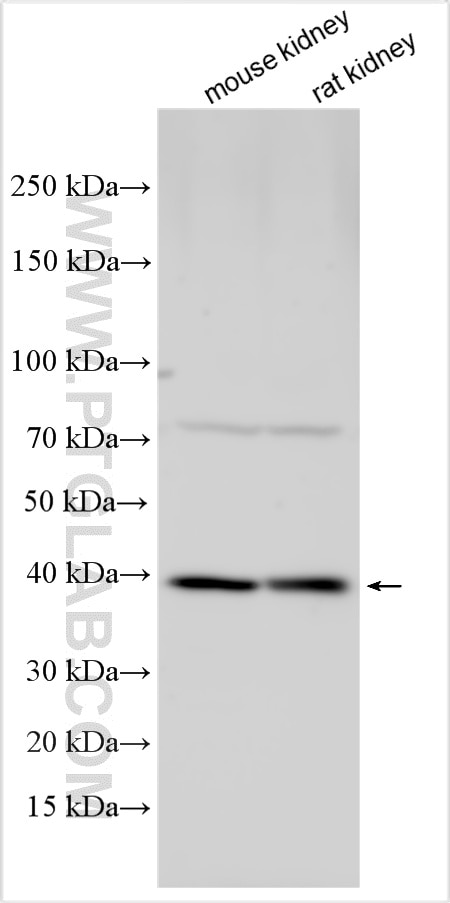
| Erfolgreiche Detektion in WB | Mausnierengewebe, Rattennierengewebe |
Empfohlene Verdünnung
| Anwendung | Verdünnung |
|---|---|
| Western Blot (WB) | WB : 1:500-1:2000 |
| It is recommended that this reagent should be titrated in each testing system to obtain optimal results. | |
| Sample-dependent, check data in validation data gallery | |
Produktinformation
33364-1-AP bindet in WB, ELISA ATP6V0D2 und zeigt Reaktivität mit human, Maus, Ratten
| Getestete Reaktivität | human, Maus, Ratte |
| Wirt / Isotyp | Kaninchen / IgG |
| Klonalität | Polyklonal |
| Typ | Antikörper |
| Immunogen | ATP6V0D2 fusion protein Ag38739 |
| Vollständiger Name | ATPase, H+ transporting, lysosomal 38kDa, V0 subunit d2 |
| Berechnetes Molekulargewicht | 40 kDa |
| Beobachtetes Molekulargewicht | 40 kDa |
| GenBank-Zugangsnummer | BC065207 |
| Gene symbol | ATP6V0D2 |
| Gene ID (NCBI) | 245972 |
| Konjugation | Unkonjugiert |
| Form | Liquid |
| Reinigungsmethode | Antigen-Affinitätsreinigung |
| Lagerungspuffer | PBS with 0.02% sodium azide and 50% glycerol |
| Lagerungsbedingungen | Bei -20°C lagern. Nach dem Versand ein Jahr lang stabil Aliquotieren ist bei -20oC Lagerung nicht notwendig. 20ul Größen enthalten 0,1% BSA. |
Hintergrundinformationen
ATP6V0D2 is a subunit of the vacuolar proton-translocating ATPase (V-ATPase) complex, which is responsible for acidifying intracellular compartments and the extracellular environment. This protein is crucial for maintaining the acidic environment necessary for various cellular processes, including bone resorption by osteoclasts (PMID: 19113919). ATP6V0D2 is also involved in the regulation of tumor-associated macrophages, where it influences tumor progression through the lactate/ATP6V0D2/HIF-2α axis (PMID: 30431439).
Protokolle
| PRODUKTSPEZIFISCHE PROTOKOLLE | |
|---|---|
| WB protocol for ATP6V0D2 antibody 33364-1-AP | Protokoll herunterladen |
| STANDARD-PROTOKOLLE | |
|---|---|
| Klicken Sie hier, um unsere Standardprotokolle anzuzeigen |

