ATP6V1H Monoklonaler Antikörper
ATP6V1H Monoklonal Antikörper für IF/ICC
Wirt / Isotyp
Maus / IgG1
Getestete Reaktivität
Hausschwein, human, Kaninchen, Maus, Ratte
Anwendung
IF/ICC
Konjugation
CoraLite® Plus 488 Fluorescent Dye
CloneNo.
3G7B5
Kat-Nr. : CL488-68425
Synonyme
Filter:
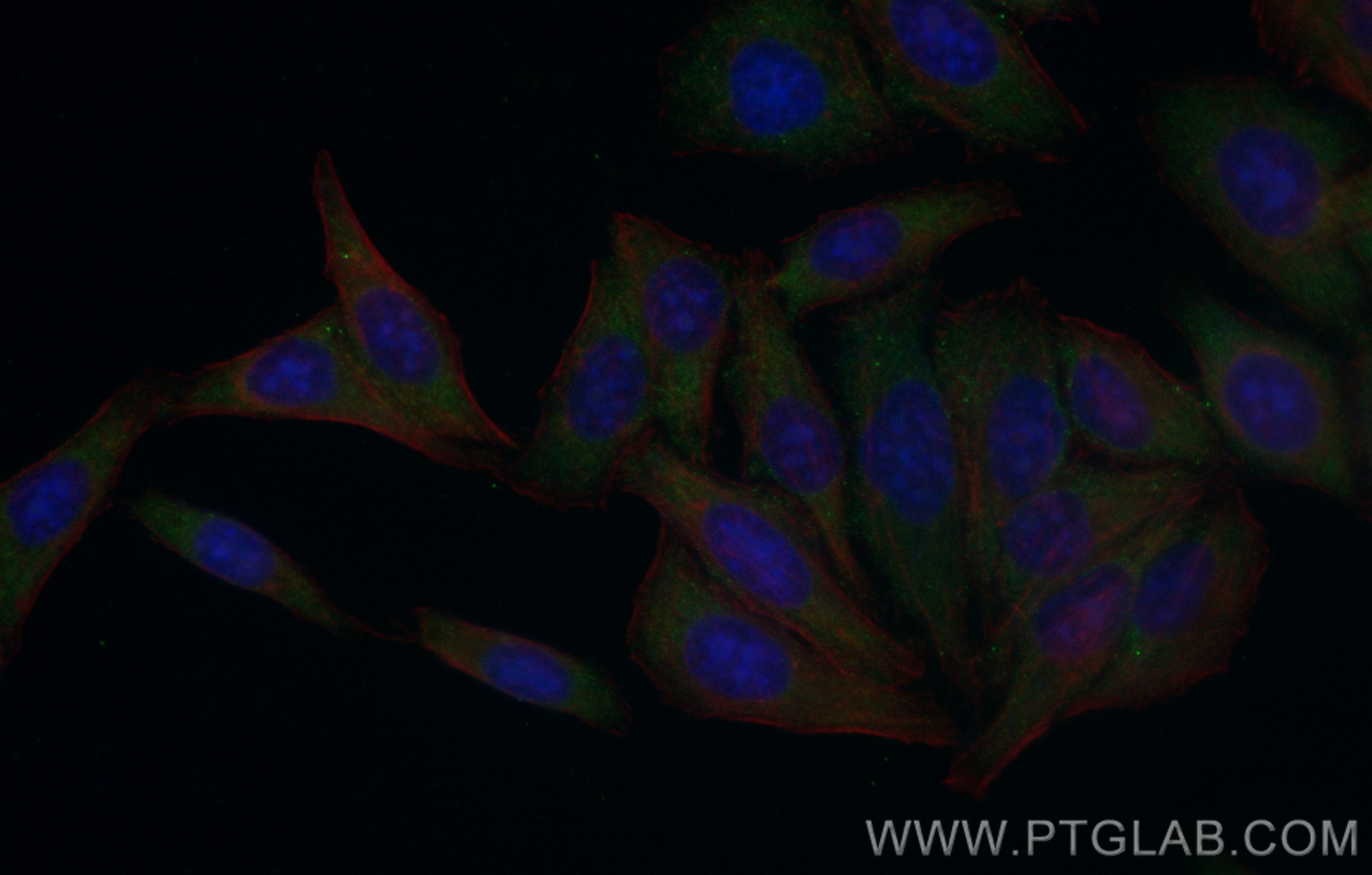
Geprüfte Anwendungen
| Erfolgreiche Detektion in IF/ICC | HepG2-Zellen |
Empfohlene Verdünnung
| Anwendung | Verdünnung |
|---|---|
| Immunfluoreszenz (IF)/ICC | IF/ICC : 1:50-1:500 |
| It is recommended that this reagent should be titrated in each testing system to obtain optimal results. | |
| Sample-dependent, check data in validation data gallery | |
Produktinformation
CL488-68425 bindet in IF/ICC ATP6V1H und zeigt Reaktivität mit Hausschwein, human, Kaninchen, Maus, Ratten
| Getestete Reaktivität | Hausschwein, human, Kaninchen, Maus, Ratte |
| Wirt / Isotyp | Maus / IgG1 |
| Klonalität | Monoklonal |
| Typ | Antikörper |
| Immunogen | ATP6V1H fusion protein Ag10130 |
| Vollständiger Name | ATPase, H+ transporting, lysosomal 50/57kDa, V1 subunit H |
| Berechnetes Molekulargewicht | 483 aa, 56 kDa |
| Beobachtetes Molekulargewicht | 50 kDa |
| GenBank-Zugangsnummer | BC025275 |
| Gene symbol | ATP6V1H |
| Gene ID (NCBI) | 51606 |
| Konjugation | CoraLite® Plus 488 Fluorescent Dye |
| Excitation/Emission maxima wavelengths | 493 nm / 522 nm |
| Form | Liquid |
| Reinigungsmethode | Protein-G-Reinigung |
| Lagerungspuffer | PBS with 50% glycerol, 0.05% Proclin300, 0.5% BSA |
| Lagerungsbedingungen | Bei -20°C lagern. Vor Licht schützen. Nach dem Versand ein Jahr stabil. Aliquotieren ist bei -20oC Lagerung nicht notwendig. 20ul Größen enthalten 0,1% BSA. |
Hintergrundinformationen
The vacuolar-type H(+)-ATPase (V-ATPase) is responsible for the acidification of endosomes, lysosomes, and other intracellular organelles. It is also involved in hydrogen ion transport across the plasma membrane into the extracellular space. The V-ATPase is a multisubunit complex with cytosolic and transmembrane domains.
Protokolle
| PRODUKTSPEZIFISCHE PROTOKOLLE | |
|---|---|
| IF protocol for CL Plus 488 ATP6V1H antibody CL488-68425 | Protokoll herunterladen |
| STANDARD-PROTOKOLLE | |
|---|---|
| Klicken Sie hier, um unsere Standardprotokolle anzuzeigen |

