BTLA/CD272 Rekombinanter Antikörper
BTLA/CD272 Rekombinant Antikörper für FC
Wirt / Isotyp
Kaninchen / IgG
Getestete Reaktivität
Maus
Anwendung
FC
Konjugation
CoraLite®594 Fluorescent Dye
CloneNo.
242133A1
Kat-Nr. : CL594-98246-2
Synonyme
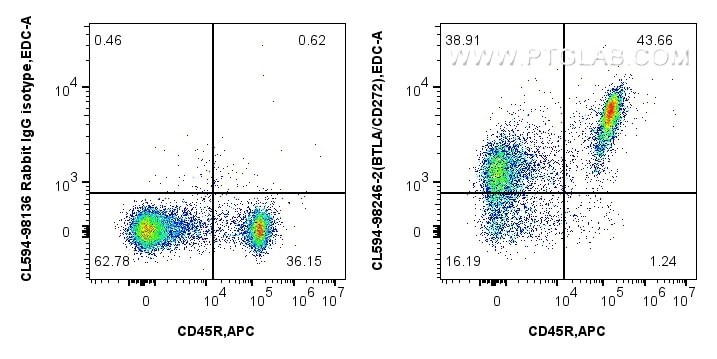
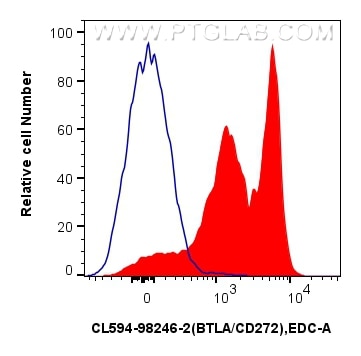
Geprüfte Anwendungen
| Erfolgreiche Detektion in FC | Maus-Splenozyten |
Empfohlene Verdünnung
| Anwendung | Verdünnung |
|---|---|
| This reagent has been tested for flow cytometric analysis. It is recommended that this reagent should be titrated in each testing system to obtain optimal results. | |
| Sample-dependent, check data in validation data gallery | |
Produktinformation
CL594-98246-2 bindet in FC BTLA/CD272 und zeigt Reaktivität mit Maus
| Getestete Reaktivität | Maus |
| Wirt / Isotyp | Kaninchen / IgG |
| Klonalität | Rekombinant |
| Typ | Antikörper |
| Immunogen | BTLA/CD272 fusion protein Eg1843 |
| Vollständiger Name | B and T lymphocyte associated |
| Berechnetes Molekulargewicht | 34kDa |
| GenBank-Zugangsnummer | AAI08964.1 |
| Gene symbol | Btla |
| Gene ID (NCBI) | 208154 |
| Konjugation | CoraLite®594 Fluorescent Dye |
| Excitation/Emission maxima wavelengths | 588 nm / 604 nm |
| Form | Liquid |
| Reinigungsmethode | Protein-A-Reinigung |
| Lagerungspuffer | PBS with 0.09% sodium azide |
| Lagerungsbedingungen | Store at 2-8°C. Avoid exposure to light. Stable for one year after shipment. |
Hintergrundinformationen
BTLA, also known as CD272, is a member of the CD28 superfamily and is a type I membrane glycoprotein identified as an inhibitory receptor (PMID: 33859648). BTLA is extensively expressed in lymph nodes, thymus, and spleen, with little or no expression in organs such as the heart, kidney, brain, and liver (PMID: 33859648). Among immune cells, BTLA is primarily expressed in B and T cells, with higher expression in B cells compared to T cells in the mouse spleen (PMID: 33859648). BTLA plays a crucial role in regulating stimulatory and inhibitory signals in immune responses.
Protokolle
| PRODUKTSPEZIFISCHE PROTOKOLLE | |
|---|---|
| FC protocol for CL594 BTLA/CD272 antibody CL594-98246-2 | Download protocol |
| STANDARD-PROTOKOLLE | |
|---|---|
| Klicken Sie hier, um unsere Standardprotokolle anzuzeigen |

