CARM1 Rekombinanter Antikörper
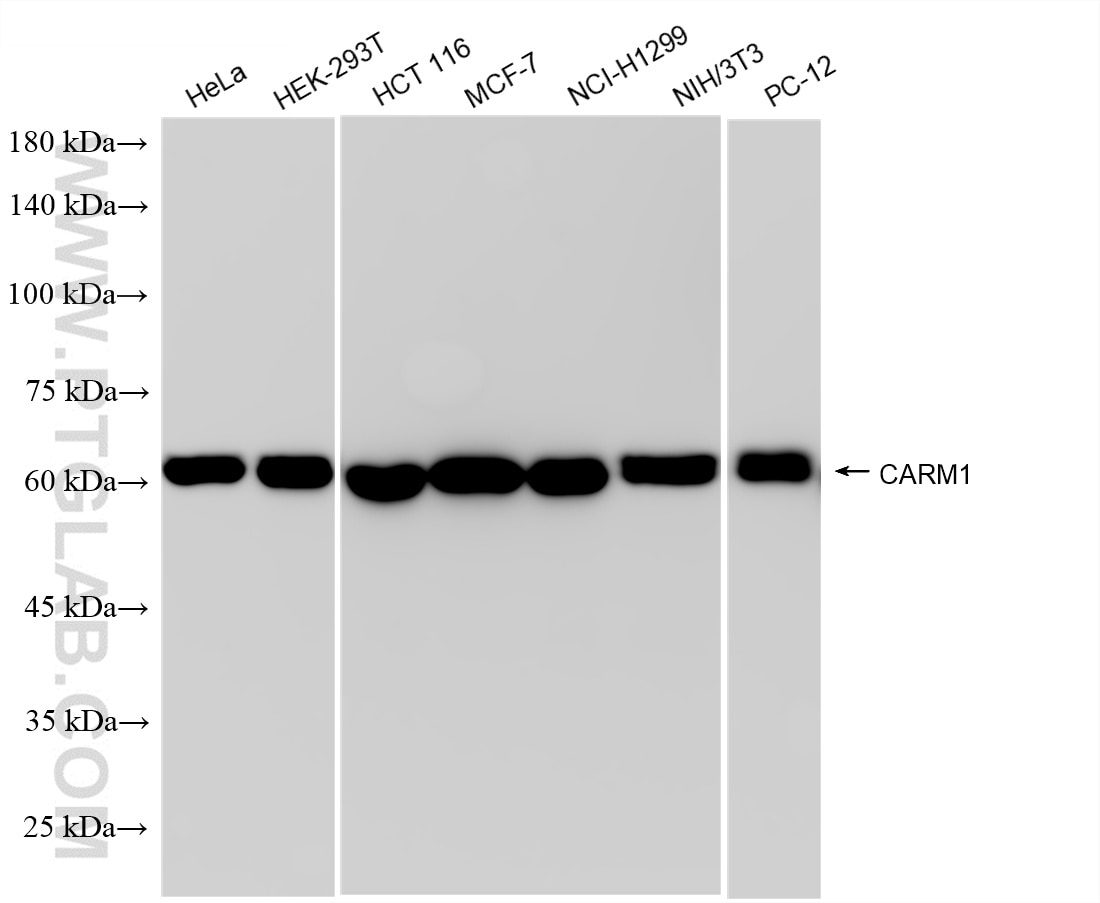
CARM1 Rekombinant Antikörper für WB, Indirect ELISA
Wirt / Isotyp
Kaninchen / IgG
Getestete Reaktivität
human, Maus, Ratte
Anwendung
WB, Indirect ELISA
Konjugation
Unkonjugiert
CloneNo.
242651F10
Kat-Nr. : 85146-3-PBS
Synonyme
Geprüfte Anwendungen
Produktinformation
85146-3-PBS bindet in WB, Indirect ELISA CARM1 und zeigt Reaktivität mit human, Maus, Ratten
| Getestete Reaktivität | human, Maus, Ratte |
| Wirt / Isotyp | Kaninchen / IgG |
| Klonalität | Rekombinant |
| Typ | Antikörper |
| Immunogen | Peptid |
| Vollständiger Name | coactivator-associated arginine methyltransferase 1 |
| Berechnetes Molekulargewicht | 66 kDa |
| Beobachtetes Molekulargewicht | 63-65 kDa |
| GenBank-Zugangsnummer | NM_199141 |
| Gene symbol | CARM1 |
| Gene ID (NCBI) | 10498 |
| Konjugation | Unkonjugiert |
| Form | Liquid |
| Reinigungsmethode | Protein-A-Reinigung |
| Lagerungspuffer | PBS only |
| Lagerungsbedingungen | Store at -80°C. 20ul Größen enthalten 0,1% BSA. |
Hintergrundinformationen
CARM1, also named as PRMT4, belongs to the protein arginine N-methyltransferase family. It is a dual functional coregulator that facilitates transcription initiation by methylation of Arg17 and Arg26 of histone H3 and also dictates the subsequent coactivator complex disassembly by methylation of the steroid receptor coactivator family coactivators and p300/cAMP-response element-binding protein. CARM1 functions as a coactivator for many nuclear receptors, such as oestrogen receptor, androgen receptor, thyroid receptor and farnesoid X-receptor. It also coactivates other transcription factors such as myocyte enhancer factor 2C (MEF2C), β-catenin, p53, nuclear factor (NF)-kB and the cAMP-responsive element-binding factor. The enzymatic activity and coactivator function of CARM1 has been found to be inactivated through phosphorylation at a conserved serine residue at mitosis stage. This antibody was generated against a synthetic peptide corresponding to a fragment of human CARM1. It is expected to specifically recognize the CRAM1. In certain type of cells, like Hela, double bands can be detected with this antibody. This may due to the additional PTM sites in cells themselves.


