CCL17/TARC Rekombinanter Antikörper
CCL17/TARC Rekombinant Antikörper für WB, ELISA
Wirt / Isotyp
Kaninchen / IgG
Getestete Reaktivität
Maus
Anwendung
WB, ELISA
Konjugation
Unkonjugiert
CloneNo.
250385G4
Kat-Nr. : 86482-1-RR
Synonyme
Geprüfte Anwendungen
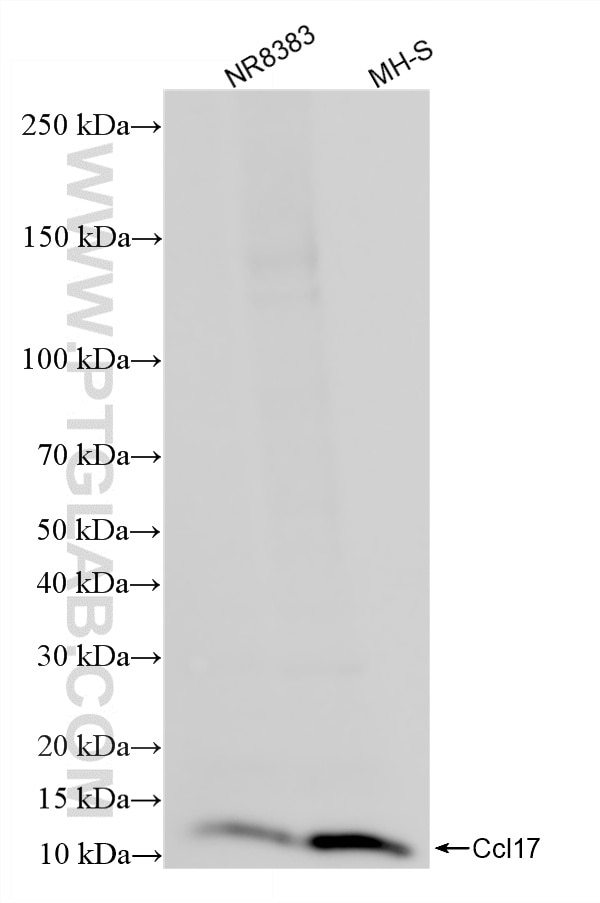
| Erfolgreiche Detektion in WB | NR8383 cells, MH-S cells |
Empfohlene Verdünnung
| Anwendung | Verdünnung |
|---|---|
| Western Blot (WB) | WB : 1:500-1:2000 |
| It is recommended that this reagent should be titrated in each testing system to obtain optimal results. | |
| Sample-dependent, check data in validation data gallery | |
Produktinformation
86482-1-RR bindet in WB, ELISA CCL17/TARC und zeigt Reaktivität mit Maus
| Getestete Reaktivität | Maus |
| Wirt / Isotyp | Kaninchen / IgG |
| Klonalität | Rekombinant |
| Typ | Antikörper |
| Immunogen | CCL17/TARC fusion protein Eg3319 |
| Vollständiger Name | chemokine (C-C motif) ligand 17 |
| Berechnetes Molekulargewicht | 11 kDa |
| Beobachtetes Molekulargewicht | 11 kDa |
| GenBank-Zugangsnummer | NM_011332.3 |
| Gene symbol | Ccl17 |
| Gene ID (NCBI) | 20295 |
| Konjugation | Unkonjugiert |
| Form | Liquid |
| Reinigungsmethode | Protein-A-Reinigung |
| Lagerungspuffer | PBS with 0.02% sodium azide and 50% glycerol |
| Lagerungsbedingungen | Bei -20°C lagern. Nach dem Versand ein Jahr lang stabil Aliquotieren ist bei -20oC Lagerung nicht notwendig. 20ul Größen enthalten 0,1% BSA. |
Hintergrundinformationen
CCL17, also named as TARC, is a member of the CC chemokine family, and is highly expressed by thymus and other cells, including keratinocytes, endothelial cells, dendritic cells, bronchial epithelial cells and fibroblasts. CCL17 plays important roles in T cell development in thymus as well as in trafficking and activation of mature T cells. CCL17 induced chemotaxis and Ca2+ influx in the cells stably expressing CCR4, thereby demonstrating the ligand-receptor relationship between CCL17 and CCR4.
Protokolle
| PRODUKTSPEZIFISCHE PROTOKOLLE | |
|---|---|
| WB protocol for CCL17/TARC antibody 86482-1-RR | Protokoll herunterladen |
| STANDARD-PROTOKOLLE | |
|---|---|
| Klicken Sie hier, um unsere Standardprotokolle anzuzeigen |

