CD106 Monoklonaler Antikörper
CD106 Monoklonal Antikörper für FC
Wirt / Isotyp
Maus / IgG1, kappa
Getestete Reaktivität
human
Anwendung
FC
Konjugation
Unkonjugiert
CloneNo.
1.G11B1
Kat-Nr. : 65049-1-Ig
Synonyme
Geprüfte Anwendungen
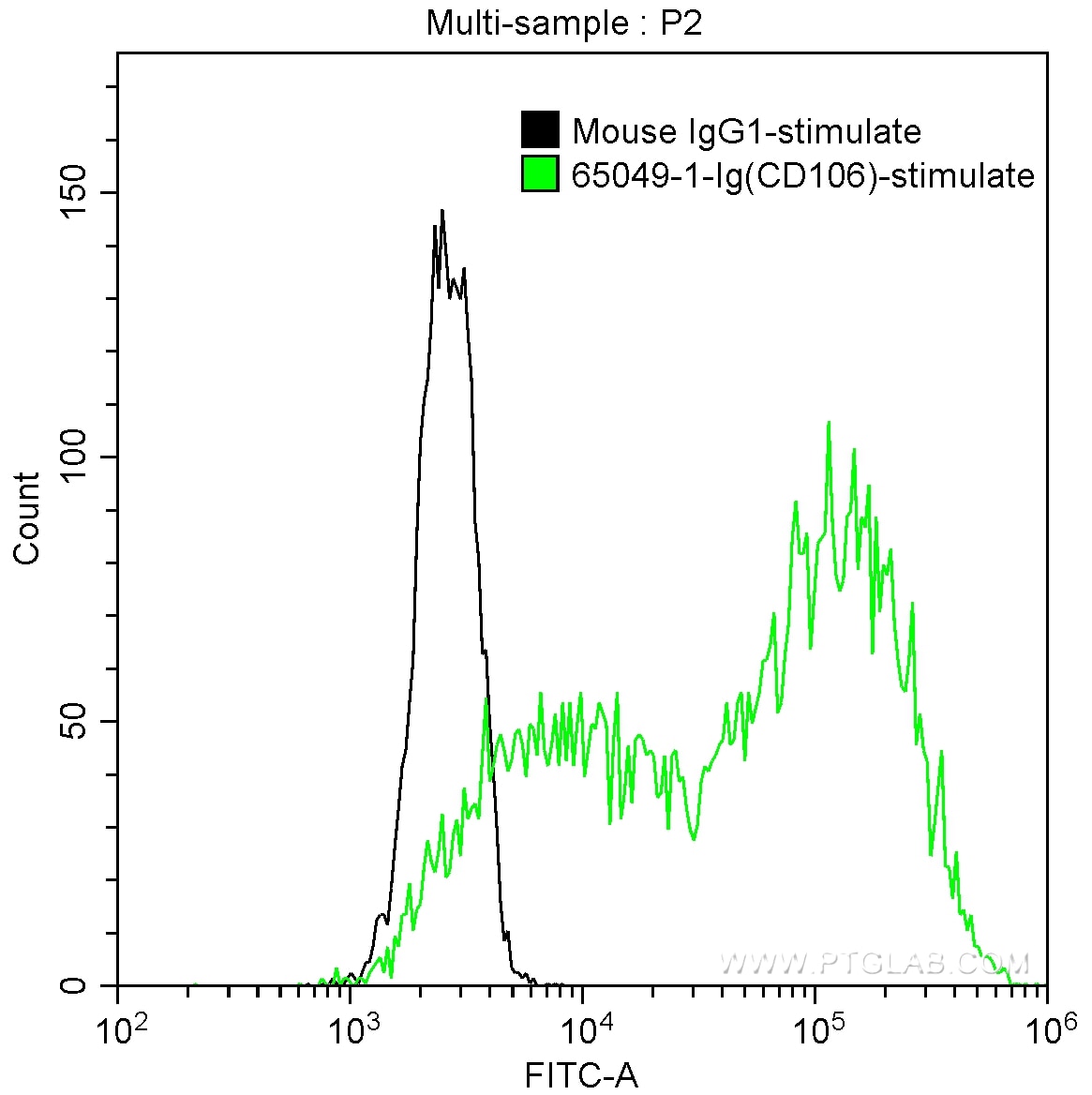
| Erfolgreiche Detektion in FC | HUVEC-Zellen |
Empfohlene Verdünnung
| Anwendung | Verdünnung |
|---|---|
| This reagent has been tested for flow cytometric analysis. It is recommended that this reagent should be titrated in each testing system to obtain optimal results. | |
| Sample-dependent, check data in validation data gallery | |
Produktinformation
65049-1-Ig bindet in FC CD106 und zeigt Reaktivität mit human
| Getestete Reaktivität | human |
| Wirt / Isotyp | Maus / IgG1, kappa |
| Klonalität | Monoklonal |
| Typ | Antikörper |
| Immunogen | k.A. |
| Vollständiger Name | vascular cell adhesion molecule 1 |
| Berechnetes Molekulargewicht | 739 aa, 81 kDa |
| GenBank-Zugangsnummer | BC017276 |
| Gene symbol | VCAM-1 |
| Gene ID (NCBI) | 7412 |
| Konjugation | Unkonjugiert |
| Form | Liquid |
| Reinigungsmethode | Affinitätsreinigung |
| Lagerungspuffer | Borate buffered saline |
| Lagerungsbedingungen | Store at 2-8°C. Stable for one year after shipment. |
Hintergrundinformationen
Vascular cell adhesion molecule 1 (VCAM1), also known as CD106, is a 110-kDa transmembrane glycoprotein belonging to the immunoglobulin gene superfamily. VCAM1 is expressed by cytokine-activated endothelium, interacts with integrin VLA4 (α4β1) present on the surface of leukocytes, and mediates both adhesion and signal transduction. It is also expressed either constitutively or inducibly in a variety of other cell types, including vascular smooth muscle cells, differentiating skeletal muscle cells, renal and neural epithelial cells, macrophages (Kupffer cells), dendritic cells, and bone marrow stromal cells (PMID: 7507076, 11359843).
Protokolle
| PRODUKTSPEZIFISCHE PROTOKOLLE | |
|---|---|
| FC protocol for CD106 antibody 65049-1-Ig | Download protocol |
| STANDARD-PROTOKOLLE | |
|---|---|
| Klicken Sie hier, um unsere Standardprotokolle anzuzeigen |

