CD158K/KIR3DL2 Polyklonaler Antikörper
CD158K/KIR3DL2 Polyklonal Antikörper für WB, ELISA
Wirt / Isotyp
Kaninchen / IgG
Getestete Reaktivität
human, Maus
Anwendung
Konjugation
Unkonjugiert
Kat-Nr. : 33010-1-AP
Synonyme
Geprüfte Anwendungen
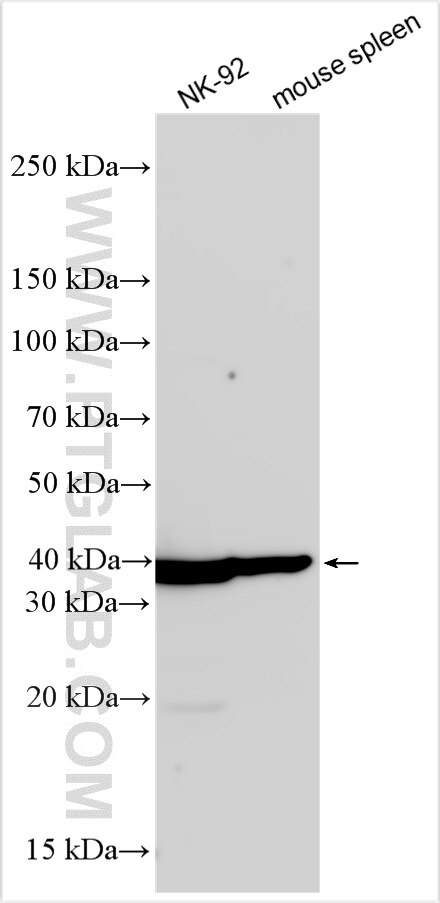
| Erfolgreiche Detektion in WB | NK-92 cells, Mausmilzgewebe |
Empfohlene Verdünnung
| Anwendung | Verdünnung |
|---|---|
| Western Blot (WB) | WB : 1:1000-1:8000 |
| It is recommended that this reagent should be titrated in each testing system to obtain optimal results. | |
| Sample-dependent, check data in validation data gallery | |
Produktinformation
33010-1-AP bindet in CD158K/KIR3DL2 und zeigt Reaktivität mit human, Maus
| Getestete Reaktivität | human, Maus |
| Wirt / Isotyp | Kaninchen / IgG |
| Klonalität | Polyklonal |
| Typ | Antikörper |
| Immunogen | CD158K/KIR3DL2 fusion protein Eg4355 |
| Vollständiger Name | killer cell immunoglobulin-like receptor, three domains, long cytoplasmic tail, 2 |
| Berechnetes Molekulargewicht | 50 kDa |
| Beobachtetes Molekulargewicht | 50-60 kda |
| GenBank-Zugangsnummer | NM_006737.4 |
| Gene symbol | KIR3DL2 |
| Gene ID (NCBI) | 3812 |
| Konjugation | Unkonjugiert |
| Form | Liquid |
| Reinigungsmethode | Antigen-Affinitätsreinigung |
| Lagerungspuffer | PBS with 0.02% sodium azide and 50% glycerol |
| Lagerungsbedingungen | Bei -20°C lagern. Nach dem Versand ein Jahr lang stabil Aliquotieren ist bei -20oC Lagerung nicht notwendig. 20ul Größen enthalten 0,1% BSA. |
Hintergrundinformationen
KIR3DL2, also known as CD158k, is an inhibitory receptor expressed by natural killer (NK) cells and a subset of CD8+ T cells. It plays a role in immune regulation by binding to HLA class I molecules, specifically HLA-A3 and HLA-A11, in a peptide-dependent fashion. KIR3DL2 can also function as an innate immune receptor for delivering CpG DNA to TLR9 in NK cells, highlighting its role in both adaptive and innate immunity. This protein is primarily expressed on the cell surface, particularly in NK cells and certain T cells. It has been implicated in various diseases, particularly in the context of hematological malignancies and autoimmune diseases. Aberrant expression of KIR3DL2 has been observed in neoplastic cells in transformed mycosis fungoides and Sézary syndrome, suggesting its potential as a therapeutic target in primary cutaneous anaplastic large-cell lymphoma (pcALCL).
Protokolle
| PRODUKTSPEZIFISCHE PROTOKOLLE | |
|---|---|
| WB protocol for CD158K/KIR3DL2 antibody 33010-1-AP | Protokoll herunterladen |
| STANDARD-PROTOKOLLE | |
|---|---|
| Klicken Sie hier, um unsere Standardprotokolle anzuzeigen |

