CD160 Rekombinanter Antikörper
CD160 Rekombinant Antikörper für FC
Wirt / Isotyp
Kaninchen / IgG
Getestete Reaktivität
human
Anwendung
FC
Konjugation
FITC Plus Fluorescent Dye
CloneNo.
241415F2
Kat-Nr. : FITC-98111
Synonyme
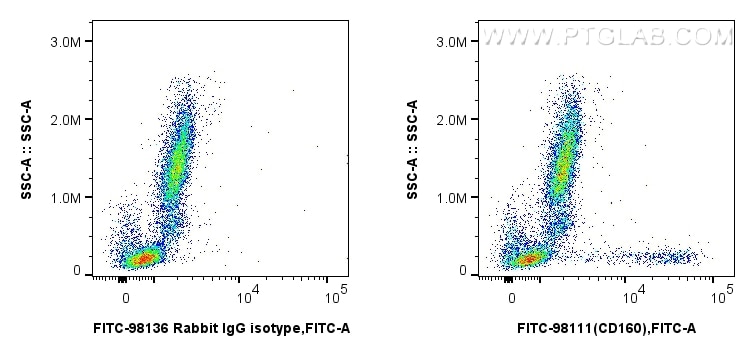
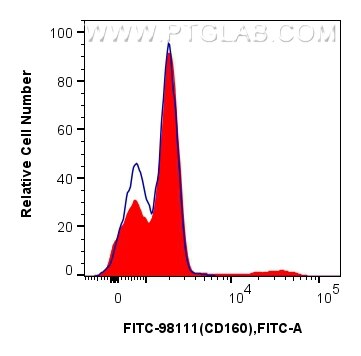
Geprüfte Anwendungen
| Erfolgreiche Detektion in FC | human peripheral blood leukocytes |
Empfohlene Verdünnung
| Anwendung | Verdünnung |
|---|---|
| This reagent has been pre-titrated and tested for flow cytometric analysis. The suggested use of this reagent is 5 ul per 10^6 cells in a 100 µl suspension or 5 ul per 100 µl of whole blood. | |
| Sample-dependent, check data in validation data gallery | |
Produktinformation
FITC-98111 bindet in FC CD160 und zeigt Reaktivität mit human
| Getestete Reaktivität | human |
| Wirt / Isotyp | Kaninchen / IgG |
| Klonalität | Rekombinant |
| Typ | Antikörper |
| Immunogen | Rekombinantes Protein |
| Vollständiger Name | CD160 molecule |
| Berechnetes Molekulargewicht | 20 kDa |
| GenBank-Zugangsnummer | BC014465 |
| Gene symbol | CD160 |
| Gene ID (NCBI) | 11126 |
| Konjugation | FITC Plus Fluorescent Dye |
| Excitation/Emission maxima wavelengths | 495 nm / 524 nm |
| Form | Liquid |
| Reinigungsmethode | Protein-A-Reinigung |
| Lagerungspuffer | PBS with 0.09% sodium azide and 0.5% BSA |
| Lagerungsbedingungen | Store at 2-8°C. Avoid exposure to light. Stable for one year after shipment. |
Hintergrundinformationen
CD160 is a glycosylphosphatidylinositol (GPI)-anchored protein that is expressed on almost all intestinal intraepithelial lymphocytes (IELs), gamma delta T cells, CD56 (dim) CD16+ cytotoxic NK cells, and a minor subset of CD4+ and CD8+ T cells (PMID: 31332204; 25179432). The binding of CD160 to both classical and non-classical MHC I enhances NK and CD8+ cytotoxic T lymphocyte functions (PMID: 25179432). CD160 is a ligand for HVEM (herpes virus entry mediator) and the binding of CD160 to HVEM inhibits T cell activity (PMID: 19426226).
Protokolle
| PRODUKTSPEZIFISCHE PROTOKOLLE | |
|---|---|
| FC protocol for FITC Plus CD160 antibody FITC-98111 | Download protocol |
| STANDARD-PROTOKOLLE | |
|---|---|
| Klicken Sie hier, um unsere Standardprotokolle anzuzeigen |

