CD40 Rekombinanter Antikörper
CD40 Rekombinant Antikörper für FC
Wirt / Isotyp
Kaninchen / IgG
Getestete Reaktivität
human
Anwendung
FC
Konjugation
Unkonjugiert
CloneNo.
241760A9
Kat-Nr. : 98191-1-RR
Synonyme
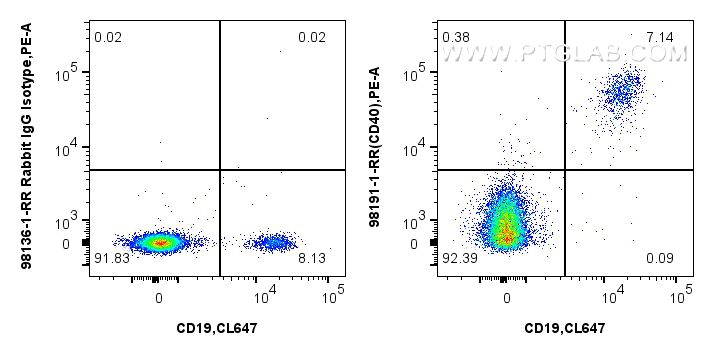
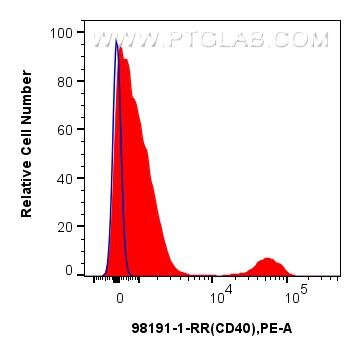
Geprüfte Anwendungen
| Erfolgreiche Detektion in FC | humane PBMCs |
Empfohlene Verdünnung
| Anwendung | Verdünnung |
|---|---|
| This reagent has been tested for flow cytometric analysis. It is recommended that this reagent should be titrated in each testing system to obtain optimal results. | |
| Sample-dependent, check data in validation data gallery | |
Produktinformation
98191-1-RR bindet in FC CD40 und zeigt Reaktivität mit human
| Getestete Reaktivität | human |
| Wirt / Isotyp | Kaninchen / IgG |
| Klonalität | Rekombinant |
| Typ | Antikörper |
| Immunogen | CD40 fusion protein Eg1797 |
| Vollständiger Name | CD40 molecule, TNF receptor superfamily member 5 |
| Berechnetes Molekulargewicht | 31kDa |
| GenBank-Zugangsnummer | NM_001250.6 |
| Gene symbol | CD40 |
| Gene ID (NCBI) | 958 |
| Konjugation | Unkonjugiert |
| Form | Liquid |
| Reinigungsmethode | Protein A purfication |
| Lagerungspuffer | PBS with 0.09% sodium azide |
| Lagerungsbedingungen | Store at 2 - 8°C. Stable for one year after shipment. |
Hintergrundinformationen
Cluster of differentiation 40 (CD40) is a costimulatory protein located on antigen presenting cells and is required for their activation. CD40 is a member of the tumor necrosis factor (TNF) receptor (TNFR) family.
What is the molecular weight of CD40?
The molecular weight of CD40 is 43 kDa.
What is the cellular localization of CD40?
CD40 can be secreted by cells or found in the cell membrane.
What is the tissue specificity of CD40?
CD40 is expressed in B cells and primary carcinoma cells but is also found in dendritic cells and macrophages (PMID: 10209159).
What is the function of CD40?
CD40 acts as a receptor for TNFSF5/CD40LG, which is expressed on activated T cells. This interaction is essential for B cell proliferation, expression of activation markers, immunoglobulin production, and isotype switching (PMID: 8809473). This interaction is also crucial for the formation of memory B cells and germinal centers, and signaling through CD40 prevents apoptosis of germinal center B cells.
What is the role of CD40 in disease?
Defects in CD40 lead to hyper-IgM immunodeficiency syndrome type 3 (HIGM3) (PMID: 11675497). This is an autosomal recessive disorder that includes the inability of B cells to undergo isotype switching, a key step in the final differentiation of the humoral immune response, and an inability to mount an antibody-specific immune response.
Protokolle
| PRODUKTSPEZIFISCHE PROTOKOLLE | |
|---|---|
| FC protocol for CD40 antibody 98191-1-RR | Download protocol |
| STANDARD-PROTOKOLLE | |
|---|---|
| Klicken Sie hier, um unsere Standardprotokolle anzuzeigen |

