CD94 Rekombinanter Antikörper
CD94 Rekombinant Antikörper für FC
Wirt / Isotyp
Kaninchen / IgG
Getestete Reaktivität
human
Anwendung
FC
Konjugation
APC Fluorescent Dye
CloneNo.
241704E11
Kat-Nr. : APC-FcA98172
Synonyme
Geprüfte Anwendungen
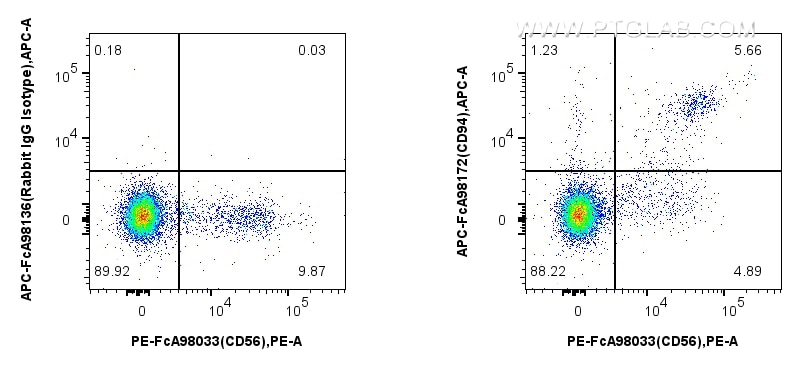
| Erfolgreiche Detektion in FC | human peripheral blood leukocytes |
Empfohlene Verdünnung
| Anwendung | Verdünnung |
|---|---|
| This reagent has been pre-titrated and tested for flow cytometric analysis. The suggested use of this reagent is 5 ul per 10^6 cells in a 100 µl suspension or 5 ul per 100 µl of whole blood. | |
| Sample-dependent, check data in validation data gallery | |
Produktinformation
APC-FcA98172 bindet in FC CD94 und zeigt Reaktivität mit human
| Getestete Reaktivität | human |
| Wirt / Isotyp | Kaninchen / IgG |
| Klonalität | Rekombinant |
| Typ | Antikörper |
| Immunogen | Rekombinantes Protein |
| Vollständiger Name | killer cell lectin-like receptor subfamily D, member 1 |
| Berechnetes Molekulargewicht | 179 aa, 20 kDa |
| GenBank-Zugangsnummer | BC028009 |
| Gene symbol | CD94 |
| Gene ID (NCBI) | 3824 |
| Konjugation | APC Fluorescent Dye |
| Excitation/Emission maxima wavelengths | 650 nm / 660 nm |
| Form | Liquid |
| Reinigungsmethode | Protein-A-Reinigung |
| Lagerungspuffer | PBS with 0.09% sodium azide and 0.5% BSA |
| Lagerungsbedingungen | Store at 2-8°C. Avoid exposure to light. Stable for one year after shipment. |
Hintergrundinformationen
CD94, also known as the killer cell lectin-like receptor (KLR) family member, is a type II integral membrane protein related to the C-type lectin superfamily. It is specifically expressed on natural killer (NK) cells and a subset of T cells, and plays a crucial role in stimulating NK cell cytolysis and the release of tumor necrosis factor. CD94 can form heterodimers with different NKG2 proteins (e.g., NKG2A, NKG2C, NKG2E, or NKG2F) to balance the function of NK cells and CD8+ T cells.
Protokolle
| PRODUKTSPEZIFISCHE PROTOKOLLE | |
|---|---|
| FC protocol for APC CD94 antibody APC-FcA98172 | Download protocol |
| STANDARD-PROTOKOLLE | |
|---|---|
| Klicken Sie hier, um unsere Standardprotokolle anzuzeigen |

