- Featured Product
- KD/KO Validated
CNOT6 Polyklonaler Antikörper
CNOT6 Polyklonal Antikörper für WB, Indirect ELISA
Wirt / Isotyp
Kaninchen / IgG
Getestete Reaktivität
human
Anwendung
WB, Indirect ELISA
Konjugation
Unkonjugiert
Kat-Nr. : 17935-1-PBS
Synonyme
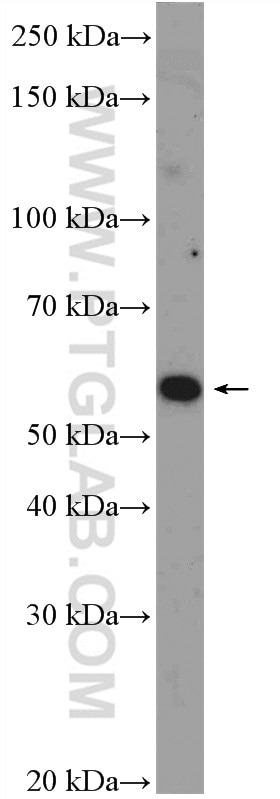
Geprüfte Anwendungen
Produktinformation
17935-1-PBS bindet in WB, Indirect ELISA CNOT6 und zeigt Reaktivität mit human
| Getestete Reaktivität | human |
| Wirt / Isotyp | Kaninchen / IgG |
| Klonalität | Polyklonal |
| Typ | Antikörper |
| Immunogen | CNOT6 fusion protein Ag11506 |
| Vollständiger Name | CCR4-NOT transcription complex, subunit 6 |
| Berechnetes Molekulargewicht | 557 aa, 63.3 kDa |
| Beobachtetes Molekulargewicht | 63 kDa |
| GenBank-Zugangsnummer | BC027476 |
| Gene symbol | CNOT6 |
| Gene ID (NCBI) | 57472 |
| Konjugation | Unkonjugiert |
| Form | Liquid |
| Reinigungsmethode | Antigen-Affinitätsreinigung |
| Lagerungspuffer | PBS only |
| Lagerungsbedingungen | Store at -80°C. 20ul Größen enthalten 0,1% BSA. |
Hintergrundinformationen
The evolutionarily conserved CCR4-NOT (CNOT) complex regulates mRNA metabolism in eukaryotic cells. This regulation occurs at different levels of mRNA synthesis and degradation, including transcription initiation, elongation, deadenylation, and degradation (PMID: 12882519). Multiple components, including CNOT1, CNOT2, CNOT3, CNOT4, CNOT6, CNOT6L, CNOT7, CNOT8, CNOT9, and CNOT10 have been identified in this complex (PMID: 19558367). In addition, the subunit composition of this complex has been shown to vary among different tissues (PMID: 21741365). The various CNOT proteins display different functions, with CNOT6, CNOT6L, CNOT7, and CNOT8 exhibiting 3'-5' RNAse activity (PMID: 11889047). Research studies indicate that the CCR4-NOT deadenylase subunits CNOT6 and CNOT6L help mediate cell survival and play a role in cell proliferation, P-body formation, and regulation of gene expression (PMID: 21233283). Additional research evidence suggests that CNOT6 can act as a nuclear hormone receptor coactivator that associates with ZNF335 (NIF-1) to regulate expression from specific RARα regulated genes (PMID: 18180299).


