CRYZ Polyklonaler Antikörper
CRYZ Polyklonal Antikörper für WB, Indirect ELISA
Wirt / Isotyp
Kaninchen / IgG
Getestete Reaktivität
human, Maus
Anwendung
WB, Indirect ELISA
Konjugation
Unkonjugiert
Kat-Nr. : 31629-1-PBS
Synonyme
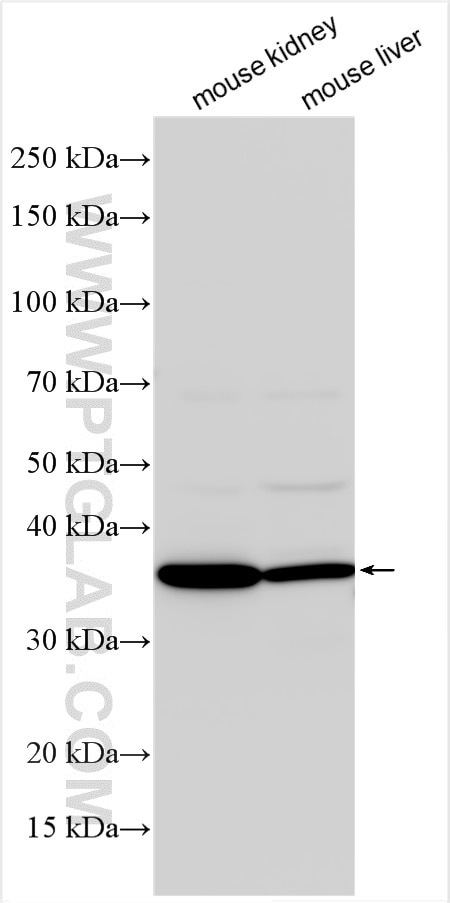
Geprüfte Anwendungen
Produktinformation
31629-1-PBS bindet in WB, Indirect ELISA CRYZ und zeigt Reaktivität mit human, Maus
| Getestete Reaktivität | human, Maus |
| Wirt / Isotyp | Kaninchen / IgG |
| Klonalität | Polyklonal |
| Typ | Antikörper |
| Immunogen | CRYZ fusion protein Ag35066 |
| Vollständiger Name | crystallin, zeta (quinone reductase) |
| Berechnetes Molekulargewicht | 35 kDa |
| Beobachtetes Molekulargewicht | 35 kDa |
| GenBank-Zugangsnummer | BC039578 |
| Gene symbol | CRYZ |
| Gene ID (NCBI) | 1429 |
| Konjugation | Unkonjugiert |
| Form | Liquid |
| Reinigungsmethode | Antigen-Affinitätsreinigung |
| Lagerungspuffer | PBS only |
| Lagerungsbedingungen | Store at -80°C. 20ul Größen enthalten 0,1% BSA. |
Hintergrundinformationen
CRYZ (Zeta-crystallin) also called quinone oxidoreductase and NADPH:quinone reductase, and it does not have alcohol dehydrogenase activity. It binds NADP and acts through a one-electron transfer process. Orthoquinones, such as 1,2-naphthoquinone or 9,10-phenanthrenequinone, are the best substrates (in vitro) for CRYZ. It may act in the detoxification of xenobiotics. CRYZ interacts with (AU)-rich elements (ARE) in the 3'-UTR of target mRNA species and enhances the stability of mRNA coding for BCL2. NADPH binding interferes with mRNA binding (PMID: 17497241; 20103721).


