CTLA-4/CD152 Rekombinanter Antikörper
CTLA-4/CD152 Rekombinant Antikörper für FC
Wirt / Isotyp
Kaninchen / IgG
Getestete Reaktivität
Maus
Anwendung
FC
Konjugation
PE Fluorescent Dye
CloneNo.
241100B8
Kat-Nr. : PE-FcA98147
Synonyme
Filter:
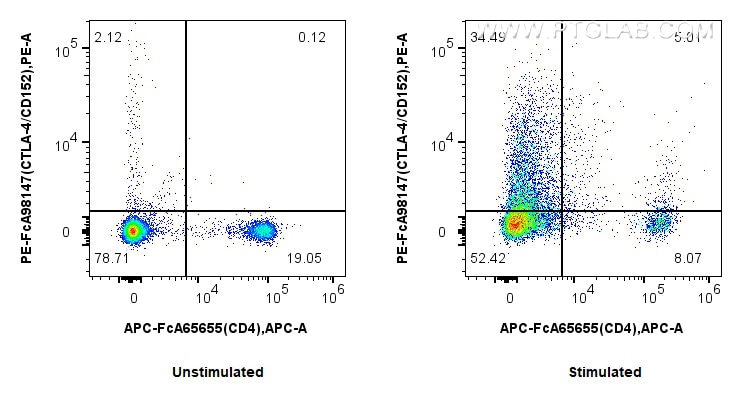
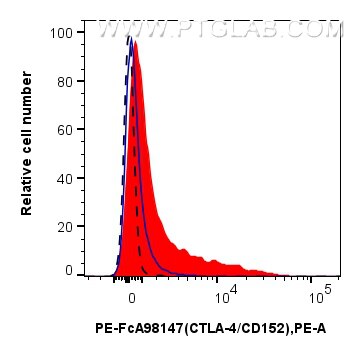
Geprüfte Anwendungen
| Erfolgreiche Detektion in FC | Con A treated mouse splenocytes |
Empfohlene Verdünnung
| Anwendung | Verdünnung |
|---|---|
| This reagent has been tested for flow cytometric analysis. It is recommended that this reagent should be titrated in each testing system to obtain optimal results. | |
| Sample-dependent, check data in validation data gallery | |
Produktinformation
PE-FcA98147 bindet in FC CTLA-4/CD152 und zeigt Reaktivität mit Maus
| Getestete Reaktivität | Maus |
| Wirt / Isotyp | Kaninchen / IgG |
| Klonalität | Rekombinant |
| Typ | Antikörper |
| Immunogen | CTLA-4/CD152 fusion protein Eg0632 |
| Vollständiger Name | cytotoxic T-lymphocyte-associated protein 4 |
| Berechnetes Molekulargewicht | 25 kDa |
| GenBank-Zugangsnummer | NM_009843.4 |
| Gene symbol | CTLA-4 |
| Gene ID (NCBI) | 12477 |
| Konjugation | PE Fluorescent Dye |
| Excitation/Emission maxima wavelengths | 496 nm, 565 nm / 578 nm |
| Form | Liquid |
| Reinigungsmethode | Protein-A-Reinigung |
| Lagerungspuffer | PBS with 0.09% sodium azide and 0.5% BSA |
| Lagerungsbedingungen | Store at 2-8°C. Avoid exposure to light. Stable for one year after shipment. |
Hintergrundinformationen
CTLA-4, also known as CD152, belonging to the immunoglobulin superfamily, is primarily found on activated T cells and regulatory T cells (Tregs). CTLA-4 is closely related to the T-cell costimulatory CD28, and both molecules bind to B7-1 and B7-2 on antigen-presenting cells. CTLA-4 acts as a negative regulatory molecule of T-cell responses. Besides the full-length transmembrane form, CTLA-4 also exists in a truncated soluble form (sCTLA-4).
Protokolle
| PRODUKTSPEZIFISCHE PROTOKOLLE | |
|---|---|
| FC protocol for PE CTLA-4/CD152 antibody PE-FcA98147 | Download protocol |
| STANDARD-PROTOKOLLE | |
|---|---|
| Klicken Sie hier, um unsere Standardprotokolle anzuzeigen |

