DHH Polyklonaler Antikörper
DHH Polyklonal Antikörper für WB, Indirect ELISA
Wirt / Isotyp
Kaninchen / IgG
Getestete Reaktivität
human, Maus, Ratte
Anwendung
WB, Indirect ELISA
Konjugation
Unkonjugiert
Kat-Nr. : 13889-1-PBS
Synonyme
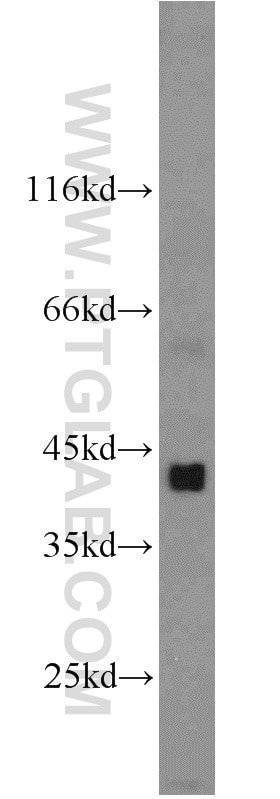
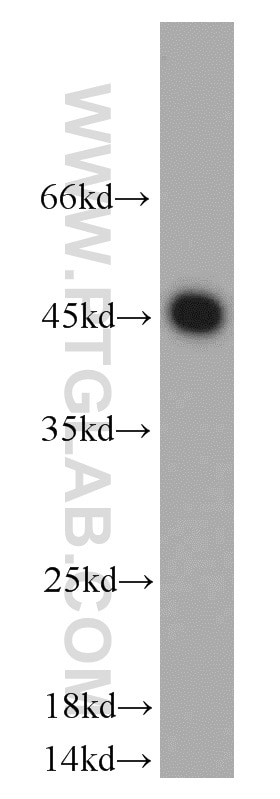
Geprüfte Anwendungen
Produktinformation
13889-1-PBS bindet in WB, Indirect ELISA DHH und zeigt Reaktivität mit human, Maus, Ratten
| Getestete Reaktivität | human, Maus, Ratte |
| Wirt / Isotyp | Kaninchen / IgG |
| Klonalität | Polyklonal |
| Typ | Antikörper |
| Immunogen | DHH fusion protein Ag4850 |
| Vollständiger Name | desert hedgehog homolog (Drosophila) |
| Berechnetes Molekulargewicht | 396 aa, 44 kDa |
| Beobachtetes Molekulargewicht | 42 kDa |
| GenBank-Zugangsnummer | BC033507 |
| Gene symbol | DHH |
| Gene ID (NCBI) | 50846 |
| Konjugation | Unkonjugiert |
| Form | Liquid |
| Reinigungsmethode | Antigen-Affinitätsreinigung |
| Lagerungspuffer | PBS only |
| Lagerungsbedingungen | Store at -80°C. 20ul Größen enthalten 0,1% BSA. |
Hintergrundinformationen
Desert hedgehog (DHH) is one of three ligands in the hedgehog signaling pathway that controls gonad
morphogenesis and nerve perineurium differentiation.
What is the molecular weight of DHH? Is DHH post-translationally modified?
DHH protein is synthesized in a precursor form of ~45 kDa. Hedgehog proteins contain a small N-terminal signal
peptide, which is cleaved off intracellularly, leading to 39 kDa species. Hedgehog proteins are then subject to
autoproteolysis, which leads to the generation of a 19 kDa N-terminal fragment with added cholesterol moiety
and a 25 kDa C-terminal fragment (PMID: 7985023). The C-terminal fragment catalyzes the precursor proteolysis,
while the N-terminal fragment gets secreted from cells and acts as an active ligand in the hedgehog signaling
pathway.
What is the subcellular localization of DHH?
DHH protein is subject to autoproteolysis, as described above, and the N-terminal fragment is secreted from
cells in a regulated manner. The amounts of extracellular hedgehog proteins determine local and long-range
signaling (PMID: 7736596 and 7885476).
What is the tissue expression pattern of DHH?
Unlike other hedgehog ligands, expression of DHH is very tissue-specific. DHH is strongly expressed in Steroli
cell precursors, adult sterol cells, and in Leydig cells in testis (PMID: 8805249, 12050120) but also in granulosa
cells in ovaries (PMID: 15878962), as well as in Schwann cells-glia of the peripheral nervous system
(PMID: 7589793).
What is the role of DHH in morphogenesis?
DHH plays a role in the correct development of male gonads and perineurium. Loss of DHH leads to peripheral
neuropathy and gonadal dysgenesis (PMID: 11017805).


