Di/Tri-Methyl-Histone H3 (Lys36) Rekombinanter Antikörper
Di/Tri-Methyl-Histone H3 (Lys36) Rekombinant Antikörper für IF/ICC
Wirt / Isotyp
Kaninchen / IgG
Getestete Reaktivität
human
Anwendung
IF/ICC
Konjugation
CoraLite® Plus 488 Fluorescent Dye
CloneNo.
241139G6
Kat-Nr. : CL488-84329
Synonyme
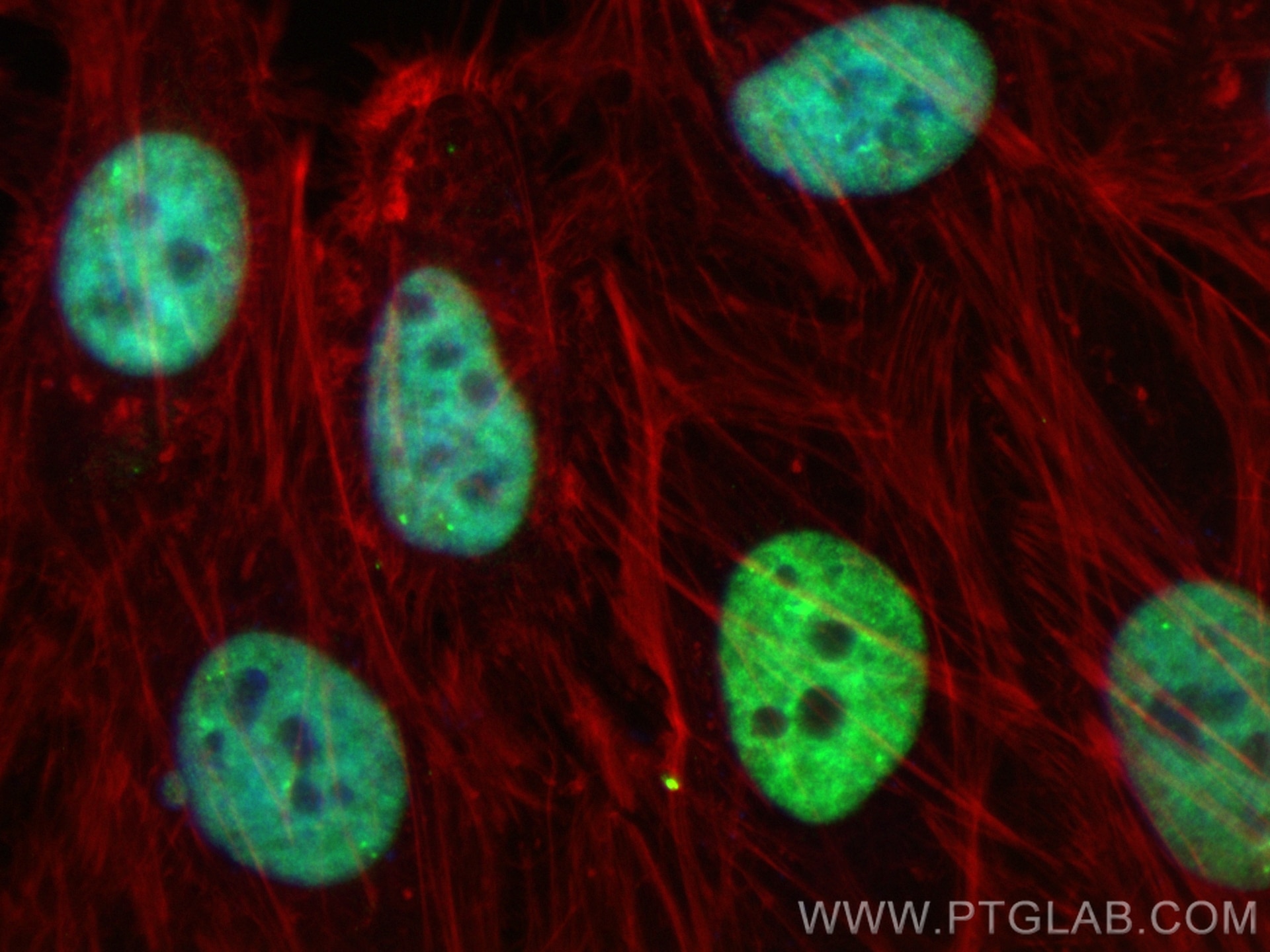
Geprüfte Anwendungen
| Erfolgreiche Detektion in IF/ICC | HeLa-Zellen |
Empfohlene Verdünnung
| Anwendung | Verdünnung |
|---|---|
| Immunfluoreszenz (IF)/ICC | IF/ICC : 1:50-1:500 |
| It is recommended that this reagent should be titrated in each testing system to obtain optimal results. | |
| Sample-dependent, check data in validation data gallery | |
Produktinformation
CL488-84329 bindet in IF/ICC Di/Tri-Methyl-Histone H3 (Lys36) und zeigt Reaktivität mit human
| Getestete Reaktivität | human |
| Wirt / Isotyp | Kaninchen / IgG |
| Klonalität | Rekombinant |
| Typ | Antikörper |
| Immunogen | Peptid |
| Vollständiger Name | histone cluster 1, H3a |
| Beobachtetes Molekulargewicht | 15 kDa |
| GenBank-Zugangsnummer | BC066245 |
| Gene symbol | HIST1H3A |
| Gene ID (NCBI) | 8350 |
| Konjugation | CoraLite® Plus 488 Fluorescent Dye |
| Excitation/Emission maxima wavelengths | 493 nm / 522 nm |
| Form | Liquid |
| Reinigungsmethode | Protein-A-Reinigung |
| Lagerungspuffer | PBS with 50% glycerol, 0.05% Proclin300, 0.5% BSA |
| Lagerungsbedingungen | Bei -20°C lagern. Vor Licht schützen. Nach dem Versand ein Jahr stabil. Aliquotieren ist bei -20oC Lagerung nicht notwendig. 20ul Größen enthalten 0,1% BSA. |
Hintergrundinformationen
Histones are small, highly basic proteins that consist of a globular domain with unstructured N- and C-terminal tails protruding from the main structure. Histone H3 is one of the five main histones that are responsible for the nucleosome structure of the chromosomal fiber in eukaryotes. Two molecules of each of the four core histones (H2A, H2B, H3, and H4) form an octamer, around which approximately 146 bp of DNA is wrapped in repeating units, called nucleosomes. In addition to their role in DNA compartmentalization, histones also play crucial roles in various biologic processes, including gene expression and regulation, DNA repair, chromatin condensation, cell cycle progression, chromosome segregation, and apoptosis. The ability of histones to regulate chromatin dynamics primarily originates from various posttranslational modifications carried out by histone-modifying enzymes.
Protokolle
| PRODUKTSPEZIFISCHE PROTOKOLLE | |
|---|---|
| IF protocol for CL Plus 488 Di/Tri-Methyl-Histone H3 (Lys36) antibody CL488-84329 | Protokoll herunterladen |
| STANDARD-PROTOKOLLE | |
|---|---|
| Klicken Sie hier, um unsere Standardprotokolle anzuzeigen |

