ERCC8 Polyklonaler Antikörper
ERCC8 Polyklonal Antikörper für WB, Indirect ELISA
Wirt / Isotyp
Kaninchen / IgG
Getestete Reaktivität
human, Maus
Anwendung
WB, Indirect ELISA
Konjugation
Unkonjugiert
Kat-Nr. : 15921-1-PBS
Synonyme
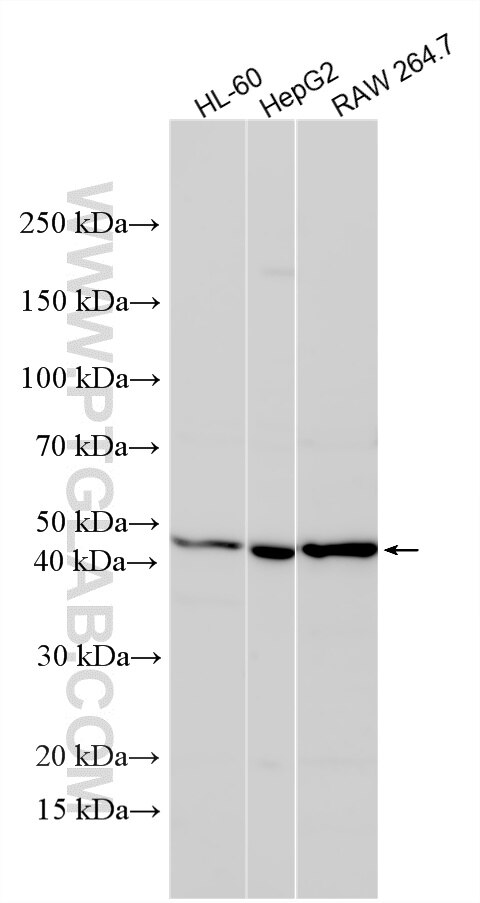
Geprüfte Anwendungen
Produktinformation
15921-1-PBS bindet in WB, Indirect ELISA ERCC8 und zeigt Reaktivität mit human, Maus
| Getestete Reaktivität | human, Maus |
| Wirt / Isotyp | Kaninchen / IgG |
| Klonalität | Polyklonal |
| Typ | Antikörper |
| Immunogen | ERCC8 fusion protein Ag8734 |
| Vollständiger Name | excision repair cross-complementing rodent repair deficiency, complementation group 8 |
| Berechnetes Molekulargewicht | 396 aa, 44 kDa |
| Beobachtetes Molekulargewicht | 42 kDa |
| GenBank-Zugangsnummer | BC009793 |
| Gene symbol | ERCC8 |
| Gene ID (NCBI) | 1161 |
| Konjugation | Unkonjugiert |
| Form | Liquid |
| Reinigungsmethode | Antigen-Affinitätsreinigung |
| Lagerungspuffer | PBS only |
| Lagerungsbedingungen | Store at -80°C. 20ul Größen enthalten 0,1% BSA. |
Hintergrundinformationen
ERCC8 (also known as Cockayne Syndrome A protein, CSA) is a critical nuclear protein that serves as a specific adapter component of the CRL4ᴱᴿᶜᶜ⁸ ubiquitin ligase complex. Its primary function is to play a central role in the transcription-coupled nucleotide excision repair pathway, specifically recognizing and repairing the template strands of actively transcribed genes damaged by factors such as ultraviolet radiation. Mutations in the ERCC8 gene cause Cockayne syndrome, an autosomal recessive disorder characterized by severe photosensitivity, premature aging, neurodevelopmental abnormalities, and sensorineural hearing loss. This demonstrates that ERCC8 is essential for maintaining transcriptional fidelity, neuronal survival, and combating oxidative stress. Therefore, ERCC8 is not only a key factor in DNA repair but also an important molecule for studying mechanisms of premature aging and neurobiology.


