FANCF Polyklonaler Antikörper
FANCF Polyklonal Antikörper für IP, ELISA
Wirt / Isotyp
Kaninchen / IgG
Getestete Reaktivität
human
Anwendung
IP, ELISA
Konjugation
Unkonjugiert
Kat-Nr. : 18060-1-AP
Synonyme
Filter:
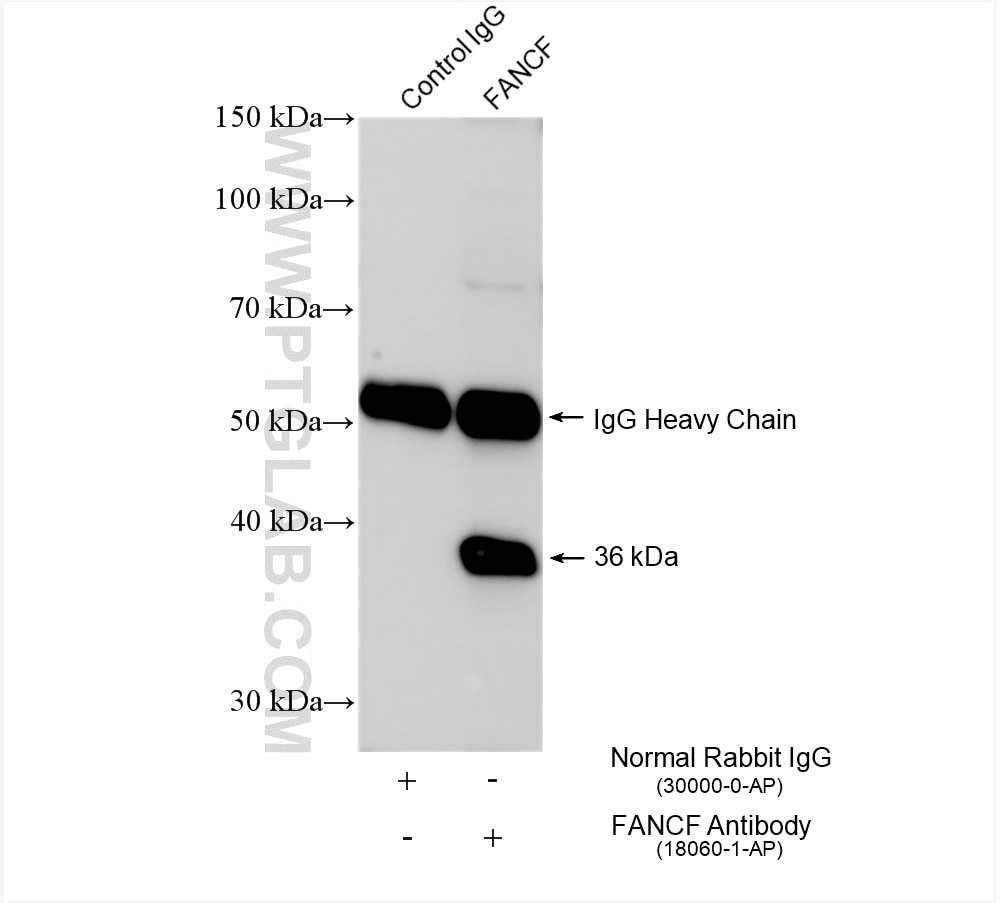
Geprüfte Anwendungen
| Erfolgreiche IP | HeLa-Zellen |
Empfohlene Verdünnung
| Anwendung | Verdünnung |
|---|---|
| Immunpräzipitation (IP) | IP : 0.5-4.0 ug for 1.0-3.0 mg of total protein lysate |
| It is recommended that this reagent should be titrated in each testing system to obtain optimal results. | |
| Sample-dependent, check data in validation data gallery | |
Produktinformation
18060-1-AP bindet in IP, ELISA FANCF und zeigt Reaktivität mit human
| Getestete Reaktivität | human |
| Wirt / Isotyp | Kaninchen / IgG |
| Klonalität | Polyklonal |
| Typ | Antikörper |
| Immunogen | FANCF fusion protein Ag12649 |
| Vollständiger Name | Fanconi anemia, complementation group F |
| Berechnetes Molekulargewicht | 374 aa, 42 kDa |
| Beobachtetes Molekulargewicht | 36 kDa |
| GenBank-Zugangsnummer | BC093867 |
| Gene symbol | FANCF |
| Gene ID (NCBI) | 2188 |
| Konjugation | Unkonjugiert |
| Form | Liquid |
| Reinigungsmethode | Antigen-Affinitätsreinigung |
| Lagerungspuffer | PBS with 0.02% sodium azide and 50% glycerol |
| Lagerungsbedingungen | Bei -20°C lagern. Nach dem Versand ein Jahr lang stabil Aliquotieren ist bei -20oC Lagerung nicht notwendig. 20ul Größen enthalten 0,1% BSA. |
Hintergrundinformationen
The Fanconi anemia complement group F (FANCF) is located on chromosome 11p15, a region enriched in cancer-associated genes. FANCF is known to be involved in DNA repair, and the overexpression of FANCF protein leads to cell proliferation and ultimately to cancer. The epigenetic silencing of FANCF has been reported in several different tumors such as ovaries, bladder, cervical, leukemic, testicular, lung, and oral tumors (PMID: 21915857, 32915143).
Protokolle
| PRODUKTSPEZIFISCHE PROTOKOLLE | |
|---|---|
| IP protocol for FANCF antibody 18060-1-AP | Protokoll herunterladen |
| STANDARD-PROTOKOLLE | |
|---|---|
| Klicken Sie hier, um unsere Standardprotokolle anzuzeigen |

