FBXL6 Polyklonaler Antikörper
FBXL6 Polyklonal Antikörper für WB, ELISA
Wirt / Isotyp
Kaninchen / IgG
Getestete Reaktivität
human
Anwendung
WB, ELISA
Konjugation
Unkonjugiert
Kat-Nr. : 33265-1-AP
Synonyme
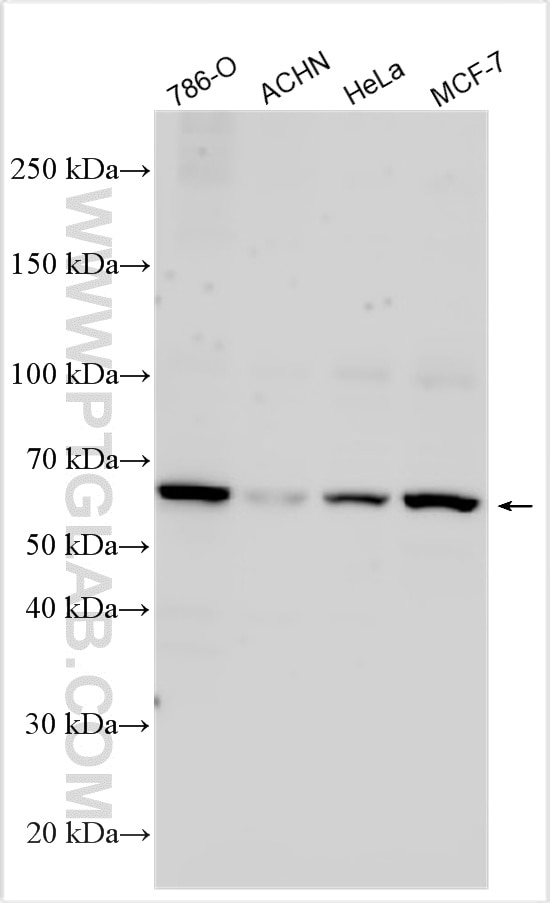
Geprüfte Anwendungen
| Erfolgreiche Detektion in WB | 786-O cells, HeLa-Zellen, MCF-7-Zellen |
Empfohlene Verdünnung
| Anwendung | Verdünnung |
|---|---|
| Western Blot (WB) | WB : 1:500-1:2000 |
| It is recommended that this reagent should be titrated in each testing system to obtain optimal results. | |
| Sample-dependent, check data in validation data gallery | |
Produktinformation
33265-1-AP bindet in WB, ELISA FBXL6 und zeigt Reaktivität mit human
| Getestete Reaktivität | human |
| Wirt / Isotyp | Kaninchen / IgG |
| Klonalität | Polyklonal |
| Typ | Antikörper |
| Immunogen | FBXL6 fusion protein Ag36604 |
| Vollständiger Name | F-box and leucine-rich repeat protein 6 |
| Berechnetes Molekulargewicht | 59kDa,539aa |
| Beobachtetes Molekulargewicht | 60 kDa |
| GenBank-Zugangsnummer | NM_012162.3 |
| Gene symbol | FBXL6 |
| Gene ID (NCBI) | 26233 |
| Konjugation | Unkonjugiert |
| Form | Liquid |
| Reinigungsmethode | Antigen-Affinitätsreinigung |
| Lagerungspuffer | PBS with 0.02% sodium azide and 50% glycerol |
| Lagerungsbedingungen | Bei -20°C lagern. Nach dem Versand ein Jahr lang stabil Aliquotieren ist bei -20oC Lagerung nicht notwendig. 20ul Größen enthalten 0,1% BSA. |
Hintergrundinformationen
FBXL6 is an F-box/LRR-type E3 ubiquitin ligase that serves as the substrate-recognition subunit of the SCF complex. It stabilizes HSP90AA1 via K63-linked ubiquitination to activate c-MYC and drive hepatocellular carcinoma progression, while also degrading defective mitochondrial ribosomal proteins to preserve mitochondrial proteostasis. Its overexpression correlates with poor prognosis in renal and colorectal cancers and can promote cell proliferation by down-regulating RPL11 to activate the MDM2-p53 axis.
Protokolle
| PRODUKTSPEZIFISCHE PROTOKOLLE | |
|---|---|
| WB protocol for FBXL6 antibody 33265-1-AP | Protokoll herunterladen |
| STANDARD-PROTOKOLLE | |
|---|---|
| Klicken Sie hier, um unsere Standardprotokolle anzuzeigen |

