GFOD1 Polyklonaler Antikörper
GFOD1 Polyklonal Antikörper für WB, ELISA
Wirt / Isotyp
Kaninchen / IgG
Getestete Reaktivität
human, Maus
Anwendung
WB, ELISA
Konjugation
Unkonjugiert
Kat-Nr. : 32902-1-AP
Synonyme
Geprüfte Anwendungen
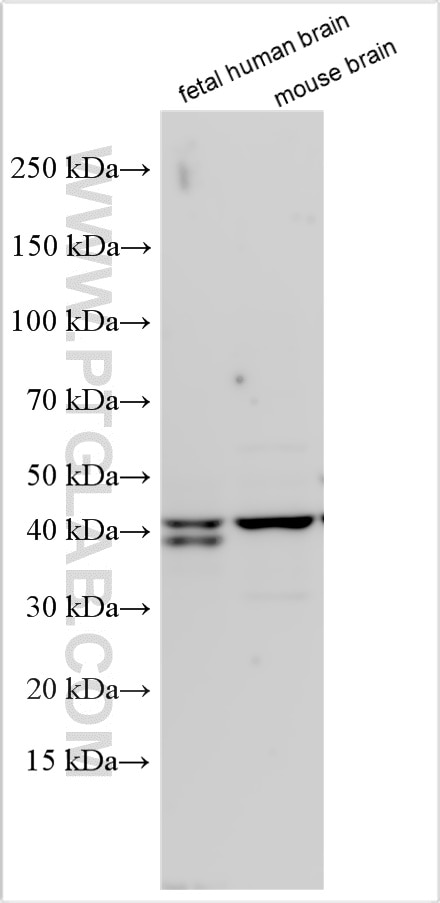
| Erfolgreiche Detektion in WB | fetales humanes Hirngewebe, Maushirngewebe |
Empfohlene Verdünnung
| Anwendung | Verdünnung |
|---|---|
| Western Blot (WB) | WB : 1:500-1:2000 |
| It is recommended that this reagent should be titrated in each testing system to obtain optimal results. | |
| Sample-dependent, check data in validation data gallery | |
Produktinformation
32902-1-AP bindet in WB, ELISA GFOD1 und zeigt Reaktivität mit human, Maus
| Getestete Reaktivität | human, Maus |
| Wirt / Isotyp | Kaninchen / IgG |
| Klonalität | Polyklonal |
| Typ | Antikörper |
| Immunogen | GFOD1 fusion protein Ag37656 |
| Vollständiger Name | glucose-fructose oxidoreductase domain containing 1 |
| Berechnetes Molekulargewicht | 390 aa, 43 kDa |
| Beobachtetes Molekulargewicht | 43 kDa |
| GenBank-Zugangsnummer | BC119005 |
| Gene symbol | GFOD1 |
| Gene ID (NCBI) | 54438 |
| Konjugation | Unkonjugiert |
| Form | Liquid |
| Reinigungsmethode | Antigen-Affinitätsreinigung |
| Lagerungspuffer | PBS with 0.02% sodium azide and 50% glycerol |
| Lagerungsbedingungen | Bei -20°C lagern. Nach dem Versand ein Jahr lang stabil Aliquotieren ist bei -20oC Lagerung nicht notwendig. 20ul Größen enthalten 0,1% BSA. |
Hintergrundinformationen
Glucose-fructose oxidoreductase domain 1 (GFOD1), may be linked to the development of ADHD. It plays a role in regulating oxidative stress in ADHD. GFOD1 may contribute to increased levels of oxidative stress specifically in the prefrontal cortex and cerebellar cortex regions and astrocytes affected by ADHD via up-regulation of the NF-κB p65/NOX2/oxidative stress axis (PMID: 40210145). There is a signal peptide at the N-terminal of this protein and the detected double strand in fetal human brain tissue is consistent with PMID: 38946427.
Protokolle
| PRODUKTSPEZIFISCHE PROTOKOLLE | |
|---|---|
| WB protocol for GFOD1 antibody 32902-1-AP | Protokoll herunterladen |
| STANDARD-PROTOKOLLE | |
|---|---|
| Klicken Sie hier, um unsere Standardprotokolle anzuzeigen |

