Glypican 3 Polyklonaler Antikörper
Glypican 3 Polyklonal Antikörper für WB, IHC, ELISA
Wirt / Isotyp
Kaninchen / IgG
Getestete Reaktivität
human, Maus
Anwendung
WB, IHC, ELISA
Konjugation
Unkonjugiert
Kat-Nr. : 30021-1-AP
Synonyme
Geprüfte Anwendungen
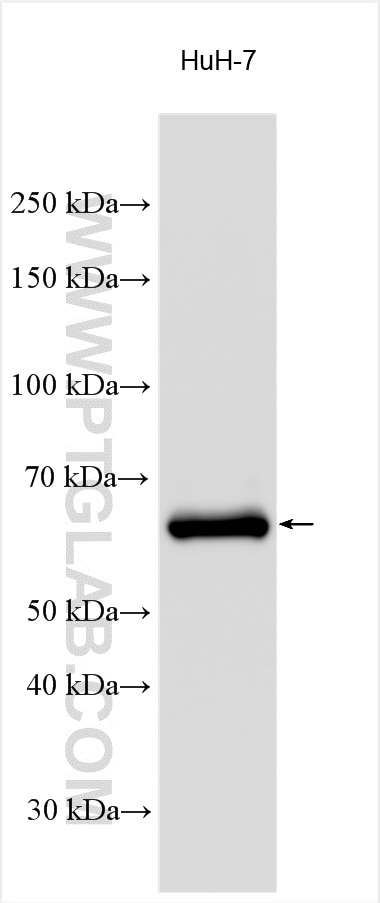
| Erfolgreiche Detektion in WB | HuH-7-Zellen |
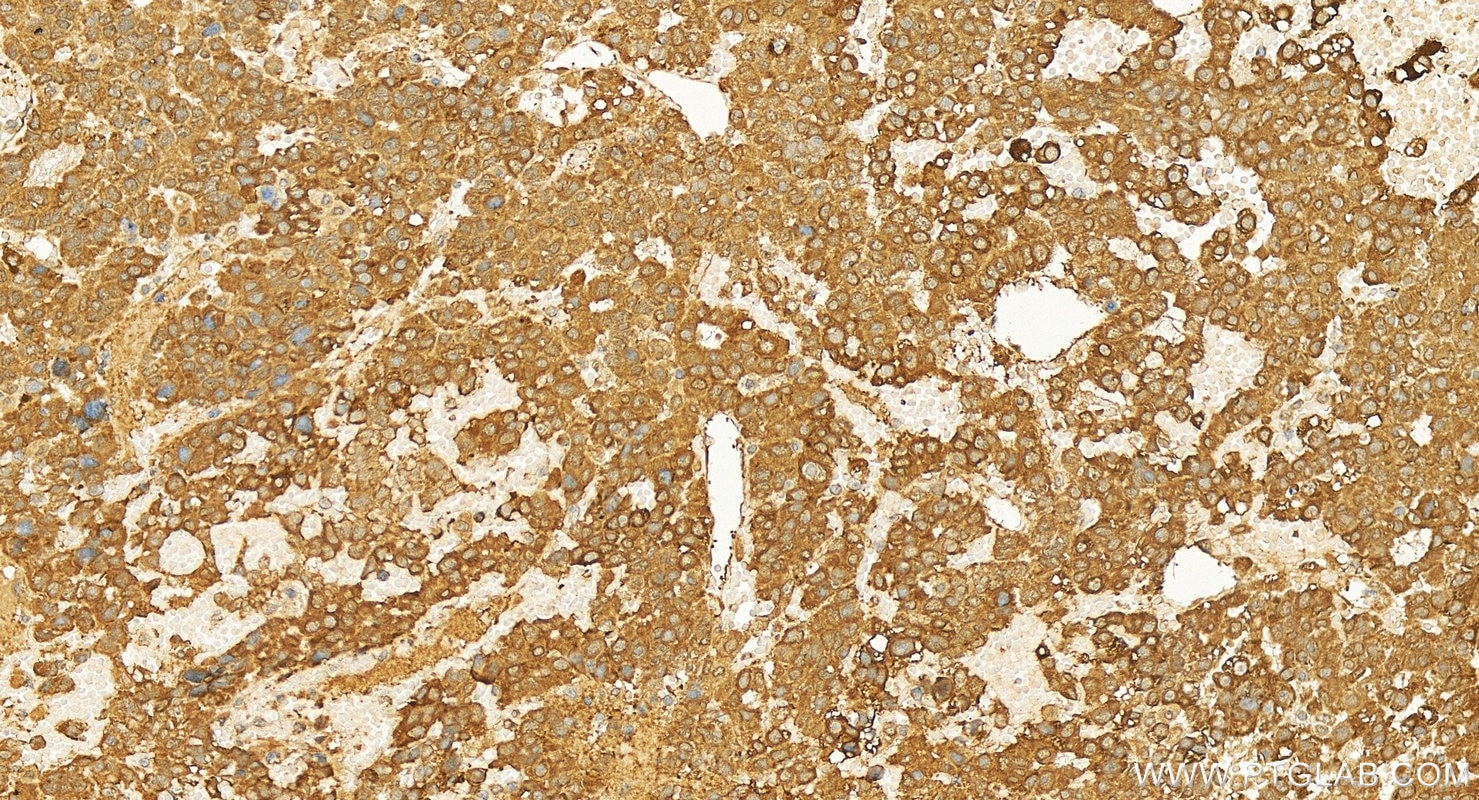
| Erfolgreiche Detektion in IHC | human hepatocellular carcinoma Hinweis: Antigendemaskierung mit TE-Puffer pH 9,0 empfohlen. (*) Wahlweise kann die Antigendemaskierung auch mit Citratpuffer pH 6,0 erfolgen. |
Empfohlene Verdünnung
| Anwendung | Verdünnung |
|---|---|
| Western Blot (WB) | WB : 1:1000-1:8000 |
| Immunhistochemie (IHC) | IHC : 1:50-1:500 |
| It is recommended that this reagent should be titrated in each testing system to obtain optimal results. | |
| Sample-dependent, check data in validation data gallery | |
Veröffentlichte Anwendungen
| WB | See 1 publications below |
| IHC | See 1 publications below |
Produktinformation
30021-1-AP bindet in WB, IHC, ELISA Glypican 3 und zeigt Reaktivität mit human, Maus
| Getestete Reaktivität | human, Maus |
| In Publikationen genannte Reaktivität | Maus |
| Wirt / Isotyp | Kaninchen / IgG |
| Klonalität | Polyklonal |
| Typ | Antikörper |
| Immunogen | Glypican 3 fusion protein Ag32559 |
| Vollständiger Name | glypican 3 |
| Berechnetes Molekulargewicht | 580 aa, 66 kDa |
| Beobachtetes Molekulargewicht | 66 kDa |
| GenBank-Zugangsnummer | BC035972 |
| Gene symbol | GPC3 |
| Gene ID (NCBI) | 2719 |
| Konjugation | Unkonjugiert |
| Form | Liquid |
| Reinigungsmethode | Antigen-Affinitätsreinigung |
| Lagerungspuffer | PBS with 0.02% sodium azide and 50% glycerol |
| Lagerungsbedingungen | Bei -20°C lagern. Nach dem Versand ein Jahr lang stabil Aliquotieren ist bei -20oC Lagerung nicht notwendig. 20ul Größen enthalten 0,1% BSA. |
Hintergrundinformationen
Glypicans (GPCs) are a family of glycosylphosphatidylinositol (GPI)-anchored heparan sulfate proteoglycans (HSPGs) that may play a role in the control of cell division and growth regulation. In mammals, there are six GPCs (GPC1 to GPC6), all of which have a similar core-protein size of approx. 60 kDa and the clustering of glycosaminoglycan attachment site near the C-terminus. They are tethered to the cell surface by GPI linkages, which can be cleaved by endogenous phospholipases, thus releasing the protein. Glypican 3 (GPC3) is highly expressed in many tissues during development and plays an important role in the regulation of embryonic growth (PMID: 22467855). Loss-of-function mutations of GPC3 result in the Simpson-Golabi-Behmel overgrowth syndrome (SGBS), and Gpc-3 null mice display developmental overgrowth (PMID: 8589713; 18477453). In hepatocellular carcinoma (HCC), the overexpression of glypican 3 has been demonstrated to be a reliable diagnostic indicator (PMID: 19212669; 22706665). The calculated molecular weight of native glypican 3 is 66 kDa, and glycinate forms of glypican 3 have higher molecular weights than 66 kDa (PMID: 12851874; 16024626; 19574424).
Protokolle
| PRODUKTSPEZIFISCHE PROTOKOLLE | |
|---|---|
| WB protocol for Glypican 3 antibody 30021-1-AP | Protokoll herunterladen |
| IHC protocol for Glypican 3 antibody 30021-1-AP | Protokoll herunterladenl |
| STANDARD-PROTOKOLLE | |
|---|---|
| Klicken Sie hier, um unsere Standardprotokolle anzuzeigen |
Publikationen
| Species | Application | Title |
|---|---|---|
Mol Cancer Res METTL3-mediated m6A modification regulates the polycomb repressive complex 1 (PRC1) components BMI1 and RNF2 in hepatocellular carcinoma cells | ||
J Hazard Mater Diesel exhaust promoted diethylnitrosamine-induced hepatocarcinogenesis in mice |

