GPR175 Polyklonaler Antikörper
GPR175 Polyklonal Antikörper für WB, ELISA
Wirt / Isotyp
Kaninchen / IgG
Getestete Reaktivität
human
Anwendung
WB, ELISA
Konjugation
Unkonjugiert
Kat-Nr. : 33499-1-AP
Synonyme
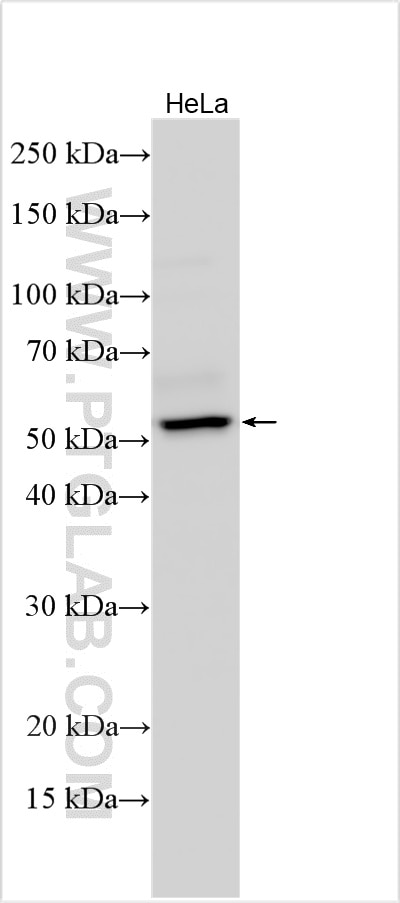
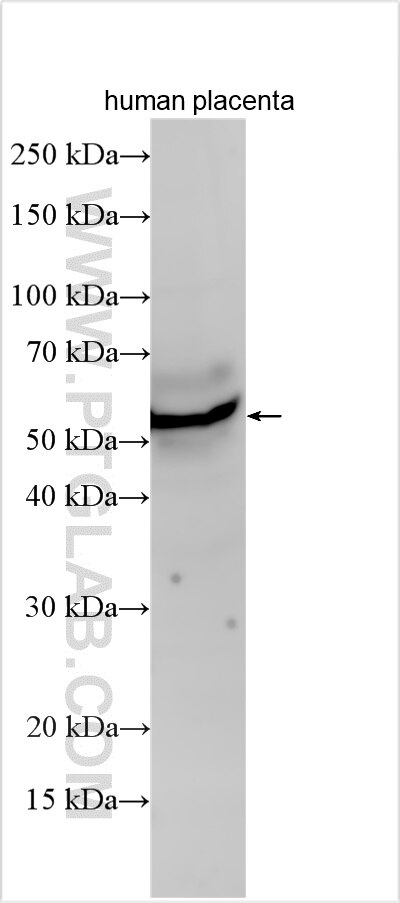
Geprüfte Anwendungen
| Erfolgreiche Detektion in WB | HeLa-Zellen, humanes Plazenta-Gewebe |
Empfohlene Verdünnung
| Anwendung | Verdünnung |
|---|---|
| Western Blot (WB) | WB : 1:500-1:3000 |
| It is recommended that this reagent should be titrated in each testing system to obtain optimal results. | |
| Sample-dependent, check data in validation data gallery | |
Produktinformation
33499-1-AP bindet in WB, ELISA GPR175 und zeigt Reaktivität mit human
| Getestete Reaktivität | human |
| Wirt / Isotyp | Kaninchen / IgG |
| Klonalität | Polyklonal |
| Typ | Antikörper |
| Immunogen | GPR175 fusion protein Ag39379 |
| Vollständiger Name | G protein-coupled receptor 175 |
| Beobachtetes Molekulargewicht | 55 kDa |
| GenBank-Zugangsnummer | BC050711 |
| Gene symbol | GPR175 |
| Gene ID (NCBI) | 131601 |
| Konjugation | Unkonjugiert |
| Form | Liquid |
| Reinigungsmethode | Antigen-Affinitätsreinigung |
| Lagerungspuffer | PBS with 0.02% sodium azide and 50% glycerol |
| Lagerungsbedingungen | Bei -20°C lagern. Nach dem Versand ein Jahr lang stabil Aliquotieren ist bei -20oC Lagerung nicht notwendig. 20ul Größen enthalten 0,1% BSA. |
Hintergrundinformationen
GPR175, also known as TPRA1 or TPRA40, is a transmembrane protein. GPR175 was first cloned as a GLP-1 receptor homolog in 3T3-L1 adipocytes and is also expressed in tissues that require Hh signaling during development, including the heart, brain, lung, pancreas, and muscle. Endogenous GPR175 localizes to cilia in a Hh-dependent manner, where it can interact with (constitutively) ciliary Gαi1 to inhibit the local production of cAMP by adenylyl cyclase. The calculated molecular weight of GPR175 is 41 kDa. With glycosylation modification, the molecular weight of GPR175 will be migrated to 55 kDa. (PMID: 26451044)
Protokolle
| PRODUKTSPEZIFISCHE PROTOKOLLE | |
|---|---|
| WB protocol for GPR175 antibody 33499-1-AP | Protokoll herunterladen |
| STANDARD-PROTOKOLLE | |
|---|---|
| Klicken Sie hier, um unsere Standardprotokolle anzuzeigen |

