HOGA1 Polyklonaler Antikörper
HOGA1 Polyklonal Antikörper für WB, ELISA
Wirt / Isotyp
Kaninchen / IgG
Getestete Reaktivität
human, Maus, Ratte
Anwendung
WB, ELISA
Konjugation
Unkonjugiert
Kat-Nr. : 27755-1-AP
Synonyme
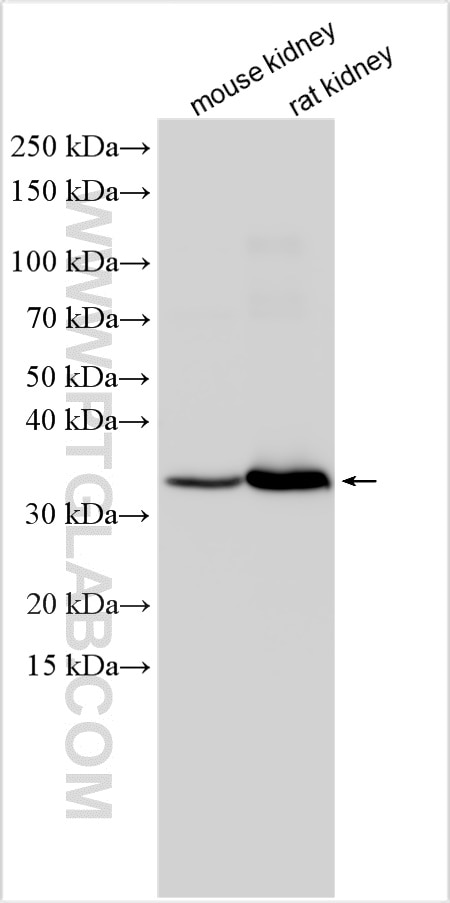
Geprüfte Anwendungen
| Erfolgreiche Detektion in WB | Mausnierengewebe, Rattennierengewebe |
Empfohlene Verdünnung
| Anwendung | Verdünnung |
|---|---|
| Western Blot (WB) | WB : 1:2000-1:12000 |
| It is recommended that this reagent should be titrated in each testing system to obtain optimal results. | |
| Sample-dependent, check data in validation data gallery | |
Produktinformation
27755-1-AP bindet in WB, ELISA HOGA1 und zeigt Reaktivität mit human, Maus, Ratten
| Getestete Reaktivität | human, Maus, Ratte |
| Wirt / Isotyp | Kaninchen / IgG |
| Klonalität | Polyklonal |
| Typ | Antikörper |
| Immunogen | HOGA1 fusion protein Ag26849 |
| Vollständiger Name | chromosome 10 open reading frame 65 |
| Beobachtetes Molekulargewicht | 35 kDa |
| GenBank-Zugangsnummer | BC045550 |
| Gene symbol | HOGA1 |
| Gene ID (NCBI) | 112817 |
| Konjugation | Unkonjugiert |
| Form | Liquid |
| Reinigungsmethode | Antigen-Affinitätsreinigung |
| Lagerungspuffer | PBS with 0.02% sodium azide and 50% glycerol |
| Lagerungsbedingungen | Bei -20°C lagern. Nach dem Versand ein Jahr lang stabil Aliquotieren ist bei -20oC Lagerung nicht notwendig. 20ul Größen enthalten 0,1% BSA. |
Hintergrundinformationen
HOGA1 (4-hydroxy-2-oxoglutarate aldolase), also known as C10orf65, DHDPSL, is a mitochondrial enzyme that plays a gatekeeper role in hydroxyproline metabolis. HOGA1 is primarily expressed in liver and kidney and catalyzes the final step of mitochondrial hydroxyproline metabolism\ from 4-hydroxy-2-oxoglutarate to glyoxylate and pyruvate (PMID: 31696211). Identification of mutations in the HOGA1 gene as the cause of autosomal recessive primary hyperoxaluria (PH) type III has revitalized research in the field of PH and related stone disease (PMID: 22781098).
Protokolle
| PRODUKTSPEZIFISCHE PROTOKOLLE | |
|---|---|
| WB protocol for HOGA1 antibody 27755-1-AP | Protokoll herunterladen |
| STANDARD-PROTOKOLLE | |
|---|---|
| Klicken Sie hier, um unsere Standardprotokolle anzuzeigen |

