KCNQ3 Polyklonaler Antikörper
KCNQ3 Polyklonal Antikörper für WB, Indirect ELISA
Wirt / Isotyp
Kaninchen / IgG
Getestete Reaktivität
human, Maus, Ratte
Anwendung
WB, Indirect ELISA
Konjugation
Unkonjugiert
Kat-Nr. : 24580-1-PBS
Synonyme
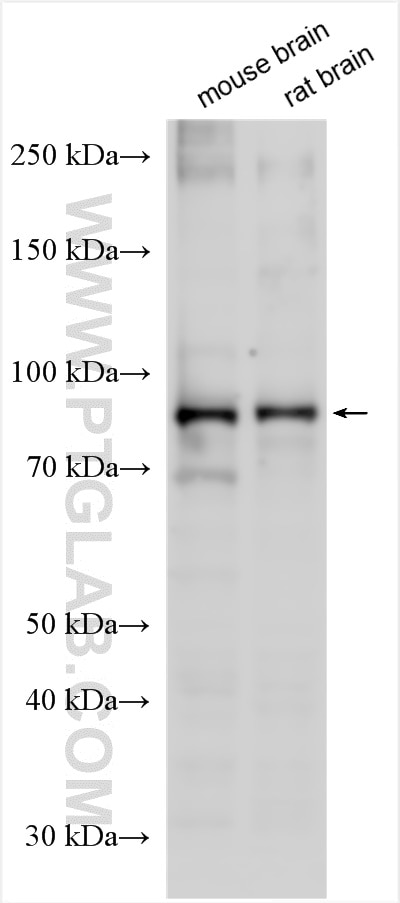
Geprüfte Anwendungen
Produktinformation
24580-1-PBS bindet in WB, Indirect ELISA KCNQ3 und zeigt Reaktivität mit human, Maus, Ratten
| Getestete Reaktivität | human, Maus, Ratte |
| Wirt / Isotyp | Kaninchen / IgG |
| Klonalität | Polyklonal |
| Typ | Antikörper |
| Immunogen | KCNQ3 fusion protein Ag20147 |
| Vollständiger Name | potassium voltage-gated channel, KQT-like subfamily, member 3 |
| Berechnetes Molekulargewicht | 872 aa, 97 kDa |
| Beobachtetes Molekulargewicht | ~90 kDa |
| GenBank-Zugangsnummer | BC128576 |
| Gene symbol | KCNQ3 |
| Gene ID (NCBI) | 3786 |
| Konjugation | Unkonjugiert |
| Form | Liquid |
| Reinigungsmethode | Antigen-Affinitätsreinigung |
| Lagerungspuffer | PBS only |
| Lagerungsbedingungen | Store at -80°C. 20ul Größen enthalten 0,1% BSA. |
Hintergrundinformationen
KCNQ3, also named as BFNC2, EBN2 and KV7.3, belongs to the potassium channel family and KQT subfamily. KCNQ3 is probably important in the regulation of neuronal excitability. Associates with KCNQ2 or KCNQ5, KCNQ3 forms a potassium channel with essentially identical properties to the channel underlying the native M-current, a slowly activating and deactivating potassium conductance which plays a critical role in determining the subthreshold electrical excitability of neurons as well as the responsiveness to synaptic inputs. Defects in KCNQ3 are the cause of benign neonatal epilepsy type 2 (EBN2).


