KCTD7 Polyklonaler Antikörper
KCTD7 Polyklonal Antikörper für WB, Indirect ELISA
Wirt / Isotyp
Kaninchen / IgG
Getestete Reaktivität
human
Anwendung
WB, Indirect ELISA
Konjugation
Unkonjugiert
Kat-Nr. : 32488-1-PBS
Synonyme
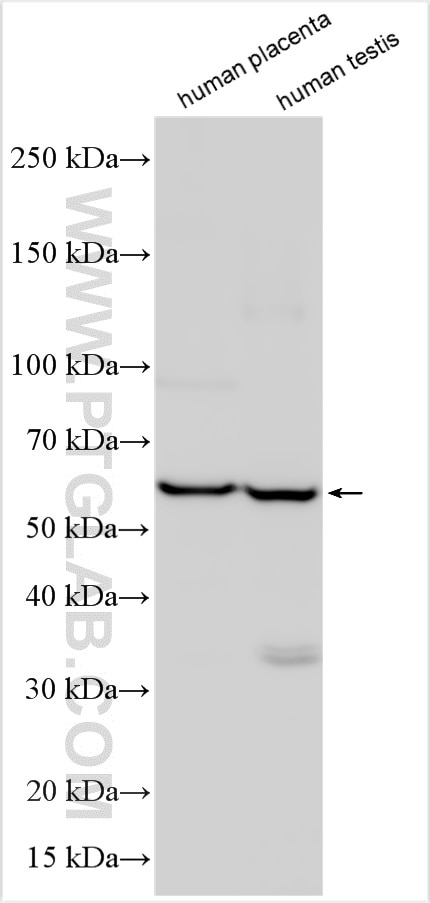
Geprüfte Anwendungen
Produktinformation
32488-1-PBS bindet in WB, Indirect ELISA KCTD7 und zeigt Reaktivität mit human
| Getestete Reaktivität | human |
| Wirt / Isotyp | Kaninchen / IgG |
| Klonalität | Polyklonal |
| Typ | Antikörper |
| Immunogen | KCTD7 fusion protein Ag35756 |
| Vollständiger Name | potassium channel tetramerisation domain containing 7 |
| Berechnetes Molekulargewicht | 33 kDa,289 aa |
| Beobachtetes Molekulargewicht | 62 kDa |
| GenBank-Zugangsnummer | NM_153033.4 |
| Gene symbol | KCTD7 |
| Gene ID (NCBI) | 154881 |
| Konjugation | Unkonjugiert |
| Form | Liquid |
| Reinigungsmethode | Antigen-Affinitätsreinigung |
| Lagerungspuffer | PBS only |
| Lagerungsbedingungen | Store at -80°C. 20ul Größen enthalten 0,1% BSA. |
Hintergrundinformationen
KCTD7, or Potassium Channel Tetramerization Domain Containing 7, is a member of the KCTD family of proteins. The role of KCTD7 in regulating autophagy-lysosome pathways, which are essential for cellular homeostasis and response to nutrient stress (PMID: 36964131). It has been implicated in several neurodegenerative disorders, particularly progressive myoclonic epilepsy (PME) and neuronal ceroid lipofuscinosis (NCL). The deficiency of KCTD7 results in the accumulation of lipofuscin and lipid droplets, which are hallmarks of NCL (PMID: 33970744). The 62 kDa form most likely corresponds to an SDS-stable dimer (PMID: 22748208).


