KLHL7 Polyklonaler Antikörper
KLHL7 Polyklonal Antikörper für WB, ELISA
Wirt / Isotyp
Kaninchen / IgG
Getestete Reaktivität
human, Maus, Ratte
Anwendung
WB, ELISA
Konjugation
Unkonjugiert
Kat-Nr. : 32697-1-AP
Synonyme
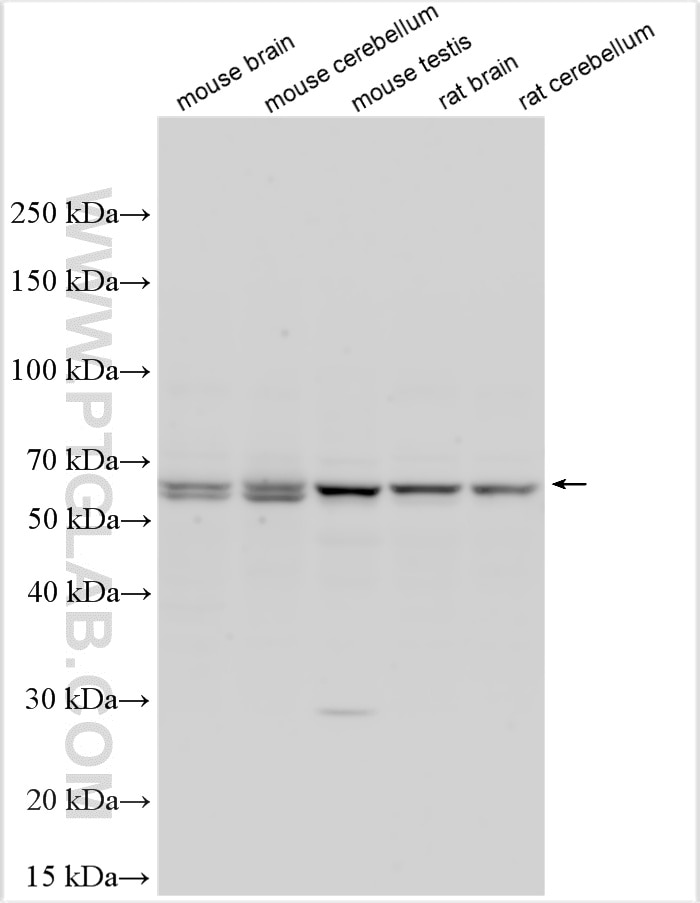
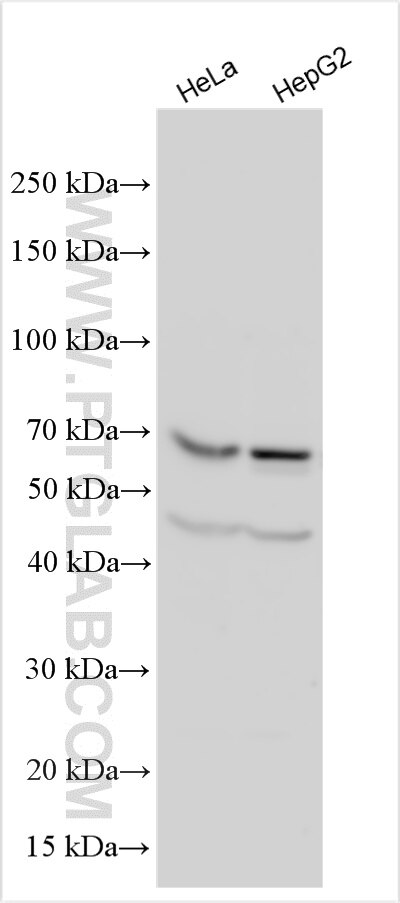
Geprüfte Anwendungen
| Erfolgreiche Detektion in WB | Maushirngewebe, HeLa-Zellen, HepG2-Zellen, Maus-Cerebellum-Gewebe, Maushodengewebe, Rattenhirngewebe, Ratten-Cerebellum-Gewebe |
Empfohlene Verdünnung
| Anwendung | Verdünnung |
|---|---|
| Western Blot (WB) | WB : 1:500-1:1000 |
| It is recommended that this reagent should be titrated in each testing system to obtain optimal results. | |
| Sample-dependent, check data in validation data gallery | |
Produktinformation
32697-1-AP bindet in WB, ELISA KLHL7 und zeigt Reaktivität mit human, Maus, Ratten
| Getestete Reaktivität | human, Maus, Ratte |
| Wirt / Isotyp | Kaninchen / IgG |
| Klonalität | Polyklonal |
| Typ | Antikörper |
| Immunogen | KLHL7 fusion protein Ag38050 |
| Vollständiger Name | kelch-like 7 (Drosophila) |
| Berechnetes Molekulargewicht | 586 aa, 66 kDa |
| Beobachtetes Molekulargewicht | 65 kDa |
| GenBank-Zugangsnummer | BC039585 |
| Gene symbol | KLHL7 |
| Gene ID (NCBI) | 55975 |
| Konjugation | Unkonjugiert |
| Form | Liquid |
| Reinigungsmethode | Antigen-Affinitätsreinigung |
| Lagerungspuffer | PBS with 0.02% sodium azide and 50% glycerol |
| Lagerungsbedingungen | Bei -20°C lagern. Nach dem Versand ein Jahr lang stabil Aliquotieren ist bei -20oC Lagerung nicht notwendig. 20ul Größen enthalten 0,1% BSA. |
Hintergrundinformationen
KLHL7 (Kelch-like protein 7) is a member of the Kelch-like protein family and plays significant roles in various biological processes, including cell cycle regulation, protein degradation, and cytoskeleton organization. KLHL7 is highly expressed in various cancers and is associated with malignant progression and poor prognosis. In breast cancer, high expression of KLHL7 is linked to higher histological grades, estrogen receptor (ER)-negative or human epidermal growth factor receptor 2 (HER-2)-positive tumors, and triple-negative breast cancer (TNBC), and patients with high KLHL7 expression have shorter survival times. In gastric cancer, silencing KLHL7 gene expression can inhibit the proliferation, migration, and invasion of gastric cancer cells and has shown tumor-suppressive effects in in vivo models. Moreover, KLHL7 is highly expressed in colorectal cancer and ovarian cancer, among others, and is significantly associated with low patient survival rates.
Protokolle
| PRODUKTSPEZIFISCHE PROTOKOLLE | |
|---|---|
| WB protocol for KLHL7 antibody 32697-1-AP | Protokoll herunterladen |
| STANDARD-PROTOKOLLE | |
|---|---|
| Klicken Sie hier, um unsere Standardprotokolle anzuzeigen |

