KPNA3 Rekombinanter Antikörper
KPNA3 Rekombinant Antikörper für WB, ELISA
Wirt / Isotyp
Kaninchen / IgG
Getestete Reaktivität
human, Maus, Ratte
Anwendung
WB, ELISA
Konjugation
Unkonjugiert
CloneNo.
251681E1
Kat-Nr. : 86722-1-RR
Synonyme
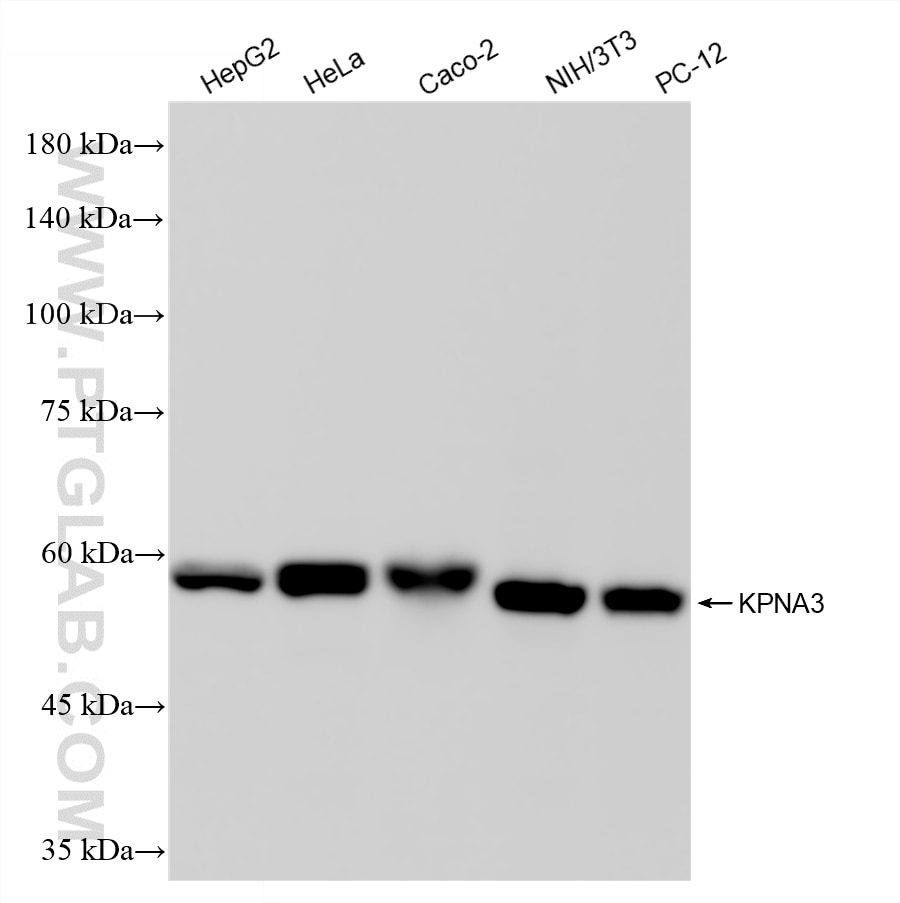
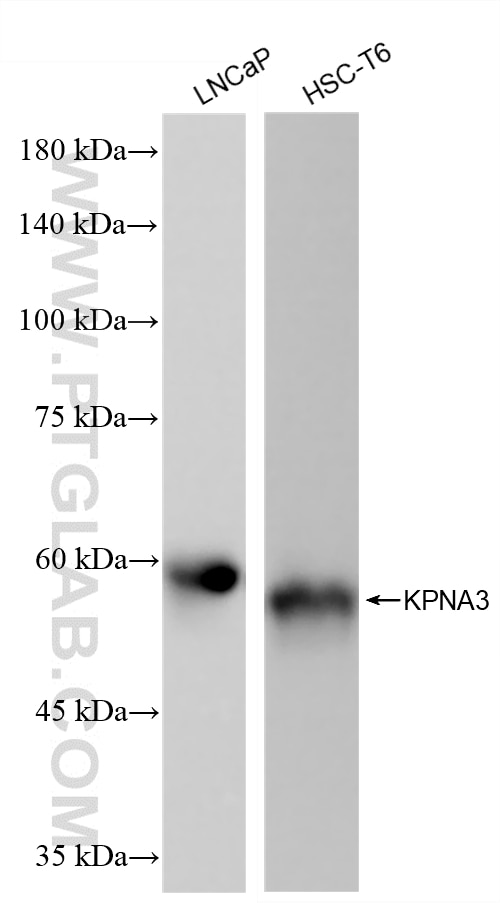
Geprüfte Anwendungen
| Erfolgreiche Detektion in WB | HepG2-Zellen, Caco-2-Zellen, HeLa-Zellen, LNCaP-Zellen, NIH/3T3-Zellen, PC-12-Zellen |
Empfohlene Verdünnung
| Anwendung | Verdünnung |
|---|---|
| Western Blot (WB) | WB : 1:5000-1:50000 |
| It is recommended that this reagent should be titrated in each testing system to obtain optimal results. | |
| Sample-dependent, check data in validation data gallery | |
Produktinformation
86722-1-RR bindet in WB, ELISA KPNA3 und zeigt Reaktivität mit human, Maus, Ratten
| Getestete Reaktivität | human, Maus, Ratte |
| Wirt / Isotyp | Kaninchen / IgG |
| Klonalität | Rekombinant |
| Typ | Antikörper |
| Immunogen | KPNA3 fusion protein Ag27755 |
| Vollständiger Name | karyopherin alpha 3 (importin alpha 4) |
| Berechnetes Molekulargewicht | 58 kDa |
| Beobachtetes Molekulargewicht | 57-60 kDa |
| GenBank-Zugangsnummer | BC017355 |
| Gene symbol | KPNA3 |
| Gene ID (NCBI) | 3839 |
| Konjugation | Unkonjugiert |
| Form | Liquid |
| Reinigungsmethode | Protein-A-Reinigung |
| Lagerungspuffer | PBS with 0.02% sodium azide and 50% glycerol |
| Lagerungsbedingungen | Bei -20°C lagern. Nach dem Versand ein Jahr lang stabil Aliquotieren ist bei -20oC Lagerung nicht notwendig. 20ul Größen enthalten 0,1% BSA. |
Hintergrundinformationen
KPNA3, karyopherin subunit alpha 3, also known as SRP1 or IPOA4. It is expected to be located in cytoplasm and nucleus, the protein is ubiquitous and highly expressed in heart, skeletal muscle. The calculated molecular weight of KPNA3 is 57 kDa. Functions in nuclear protein import as an adapter protein for nuclear receptor KPNB1. Binds specifically and directly to substrates containing either a simple or bipartite NLS motif. Docking of the importin/substrate complex to the nuclear pore complex (NPC) is mediated by KPNB1 through binding to nucleoporin FxFG repeats and the complex is subsequently translocated through the pore by an energy requiring, Ran-dependent mechanism. At the nucleoplasmic side of the NPC, Ran binds to importin-beta and the three components separate and importin-alpha and -beta are re-exported from the nucleus to the cytoplasm where GTP hydrolysis releases Ran from importin.
Protokolle
| PRODUKTSPEZIFISCHE PROTOKOLLE | |
|---|---|
| WB protocol for KPNA3 antibody 86722-1-RR | Protokoll herunterladen |
| STANDARD-PROTOKOLLE | |
|---|---|
| Klicken Sie hier, um unsere Standardprotokolle anzuzeigen |

