Kir2.1 Polyklonaler Antikörper
Kir2.1 Polyklonal Antikörper für WB, Indirect ELISA
Wirt / Isotyp
Kaninchen / IgG
Getestete Reaktivität
human, Maus, Ratte
Anwendung
WB, Indirect ELISA
Konjugation
Unkonjugiert
Kat-Nr. : 19965-1-PBS
Synonyme
Geprüfte Anwendungen
Produktinformation
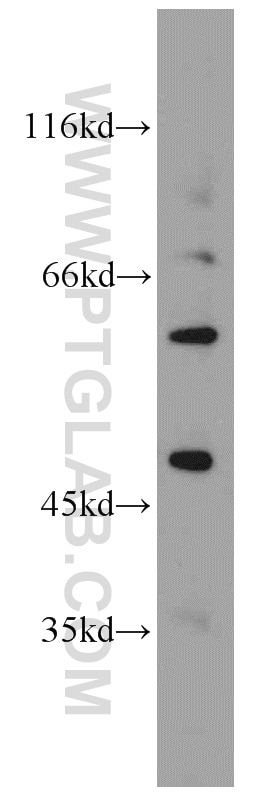
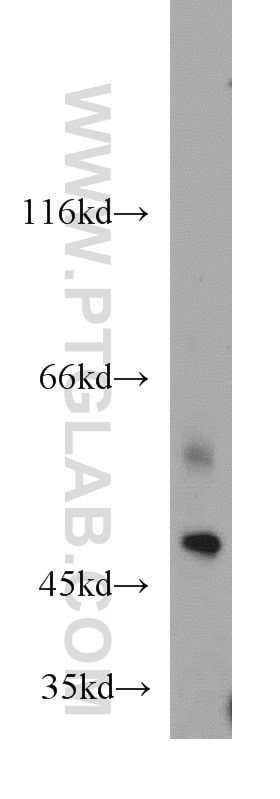
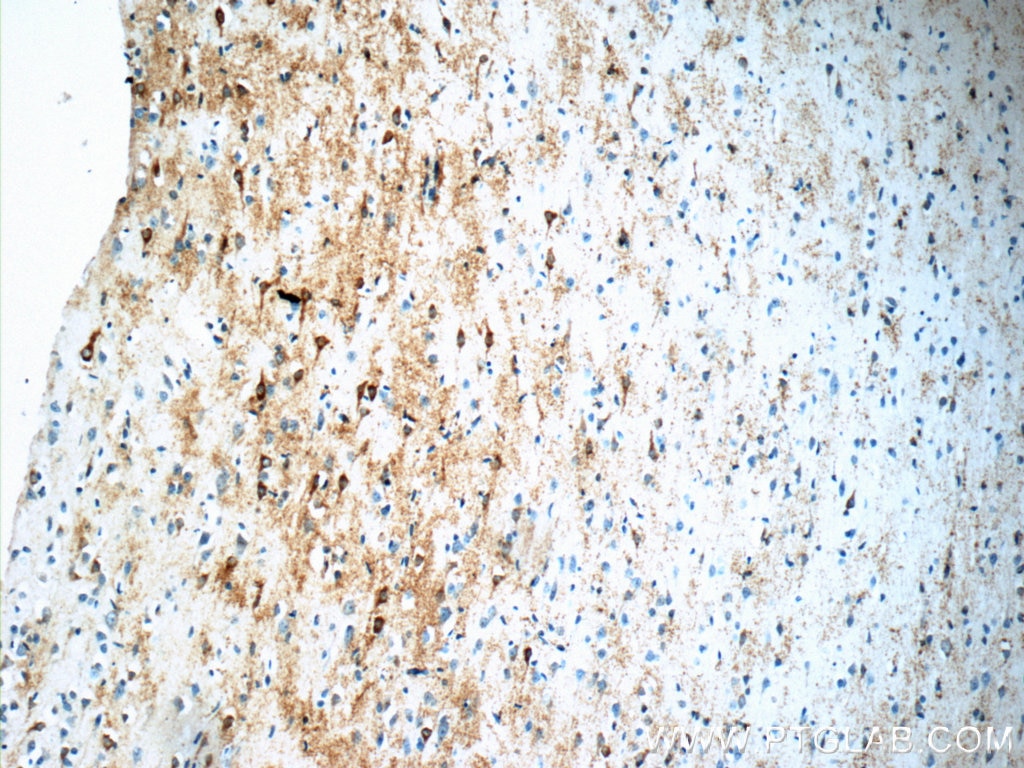
19965-1-PBS bindet in WB, Indirect ELISA Kir2.1 und zeigt Reaktivität mit human, Maus, Ratten
| Getestete Reaktivität | human, Maus, Ratte |
| Wirt / Isotyp | Kaninchen / IgG |
| Klonalität | Polyklonal |
| Typ | Antikörper |
| Immunogen | Peptid |
| Vollständiger Name | potassium inwardly-rectifying channel, subfamily J, member 2 |
| Berechnetes Molekulargewicht | 48 kDa |
| Beobachtetes Molekulargewicht | 50 kDa, 60 kDa |
| GenBank-Zugangsnummer | NM_000891 |
| Gene symbol | Kir2.1 |
| Gene ID (NCBI) | 3759 |
| Konjugation | Unkonjugiert |
| Form | Liquid |
| Reinigungsmethode | Antigen-Affinitätsreinigung |
| Lagerungspuffer | PBS only |
| Lagerungsbedingungen | Store at -80°C. 20ul Größen enthalten 0,1% BSA. |
Hintergrundinformationen
KCNJ2, also named as HHBIRK1, HHIRK1, IRK1, KIR2.1, LQT7 and SQT3, belongs to the inward rectifier-type potassium channel family. KCNJ2 probably participates in establishing action potential waveform and excitability of neuronal and muscle tissues. Inward rectifier potassium channels are characterized by a greater tendency to allow potassium to flow into the cell rather than out of it. Their voltage dependence is regulated by the concentration of extracellular potassium; as external potassium is raised, the voltage range of the channel opening shifts to more positive voltages. The inward rectification is mainly due to the blockage of outward current by internal magnesium. KCNJ2 can be blocked by extracellular barium or cesium. Defects in KCNJ2 are the cause of long QT syndrome type 7 (LQT7). Defects in KCNJ2 are the cause of short QT syndrome type 3 (SQT3). The antibody recognizes the C-term of KCNJ2.


