Kir6.2 Polyklonaler Antikörper
Kir6.2 Polyklonal Antikörper für WB, Indirect ELISA
Wirt / Isotyp
Kaninchen / IgG
Getestete Reaktivität
human, Maus, Ratte
Anwendung
WB, Indirect ELISA
Konjugation
Unkonjugiert
Kat-Nr. : 16920-1-PBS
Synonyme
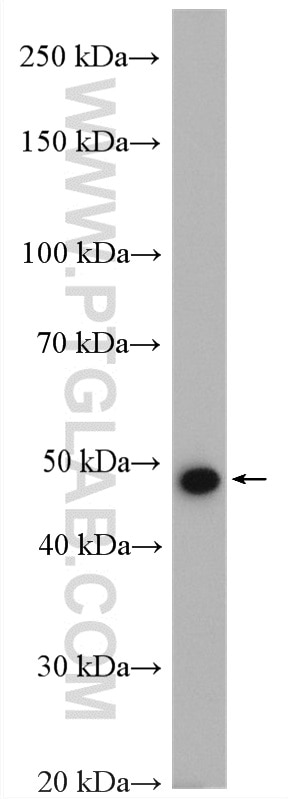
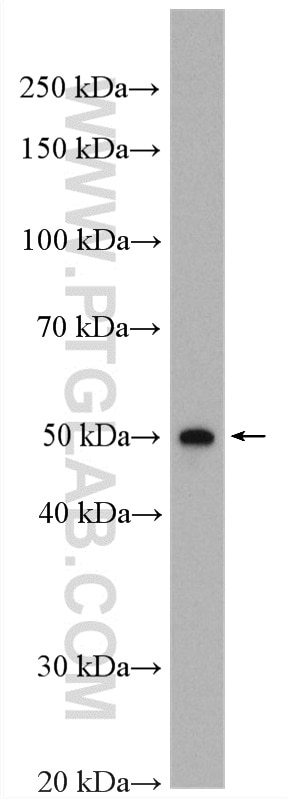
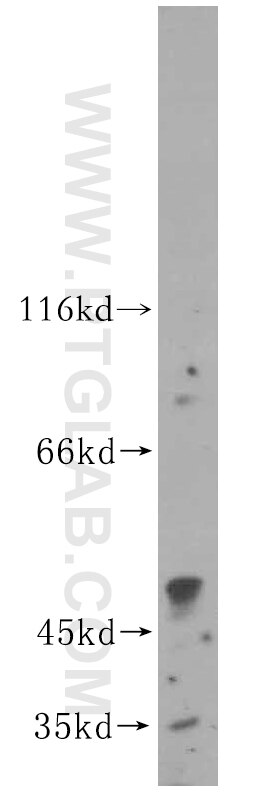
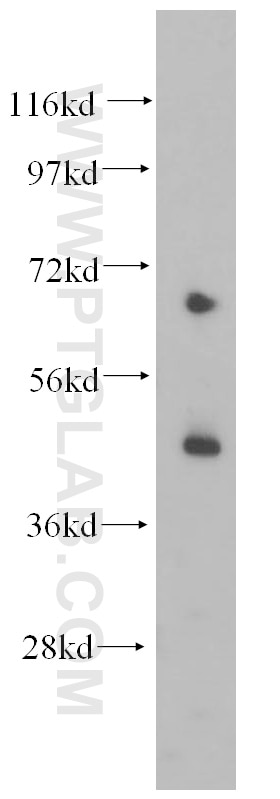
Geprüfte Anwendungen
Produktinformation
16920-1-PBS bindet in WB, Indirect ELISA Kir6.2 und zeigt Reaktivität mit human, Maus, Ratten
| Getestete Reaktivität | human, Maus, Ratte |
| Wirt / Isotyp | Kaninchen / IgG |
| Klonalität | Polyklonal |
| Typ | Antikörper |
| Immunogen | Kir6.2 fusion protein Ag10262 |
| Vollständiger Name | potassium inwardly-rectifying channel, subfamily J, member 11 |
| Berechnetes Molekulargewicht | 390 aa, 44 kDa |
| Beobachtetes Molekulargewicht | 48 kDa |
| GenBank-Zugangsnummer | BC064497 |
| Gene symbol | Kir6.2 |
| Gene ID (NCBI) | 3767 |
| Konjugation | Unkonjugiert |
| Form | Liquid |
| Reinigungsmethode | Antigen-Affinitätsreinigung |
| Lagerungspuffer | PBS only |
| Lagerungsbedingungen | Store at -80°C. 20ul Größen enthalten 0,1% BSA. |
Hintergrundinformationen
Kir6.2 (also known as BIR or IKATP), encoded by the KCNJ11 gene, is the pore-forming unit of the ATP-sensitive K+ channel, an inward-rectifier potassium ion channel. Kir6.2 is controlled by G-proteins and is found associated with the sulfonylurea receptor (SUR) to constitute the ATP-sensitive K+ channel. The KCNJ11 gene is located at 11p15.1 and has no intron. Mutations in KCNJ11 are a cause of familial PHHI, an autosomal recessive disorder characterized by unregulated ins secretion. Defects in KCNJ11 may also contribute to autosomal dominant non-ins-dependent diabetes mellitus type II (NIDDM), transient neonatal diabetes mellitus type 3 (TNDM3), and permanent neonatal diabetes mellitus (PNDM).


