LRAT Polyklonaler Antikörper
LRAT Polyklonal Antikörper für WB, Indirect ELISA
Wirt / Isotyp
Kaninchen / IgG
Getestete Reaktivität
human, Maus, Ratte
Anwendung
WB, Indirect ELISA
Konjugation
Unkonjugiert
Kat-Nr. : 12815-1-PBS
Synonyme
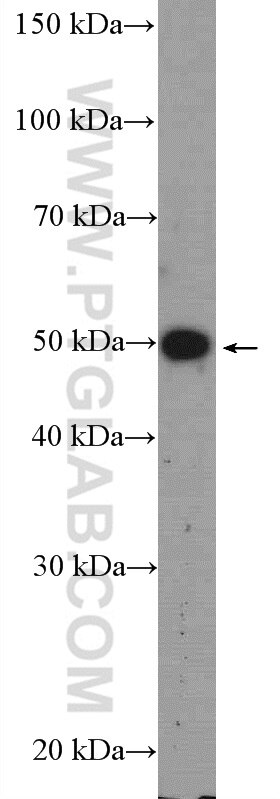
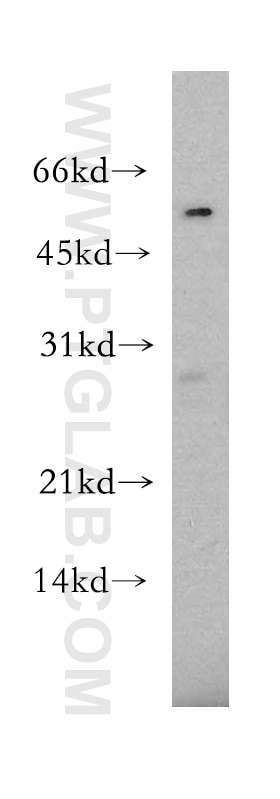

Geprüfte Anwendungen
Produktinformation
12815-1-PBS bindet in WB, Indirect ELISA LRAT und zeigt Reaktivität mit human, Maus, Ratten
| Getestete Reaktivität | human, Maus, Ratte |
| Wirt / Isotyp | Kaninchen / IgG |
| Klonalität | Polyklonal |
| Typ | Antikörper |
| Immunogen | LRAT fusion protein Ag3556 |
| Vollständiger Name | lecithin retinol acyltransferase (phosphatidylcholine--retinol O-acyltransferase) |
| Berechnetes Molekulargewicht | 230 aa, 26 kDa |
| Beobachtetes Molekulargewicht | 26 kDa, 50-54 kDa |
| GenBank-Zugangsnummer | BC031053 |
| Gene symbol | LRAT |
| Gene ID (NCBI) | 9227 |
| Konjugation | Unkonjugiert |
| Form | Liquid |
| Reinigungsmethode | Antigen-Affinitätsreinigung |
| Lagerungspuffer | PBS only |
| Lagerungsbedingungen | Store at -80°C. 20ul Größen enthalten 0,1% BSA. |
Hintergrundinformationen
LRAT belongs to the H-rev107 family. LRAT transfers the acyl group from the sn-1 position of phosphatidylcholine to all-trans retinol, producing all-trans retinyl esters. LRAT plays a critical role in vision. It provides the all-trans retinyl ester substrates for the isomerohydrolase which processes the esters into 11-cis-retinol in the retinal pigment epithelium; due to a membrane-associated alcohol dehydrogenase, LRAT monomers (26kDa) interact in membranes and form functional homodimers (50-54 kDa) through protein-protein interactions and disulfide bond formation.Defects in LRAT are a cause of severe early-onset retinal dystrophy (RD). This antibody was generated against the internal residues of human LRAT. It is predicted to detect endogenous LRAT.


