LRFN2 Polyklonaler Antikörper
LRFN2 Polyklonal Antikörper für WB, Indirect ELISA
Wirt / Isotyp
Kaninchen / IgG
Getestete Reaktivität
human, Maus, Ratte
Anwendung
WB, Indirect ELISA
Konjugation
Unkonjugiert
Kat-Nr. : 27576-1-PBS
Synonyme
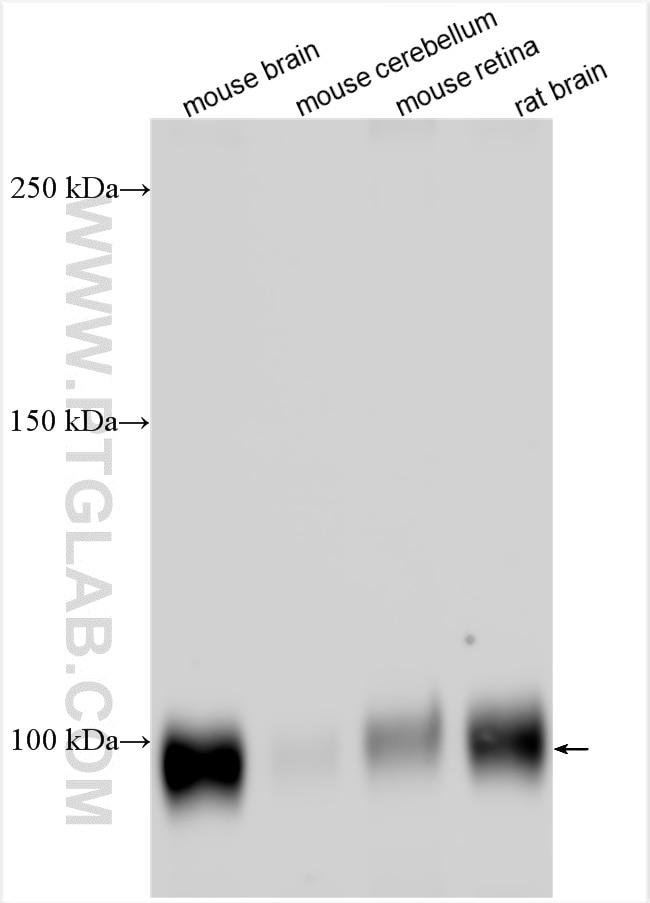
Geprüfte Anwendungen
Produktinformation
27576-1-PBS bindet in WB, Indirect ELISA LRFN2 und zeigt Reaktivität mit human, Maus, Ratten
| Getestete Reaktivität | human, Maus, Ratte |
| Wirt / Isotyp | Kaninchen / IgG |
| Klonalität | Polyklonal |
| Typ | Antikörper |
| Immunogen | LRFN2 fusion protein Ag24558 |
| Vollständiger Name | leucine rich repeat and fibronectin type III domain containing 2 |
| Berechnetes Molekulargewicht | 789 aa, 85 kDa |
| Beobachtetes Molekulargewicht | 85-100 kDa |
| GenBank-Zugangsnummer | BC142616 |
| Gene symbol | LRFN2 |
| Gene ID (NCBI) | 57497 |
| Konjugation | Unkonjugiert |
| Form | Liquid |
| Reinigungsmethode | Antigen-Affinitätsreinigung |
| Lagerungspuffer | PBS only |
| Lagerungsbedingungen | Store at -80°C. 20ul Größen enthalten 0,1% BSA. |
Hintergrundinformationen
LRFN2, also known as SALM1. It is mainly located in cell membrane and cytoplasm, and it is expressed at the synaptic contact at the base of cone cells, especially at the base of presynaptic endings, which is closely related to the dendrites of OFF bipolar cells (PMID: 40251167). In mammals, LRFN2 is mainly expressed in cone cells, but not in rod cells, and its expression in other retinal neurons is limited. In addition, the expression level in embryonic nerve cells is relatively low, mainly in more mature cells. LRFN2 plays a key role in synaptic transmission between cone cells and OFF bipolar cells. It can maintain the physical connection between cone cells and OFF bipolar cells, and gather glutamate receptors at the postsynaptic membrane to ensure strong dendritic transmission in OFF pathway, thus participating in the transmission of visual signals, which is very important for the coding of visual contrast and the defense behavior driven by looming. In bladder cancer, the increased expression of LRFN2 will inhibit the infiltration and functional transformation of CD8+ T cells, thus weakening the anti-tumor immune response, leading to bladder cancer resistance to immune checkpoint inhibitors, and its high expression is related to the poor prognosis of bladder cancer patients (PMID:37802603).


