NKp46/NCR1 Rekombinanter Antikörper
NKp46/NCR1 Rekombinant Antikörper für FC
Wirt / Isotyp
Kaninchen / IgG
Getestete Reaktivität
human
Anwendung
FC
Konjugation
CoraLite® Plus 647 Fluorescent Dye
CloneNo.
242549D12
Kat-Nr. : CL647-98340
Synonyme
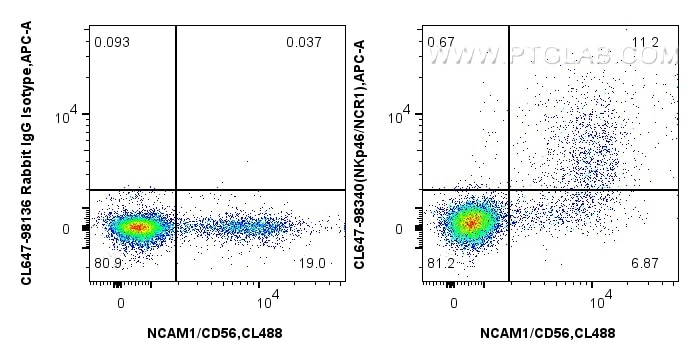
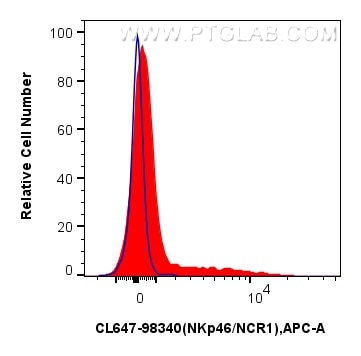
Geprüfte Anwendungen
| Erfolgreiche Detektion in FC | humane PBMCs |
Empfohlene Verdünnung
| Anwendung | Verdünnung |
|---|---|
| This reagent has been pre-titrated and tested for flow cytometric analysis. The suggested use of this reagent is 5 ul per 10^6 cells in a 100 µl suspension or 5 ul per 100 µl of whole blood. | |
| Sample-dependent, check data in validation data gallery | |
Produktinformation
CL647-98340 bindet in FC NKp46/NCR1 und zeigt Reaktivität mit human
| Getestete Reaktivität | human |
| Wirt / Isotyp | Kaninchen / IgG |
| Klonalität | Rekombinant |
| Typ | Antikörper |
| Immunogen | NKp46/NCR1 fusion protein Eg1364 |
| Vollständiger Name | natural cytotoxicity triggering receptor 1 |
| Berechnetes Molekulargewicht | 34kDa |
| Gene symbol | NCR1 |
| Gene ID (NCBI) | 9437 |
| Konjugation | CoraLite® Plus 647 Fluorescent Dye |
| Excitation/Emission maxima wavelengths | 654 nm / 674 nm |
| Form | Liquid |
| Reinigungsmethode | Protein-A-Reinigung |
| Lagerungspuffer | PBS with 0.09% sodium azide and 0.5% BSA |
| Lagerungsbedingungen | Store at 2-8°C. Avoid exposure to light. Stable for one year after shipment. |
Hintergrundinformationen
NKp46, also known as NCR1 or CD335, is an Ig-like superfamily cell surface receptor that is highly conserved in mammals (PMID: 22021440). NKp46 is a type I transmembrane glycoprotein consisting of two extracellular Ig-like domains, a transmembrane domain, and an intracellular tail (PMID: 9730896). It is expressed on NK cells, rare T-cell subsets and a mucosal population of NKp46+ innate lymphoid cells (PMID: 9730896; 22021440). NKp46 is the major triggering receptor involved in the natural cytotoxicity (PMID: 10359120; 10092106; 15356098).
Protokolle
| PRODUKTSPEZIFISCHE PROTOKOLLE | |
|---|---|
| FC protocol for CL Plus 647 NKp46/NCR1 antibody CL647-98340 | Download protocol |
| STANDARD-PROTOKOLLE | |
|---|---|
| Klicken Sie hier, um unsere Standardprotokolle anzuzeigen |

