NME1+NME2 Polyklonaler Antikörper
NME1+NME2 Polyklonal Antikörper für WB, ELISA
Wirt / Isotyp
Kaninchen / IgG
Getestete Reaktivität
human
Anwendung
WB, ELISA
Konjugation
Unkonjugiert
Kat-Nr. : 33046-1-AP
Synonyme
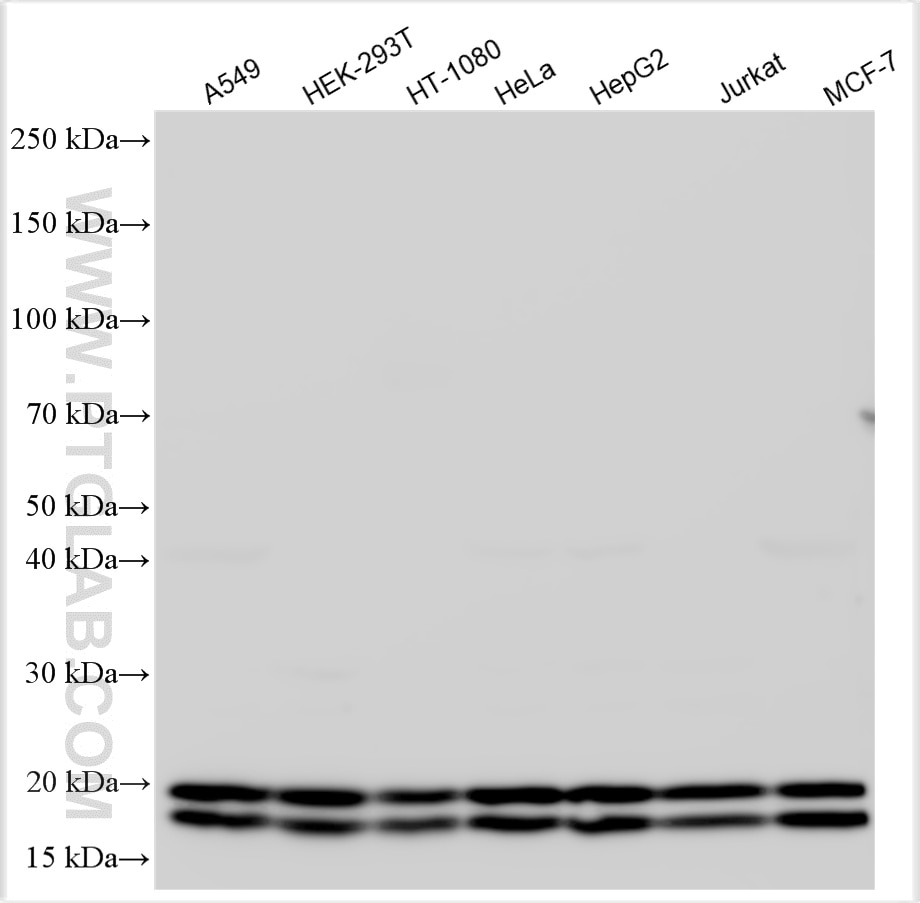
Geprüfte Anwendungen
| Erfolgreiche Detektion in WB | A549-Zellen, HEK-293T-Zellen, HeLa-Zellen, HepG2-Zellen, HT-1080.Zellen, Jurkat-Zellen, MCF-7-Zellen |
Empfohlene Verdünnung
| Anwendung | Verdünnung |
|---|---|
| Western Blot (WB) | WB : 1:5000-1:50000 |
| It is recommended that this reagent should be titrated in each testing system to obtain optimal results. | |
| Sample-dependent, check data in validation data gallery | |
Produktinformation
33046-1-AP bindet in WB, ELISA NME1+NME2 und zeigt Reaktivität mit human
| Getestete Reaktivität | human |
| Wirt / Isotyp | Kaninchen / IgG |
| Klonalität | Polyklonal |
| Typ | Antikörper |
| Immunogen | NME1+NME2 fusion protein Ag37892 |
| Vollständiger Name | NME1-NME2 readthrough transcript |
| Berechnetes Molekulargewicht | 17 kDa / 20 kDa |
| Beobachtetes Molekulargewicht | 17 kDa, 20 kDa |
| GenBank-Zugangsnummer | BC107894 |
| Gene symbol | NME1-NME2 |
| Gene ID (NCBI) | 654364 |
| Konjugation | Unkonjugiert |
| Form | Liquid |
| Reinigungsmethode | Antigen-Affinitätsreinigung |
| Lagerungspuffer | PBS with 0.02% sodium azide and 50% glycerol |
| Lagerungsbedingungen | Bei -20°C lagern. Nach dem Versand ein Jahr lang stabil Aliquotieren ist bei -20oC Lagerung nicht notwendig. 20ul Größen enthalten 0,1% BSA. |
Hintergrundinformationen
NME1 and NME2 are associated with metastatic tumor suppression. NME1 and NME2 are multispecificity kinases phosphorylating serine, threonine, histidine, and aspartic acid residues of substrate proteins (PMID: 39032654). NME1 can catalyze the transfer of the terminal phosphate group of nucleoside triphosphates to nucleoside diphosphates to generate nucleoside triphosphates, which is crucial for DNA synthesis and repair. It also participates in cell signal transduction, proliferation, differentiation, and apoptosis. Reduced expression of NME1 is associated with increased tumor metastasis. For instance, in breast cancer, gastric cancer, and other malignancies, restoring NME1 expression can inhibit tumor invasion and metastasis. Similar to NME1, NME2 possesses nucleoside diphosphate kinase activity, participating in nucleotide metabolism and cell signaling regulation. It can form hexameric complexes with NME1 and also exists as homohexamers. Its functions overlap with those of NME1 to some extent but also exhibit unique roles in certain physiological processes. NME2 is involved in tumor metastasis regulation. However, its expression changes and specific mechanisms in different cancers may vary. In some tumors, NME2 expression is downregulated, while in others, it may be upregulated. For example, in hepatocellular carcinoma, reduced NME2 expression is associated with tumor progression and poor prognosis, whereas in ovarian cancer, elevated NME2 expression may promote tumor cell proliferation and metastasis.
Protokolle
| PRODUKTSPEZIFISCHE PROTOKOLLE | |
|---|---|
| WB protocol for NME1+NME2 antibody 33046-1-AP | Protokoll herunterladen |
| STANDARD-PROTOKOLLE | |
|---|---|
| Klicken Sie hier, um unsere Standardprotokolle anzuzeigen |

