NSMCE1 Polyklonaler Antikörper
NSMCE1 Polyklonal Antikörper für WB, ELISA
Wirt / Isotyp
Kaninchen / IgG
Getestete Reaktivität
human
Anwendung
WB, ELISA
Konjugation
Unkonjugiert
Kat-Nr. : 32113-1-AP
Synonyme
Filter:
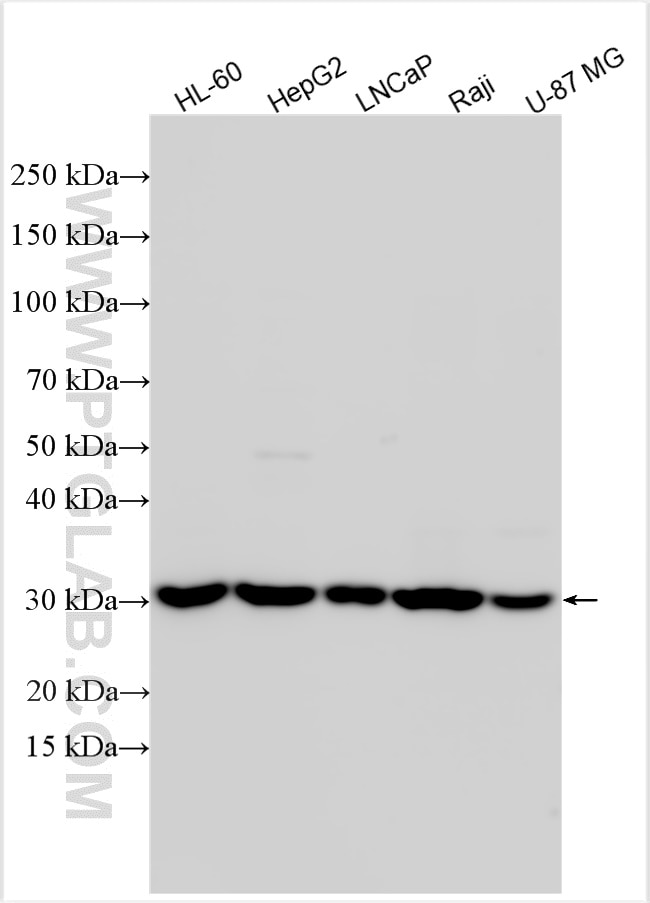
Geprüfte Anwendungen
| Erfolgreiche Detektion in WB | HL-60-Zellen, HepG2-Zellen, LNCaP-Zellen, Raji-Zellen, U-87 MG-Zellen |
Empfohlene Verdünnung
| Anwendung | Verdünnung |
|---|---|
| Western Blot (WB) | WB : 1:1000-1:6000 |
| It is recommended that this reagent should be titrated in each testing system to obtain optimal results. | |
| Sample-dependent, check data in validation data gallery | |
Produktinformation
32113-1-AP bindet in WB, ELISA NSMCE1 und zeigt Reaktivität mit human
| Getestete Reaktivität | human |
| Wirt / Isotyp | Kaninchen / IgG |
| Klonalität | Polyklonal |
| Typ | Antikörper |
| Immunogen | NSMCE1 fusion protein Ag36841 |
| Vollständiger Name | non-SMC element 1 homolog (S. cerevisiae) |
| Berechnetes Molekulargewicht | 31 kDa |
| Beobachtetes Molekulargewicht | 31 kDa |
| GenBank-Zugangsnummer | BC018938 |
| Gene symbol | NSMCE1 |
| Gene ID (NCBI) | 197370 |
| Konjugation | Unkonjugiert |
| Form | Liquid |
| Reinigungsmethode | Antigen-Affinitätsreinigung |
| Lagerungspuffer | PBS with 0.02% sodium azide and 50% glycerol |
| Lagerungsbedingungen | Bei -20°C lagern. Nach dem Versand ein Jahr lang stabil Aliquotieren ist bei -20oC Lagerung nicht notwendig. 20ul Größen enthalten 0,1% BSA. |
Hintergrundinformationen
Non-structural maintenance of chromosomes element 1 homolog (NSMCE1, also known as NSE1) located in the nucleoplasm, which involves the maintenance of genome integrity, DNA damage response, and DNA repair (PMID: 18086888; 20864041; 29225034). NSMCE3/MAGEG1 and NSMCE1 ubiquitin ligase are components of the SMC5-SMC6 complex and may positively regulate homologous recombination-mediated DNA repair (PMID: 18086888).
Protokolle
| PRODUKTSPEZIFISCHE PROTOKOLLE | |
|---|---|
| WB protocol for NSMCE1 antibody 32113-1-AP | Protokoll herunterladen |
| STANDARD-PROTOKOLLE | |
|---|---|
| Klicken Sie hier, um unsere Standardprotokolle anzuzeigen |

