NTN3 Polyklonaler Antikörper
NTN3 Polyklonal Antikörper für WB, Indirect ELISA
Wirt / Isotyp
Kaninchen / IgG
Getestete Reaktivität
human, Maus, Ratte
Anwendung
WB, Indirect ELISA
Konjugation
Unkonjugiert
Kat-Nr. : 31893-1-PBS
Synonyme
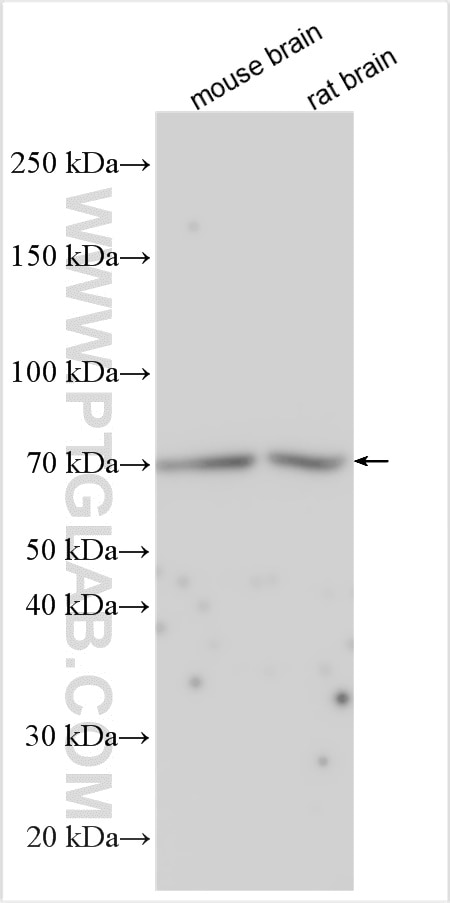
Geprüfte Anwendungen
Produktinformation
31893-1-PBS bindet in WB, Indirect ELISA NTN3 und zeigt Reaktivität mit human, Maus, Ratten
| Getestete Reaktivität | human, Maus, Ratte |
| Wirt / Isotyp | Kaninchen / IgG |
| Klonalität | Polyklonal |
| Typ | Antikörper |
| Immunogen | NTN3 fusion protein Ag34435 |
| Vollständiger Name | netrin 3 |
| Berechnetes Molekulargewicht | 61 kDa |
| Beobachtetes Molekulargewicht | 62-70 kDa |
| GenBank-Zugangsnummer | Netrin-3 |
| Gene symbol | NTN3 |
| Gene ID (NCBI) | 4917 |
| Konjugation | Unkonjugiert |
| Form | Liquid |
| Reinigungsmethode | Antigen-Affinitätsreinigung |
| Lagerungspuffer | PBS only |
| Lagerungsbedingungen | Store at -80°C. 20ul Größen enthalten 0,1% BSA. |
Hintergrundinformationen
NTN3 (Netrin-3), also known as NTN2L. NTN3 (Netrin-3) is predicted to be located in the Golgi apparatus and extracellular region, and it is also predicted to be active in the basement membrane. It is detected in various amounts in the skin, esophagus, bronchus, nasal cavity, kidney, and vagina in healthy human tissues (PMID: 37345154). The protein is predicted to enable signaling receptor binding activity and is involved in animal organ morphogenesis, neuron projection development, and tissue development. Netrins, including NTN3, are a group of proteins that exhibit structural homology to the extracellular matrix protein laminin and influence neurological and tumor progression. NTN3, along with other netrin family members, may play a role in tumor growth and migration in specific organs where they are expressed, potentially affecting disease progression. However, further research is needed to elucidate the precise prognostic and biological implications of NTN3 in various diseases, including cancer (PMID: 32251318). The molecular weight of NTN3 is 62 kDa. It is possible that the protein has glycosylation modification.


